FREE TEMPLATE
Free Team Charter Template (With a Filled-In Example)
A free team charter template with a worked example. Agree purpose, goals, roles, ways of working and decision rules, then run it live with your team and AI.
- Free, no sign-up
- Use ChatGPT, Claude or your own AI
- Up to 10 people
Try the example
Interactive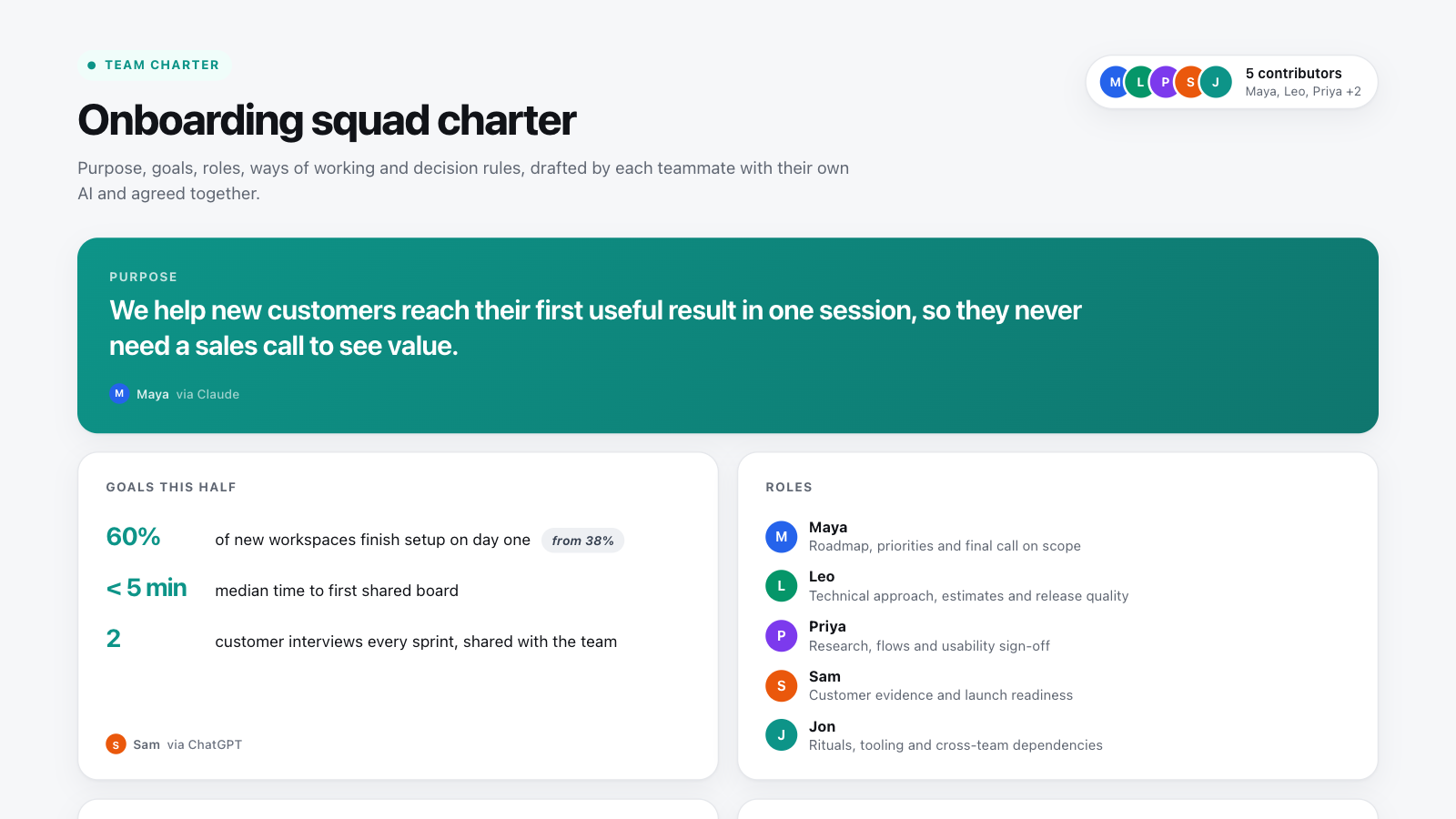
How to use this template in Boardblend
Open it as a live board
One click opens a ready-made board with every section laid out and empty. No account needed.
Connect your AI
Each person connects their own assistant to research and draft privately.
Decide together
Invite up to 10 people, agree the final version, then export it as a PDF or PNG.
What is a team charter?
A team charter (sometimes called a team working agreement) is a short, shared agreement on why a team exists, what it is trying to achieve and how its members will work together. It turns unspoken assumptions—who decides, how fast to reply, when to meet—into explicit rules everyone has agreed to.
The template above is a complete example, not a blank form. It shows the charter of a five-person onboarding squad, with every section filled in, and a sign-off panel you can click to see how agreement is tracked.
What goes in a team charter
The example uses eight sections. Each answers a question that causes friction when it is left vague.
| Section | Question it answers | Example from the template |
|---|---|---|
| Purpose | Why does this team exist? | Help new customers reach a useful result in one session |
| Goals | How will we know we're succeeding? | 60% of new workspaces finish setup on day one |
| Roles | Who owns what? | Design owns usability sign-off |
| Ways of working | How do we work day to day? | No meetings on Tuesday and Thursday mornings |
| How we decide | Who makes which calls, and how? | Reversible decisions belong to the owner |
| Escalation | What happens when we're stuck? | The lead decides after hearing each view once |
| Review date | When do we revisit it? | Every quarter, or when someone joins or leaves |
| Agreement | Has everyone actually agreed? | Each teammate signs off |
Purpose
Write one sentence that names who you serve and the outcome you create for them. Avoid listing activities ("we build onboarding features"). A purpose should still be true if your roadmap changes.
Goals
Choose two to four measurable goals with a baseline and a target. If you already use OKRs, link to them rather than duplicating them; see the OKR template for a worked example.
Roles and responsibilities
List each person and the decisions or outcomes they own, not just their job title. Gaps and overlaps become obvious when ownership is written down.
Ways of working
Agree the rhythms people trip over: meeting cadence, focus time, where decisions are recorded and how quickly reviews and messages get a response.
How we decide
Most team conflict is about how a decision gets made, not the decision itself. The example sorts decisions into reversible, costly to undo and stuck, each with a clear rule. This also reduces groupthink, because objections have a defined place to go.
Download your team charter
Fill in the board with your team, then use Export PDF or Export PNG to download a copy to share, print or attach to a document. A finished charter exported as a PDF fits neatly into an onboarding doc or team wiki.
How to run a team charter session
- Prepare privately (15 minutes). Before the meeting, each person drafts the sections they know best. In Boardblend, everyone can ask their own AI to propose wording based on how the team actually works today.
- Compare drafts (20 minutes). Put the drafts side by side. Look for differences in what people think the purpose is, or who owns a decision. Those differences are the most valuable part of the session.
- Agree each section (30 minutes). Work through the sections in order. Write down the wording everyone can live with, not the most eloquent version.
- Sign off (5 minutes). Ask each person to confirm agreement explicitly. Silence is not agreement.
- Set a review date. Put the next review in the calendar before you leave.
Common mistakes
- Writing it alone. A charter the lead writes and presents is a policy, not an agreement.
- Making it too long. If it doesn't fit on one screen, nobody will reread it.
- Vague rules. "Communicate openly" changes nothing. "Decisions are written in the team channel within 24 hours" does.
- Never revisiting it. Teams change. Review the charter every quarter.
Why run it with AI
Each teammate's assistant can turn rough notes into a clear draft, check a goal for measurability or suggest decision rules that fit the team's size. Because everyone drafts privately before the group compares, the first loud opinion doesn't set the agenda—an approach covered in how to brainstorm with AI.
For the decisions your charter says the team will make together, a decision matrix is a good next template.
COMMON QUESTIONS
Frequently asked questions
What should a team charter include?
A useful team charter covers purpose, measurable goals, roles and responsibilities, ways of working, how decisions are made, how conflict is escalated, and a date to review it. Keep it to one page so people actually use it.
Who should write the team charter?
The whole team. A lead can draft the purpose, but each person should propose the parts they know best—for example engineering on review times or design on sign-off—and everyone should agree the final version.
How long does it take to create a team charter?
Most teams need 60 to 90 minutes in one session if people prepare their input beforehand. Drafting privately first, then comparing and agreeing together, is faster than writing every line as a group.
How often should a team charter be updated?
Review it every quarter, and whenever someone joins or leaves, the team's goals change, or the same friction keeps coming up in retrospectives.
Is this team charter template free?
Yes. Start a live board without an account. When the charter is agreed, export it as a PDF or PNG to share it anywhere.
What is the difference between a team charter and a project charter?
A project charter defines one project's scope, budget, sponsor and timeline. A team charter defines how a group of people works together, whatever projects they take on.
RUN IT WITH YOUR TEAM
Start your team charter in one click.
Everyone brings their own AI, adds their thinking, and you agree the result together on one live canvas.
More free templates
OKR template
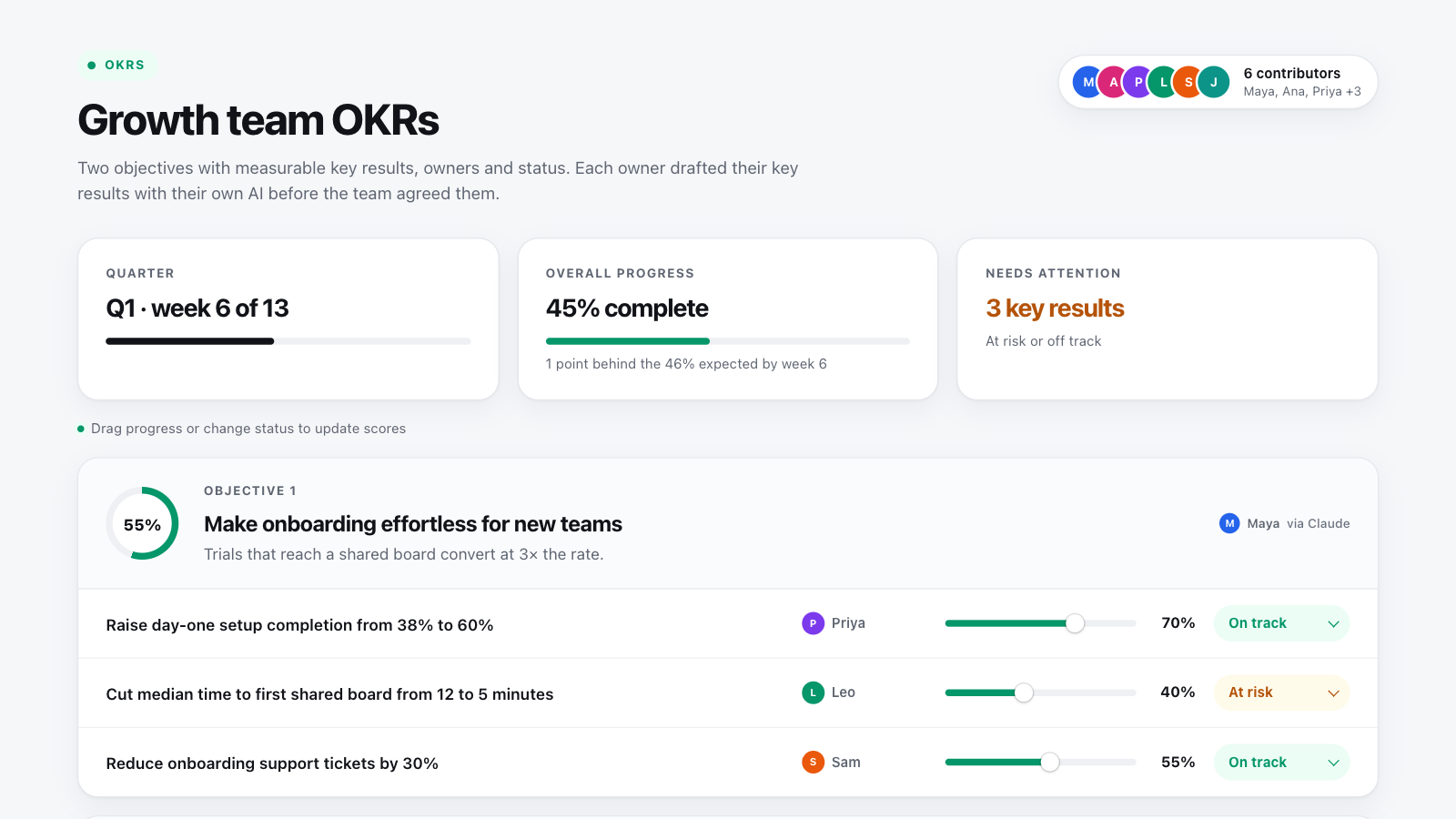
Set objectives with measurable key results, owners and status, and track progress as a team.
Decision matrix template
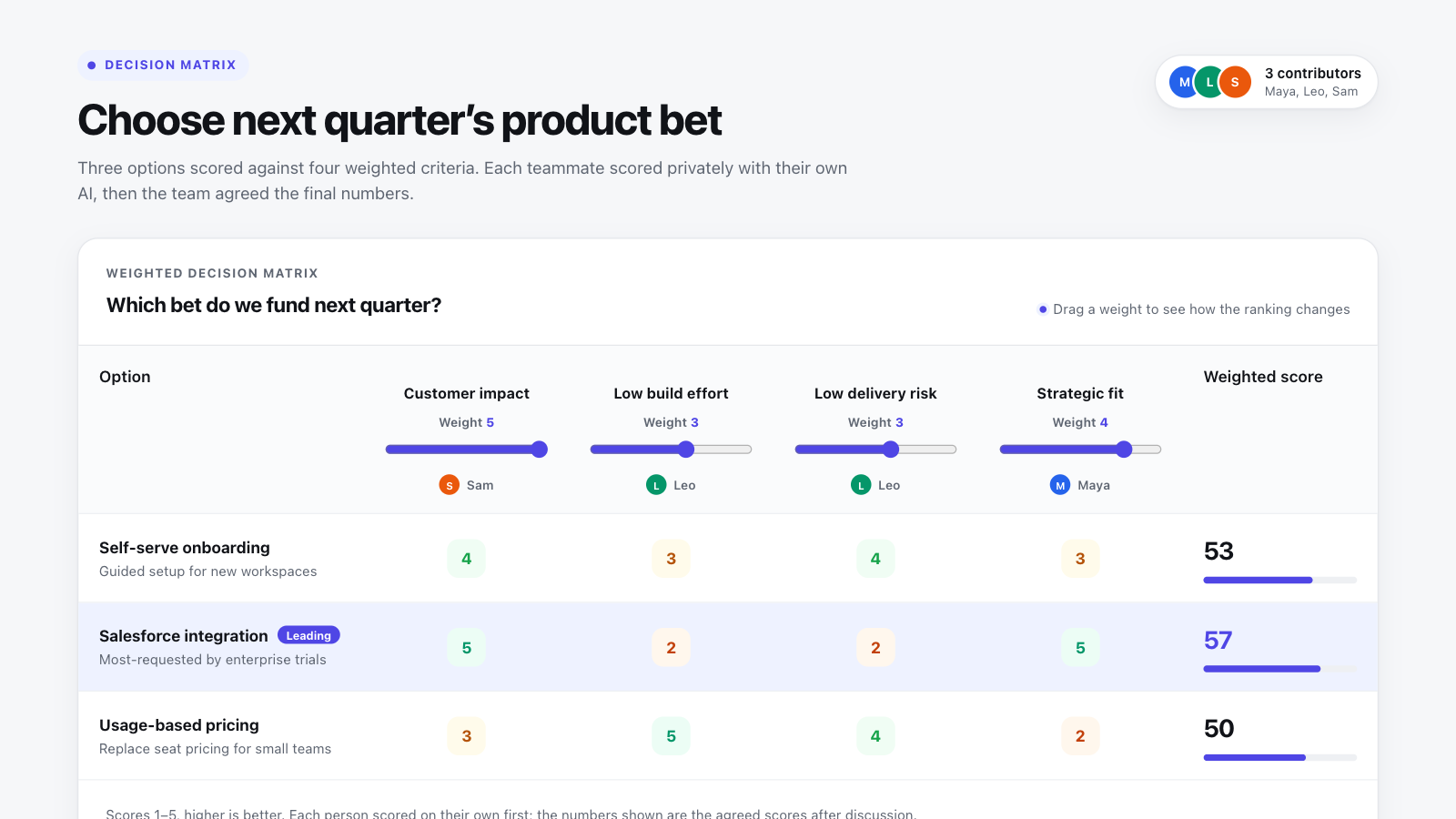
Score options against weighted criteria and see live which one wins, and how close it is.
Lessons learned template
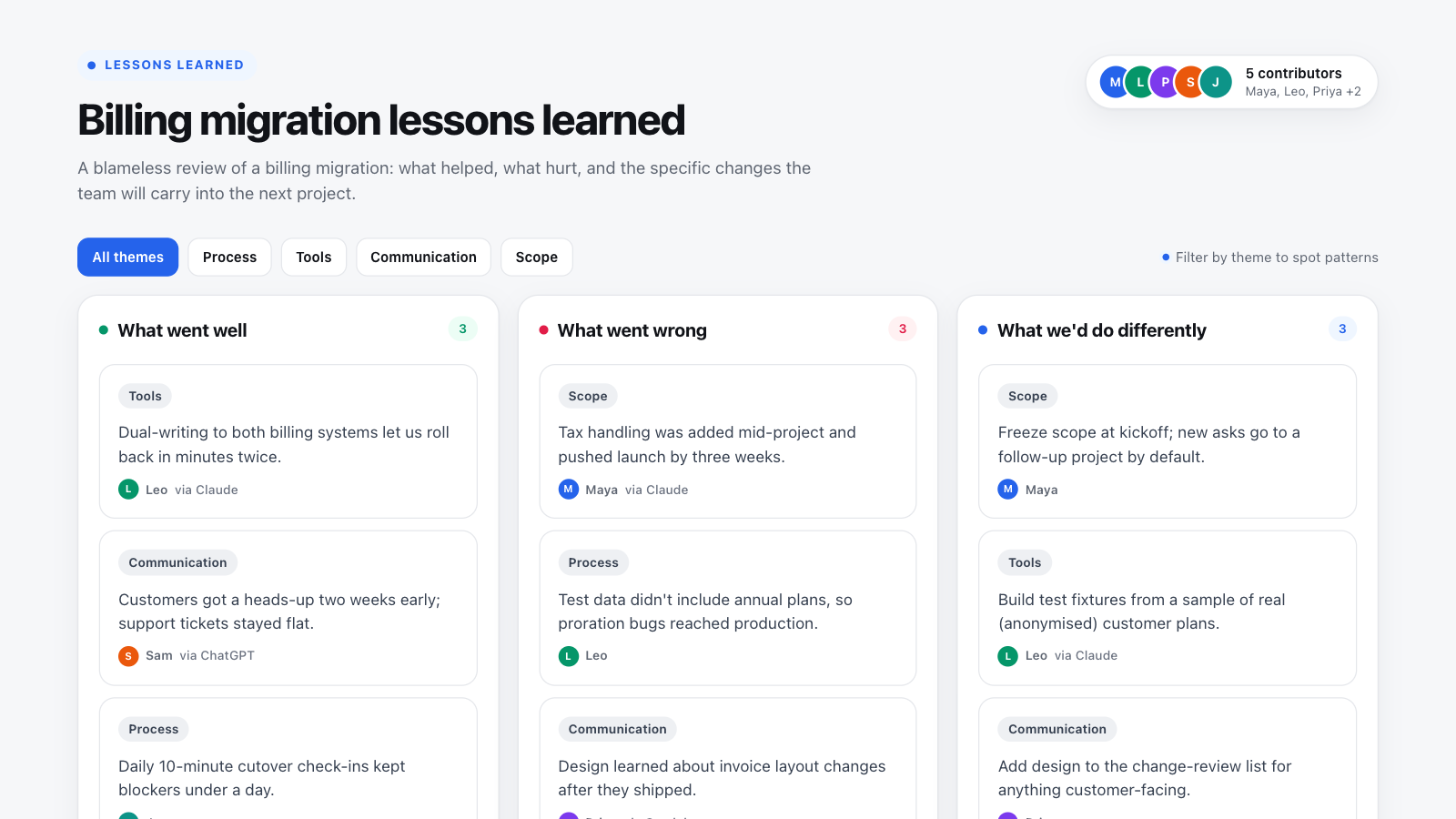
Capture what went well, what went wrong and what to change, with owners for every action.