PRACTICAL GUIDE
How to Prioritize Features With Product, Design and Engineering
Prioritize features using developer feedback, customer evidence, and clear low, medium, and high scores. Includes a copyable worksheet and worked example.

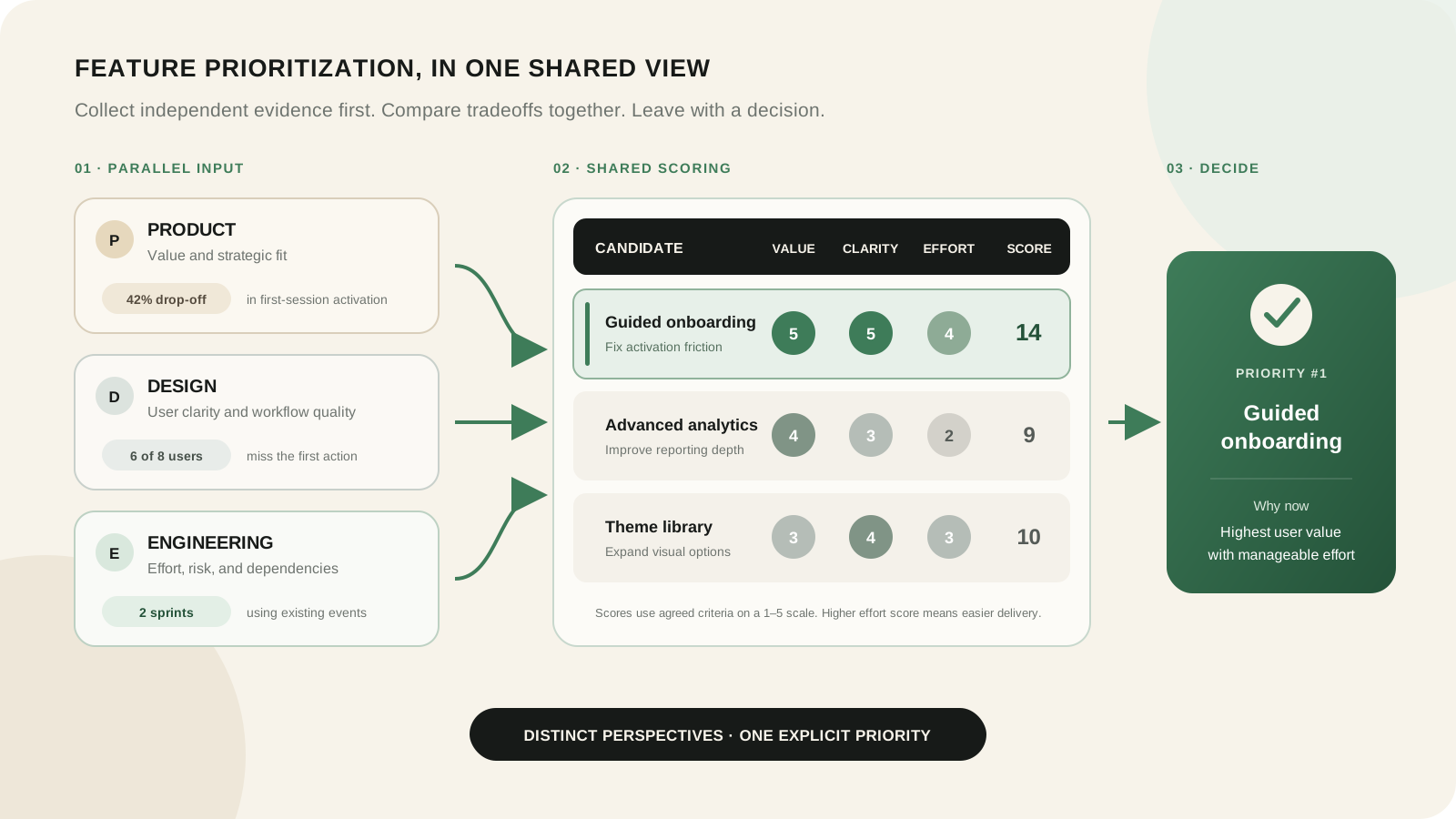
Feature prioritization fails when a team treats one number as alignment. Product, design, and engineering may assign similar scores for completely different reasons—or disagree because each function sees evidence the others do not.
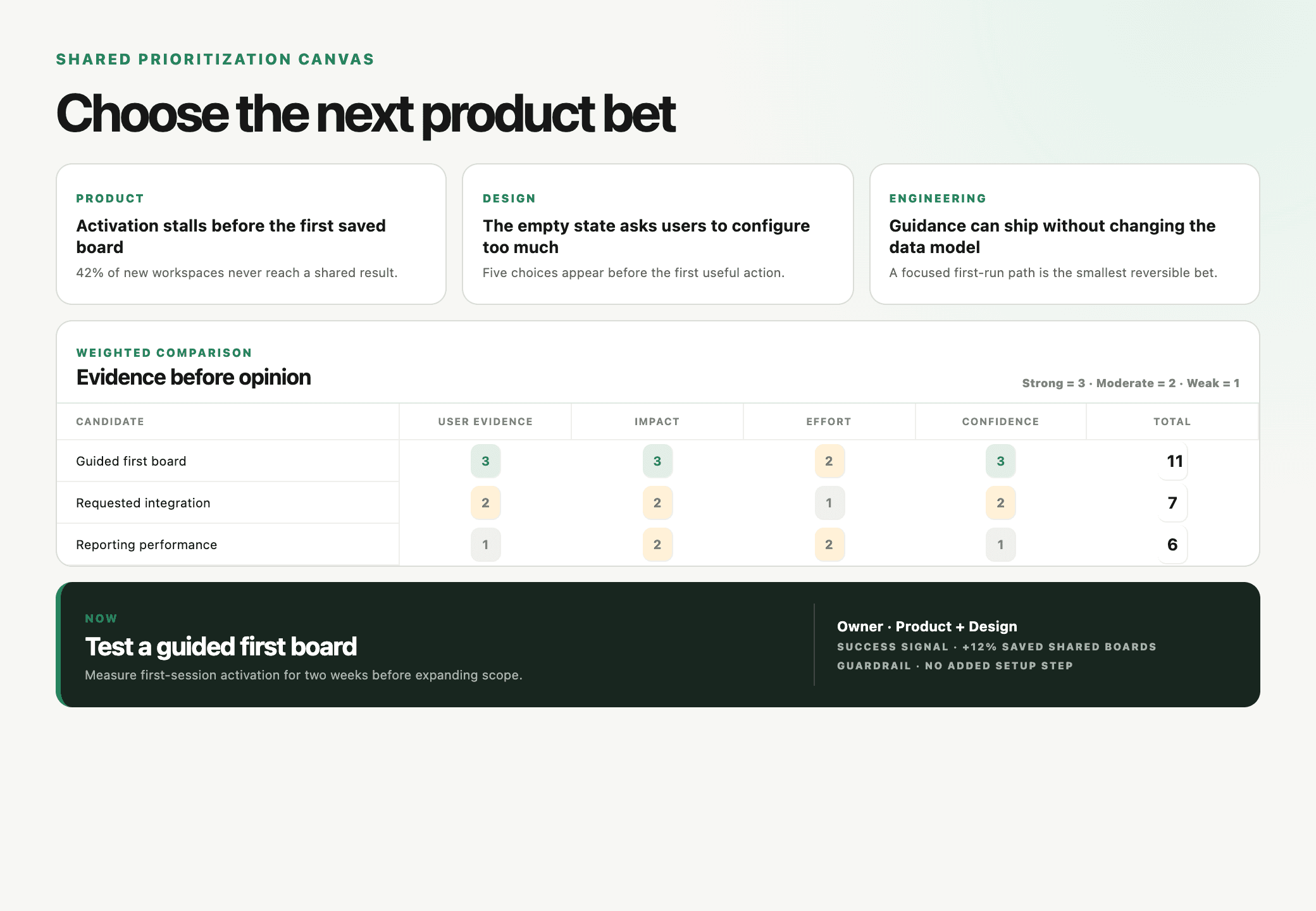
A stronger process makes those inputs visible before the team chooses. Define the outcome, compare problems rather than request wording, gather evidence in parallel, select a lightweight framework, discuss the disagreements, and record what is now, next, and not now.
Why cross-functional feature prioritization breaks down
Common failure modes appear before scoring begins:
- requests arrive at different levels of detail;
- the loudest customer or executive supplies the framing;
- product estimates value while engineering estimates a preselected solution;
- design evidence is reduced to polish;
- dependencies and reliability work compete poorly with visible features;
- the team changes criteria to justify a favourite; and
- a ranked list appears without a decision boundary or capacity limit.
The result is a precise-looking backlog with weak causal reasoning. The fix is to compare the same kind of object: a defined problem, affected users, evidence, expected outcome, possible approaches, uncertainty, and delivery implications.
What each function contributes
Product: strategy, outcomes, customer and revenue evidence
Product connects an initiative to the target outcome and business context. Useful inputs include user reach, frequency, revenue or retention evidence, strategic fit, opportunity cost, and the expected behavioural change.
Product should distinguish customer evidence from request volume. Ten requests from one segment do not automatically outweigh a silent problem affecting most users.
Design: user problems, usability, coherence, and research confidence
Design contributes observed behaviour, task friction, journey context, accessibility, information architecture, and confidence in the problem definition. It can also show when several requests are symptoms of one underlying workflow problem.
Design is not only evaluating interface effort. It is helping the team decide whether the proposed change solves the right problem coherently.
Engineering: effort, dependencies, risk, and reversibility
Engineering contributes delivery ranges, architecture constraints, security and reliability risk, platform leverage, ongoing operational cost, dependencies, and whether a smaller experiment is possible.
An effort estimate should describe a solution at a given confidence level. If the problem is still vague, a precise estimate is misleading.
Step 1—Define the outcome and decision boundary
State the outcome, time horizon, available capacity, and owner. “Prioritize the backlog” has no stopping rule. “Choose one activation improvement for the next six-week cycle” can produce a decision.
Write down non-negotiable commitments, regulatory work, and reliability thresholds before evaluating discretionary features. Do not make mandatory work compete in a popularity contest.
Step 2—Turn requests into comparable problem statements
Rewrite each candidate using the same structure:
- Who experiences the problem?
- What are they trying to do?
- What evidence shows the problem exists?
- Which outcome should change?
- How confident are we?
- What is the smallest way to learn or improve it?
“Build Slack integration” becomes “Teams coordinating incidents duplicate status updates between Boardblend and Slack, increasing delay and inconsistency.” Now the team can compare the problem with other opportunities and consider more than one solution.
Step 3—Gather role-specific evidence in parallel
Ask product, design, and engineering to prepare their inputs independently before a prioritization meeting. This reduces anchoring and makes disagreement informative.
Each function should add sources, assumptions, and confidence. If hierarchy or early opinions are distorting the process, use the techniques in these groupthink examples.
How to prioritize features based on developer feedback
Ask developers what changes the decision, beyond how long a requested feature might take. A dependency, recurring incident, or smaller solution can change which work belongs next.
- Collect specific observations. Link the issue, support case, performance trace, or technical investigation. Separate an observed problem from a proposed solution.
- Connect the feedback to user value. Name the affected workflow and users. Product and design add evidence of the impact; repeated internal requests alone do not establish customer demand.
- Compare delivery options. Ask engineering for the smallest useful change, an effort range, dependencies, maintenance cost, and what still needs investigation.
- Choose the next action together. Compare value, effort, and confidence using the scale below. Record a delivery decision or a bounded investigation with an owner and a question it must answer.
For example, “rewrite the canvas renderer” is a proposed solution. “Large sessions stall when participants add cards” is a problem the team can verify. Traces and support cases may justify a small performance fix before a rewrite or another visible feature. This is an illustrative scenario, not a reported customer result.
Copyable developer-feedback worksheet
Copy this table once for each candidate. Keep the evidence beside the recommendation so another team member can review it without attending the meeting.
| Field | Fill in |
|---|---|
| Feature and problem | Proposed feature; affected users and workflow |
| Developer feedback | Observation; source link; contributor; date |
| Customer impact | User evidence; target outcome; cost of leaving it unresolved |
| Smallest useful change | Proposed scope; alternative approach |
| Delivery constraints | Effort range; dependencies; maintenance and operational risks |
| Assessment | Value: low/medium/high; effort: low/medium/high; confidence: low/medium/high; reasons |
| Next action | Now/next/not now/investigate; owner; due date; evidence that would change the decision |
Mark missing inputs as unknown. Assign someone to check them before treating the feature as ready to rank.
Step 4—Choose the lightest useful framework
Value versus effort
Use a value-versus-effort matrix for a small option set when both dimensions can be discussed honestly. It is fast and visual, but broad labels can hide disagreement. Add confidence and risk rather than pretending every item fits one exact quadrant.
RICE prioritization
RICE compares Reach × Impact × Confidence ÷ Effort. It is useful when teams can estimate the inputs consistently. Define the period, impact scale, confidence rules, and effort unit before scoring.
RICE is not appropriate when strategic commitments, legal requirements, dependencies, or severe downside risk dominate. Those constraints should be handled explicitly.
Weighted scoring
Weighted scoring helps when the decision needs several criteria such as user value, strategic fit, confidence, effort, risk, and platform leverage. Keep the list short. Too many weights make the model hard to understand and easy to manipulate.
Kano
Kano distinguishes basic expectations, performance features, and delighters. It is useful for understanding satisfaction effects, especially with research, but it does not directly settle effort, sequencing, or strategy.
Step 5—Agree on criteria and weights first
Set the rules before seeing final scores. Define what a 1, 3, or 5 means for each criterion. Decide whether low confidence reduces a score, adds a research step, or widens a range.
Weights are strategic choices. If retention is the current company goal, say so explicitly instead of giving it a hidden advantage later.
Feature prioritization with low, medium, and high scores
Use a shared definition for each label. This example uses a two-week delivery window; agree on effort thresholds that fit your team before applying it.
| Criterion | Low | Medium | High |
|---|---|---|---|
| User value | Minor inconvenience with a workable alternative | Repeated friction in an important workflow | Blocks a core task or directly threatens the agreed outcome |
| Engineering effort | Up to 2 engineer-days | More than 2 and up to 10 engineer-days | More than 10 engineer-days |
| Confidence | Mainly assumptions or untested requests | One relevant source supports the expected outcome | Independent sources and repeated observations support the expected outcome |
High value strengthens the case for work; high effort increases its cost. Keep the three labels separate. High value with low confidence suggests validation, while high value with high confidence and manageable effort is a stronger delivery candidate. Check dependencies and capacity before committing.
Step 6—Score independently
Have each function score only the criteria it can support, then reveal results together. Require a short rationale and evidence link for every extreme score.
Independent scoring is not about averaging three opinions. It prevents the first confident number from becoming the group’s baseline.
Step 7—Discuss disagreements, confidence, and dependencies
Start with the largest gaps. Ask:
- Are we scoring the same problem and solution?
- Which evidence would change either view?
- Is one score describing impact while another describes urgency?
- Does a dependency create leverage across several items?
- Can we run a smaller validation before committing?
Update scores only when the underlying reasoning changes. Preserve the original range so the decision record shows where uncertainty existed.
Step 8—Record the decision and next validation step
Create three explicit outcomes: now, next, and not now. For each selected initiative, record the rationale, expected outcome, owner, first milestone, measurement, and review trigger. For deferred items, state what evidence or condition would reopen the decision.
Use the AI-assisted decision-making template to capture the choice, supporting evidence, and conditions for review in one record.
Worked example: prioritize five features
A collaboration product is considering:
- guided onboarding;
- Slack notifications;
- faster large-canvas loading;
- custom templates; and
- advanced export controls.
The team defines the decision as choosing one activation initiative and one reliability investment for the next cycle.
| Candidate | Evidence | Value | Effort | Confidence | Decision |
|---|---|---|---|---|---|
| Guided onboarding | New users miss the first successful action | High | Medium | Medium | Validate a smaller guided step |
| Slack notifications | Repeated requests from large teams | Medium | Medium | Medium | Next |
| Canvas performance | Severe delays on valuable large sessions | High | Medium | High | Now |
| Custom templates | Broad interest, unclear repeated use | Medium | High | Low | Research |
| Export controls | Required by two enterprise prospects | Medium | High | High | Not now; reopen with signed demand |
Performance wins because the problem is severe, well evidenced, and affects retention. Onboarding receives a smaller experiment because its value is plausible but the proposed solution is not yet validated. The team does not merely sort five features; it selects two different kinds of action.
A 45-minute feature prioritization workshop
| Time | Activity |
|---|---|
| 0–5 minutes | Confirm outcome, boundary, criteria, and decision owner |
| 5–12 minutes | Review comparable problem statements and evidence gaps |
| 12–20 minutes | Product, design, and engineering score independently |
| 20–32 minutes | Discuss the largest disagreements and dependencies |
| 32–39 minutes | Compare the leading portfolio against capacity |
| 39–45 minutes | Record now, next, not now, owners, and validation steps |
Use the AI brainstorming workshop before prioritization when the team still needs meaningfully different solution options.
Common feature prioritization mistakes
- Treating request counts as customer value.
- Asking engineering for estimates after the solution is fixed.
- Using RICE with invented reach or impact numbers.
- Changing weights after a preferred feature ranks poorly.
- Averaging scores before discussing why they differ.
- Letting all work compete even when some work is mandatory.
- Producing a ranking without a capacity boundary.
- Recording the winner but not the rejected alternative or review trigger.
Boardblend keeps the role-specific evidence and agent contributions visible on one canvas. That makes AI useful for challenging inputs and organizing comparisons without allowing a generated ranking to replace accountable product judgment.
COMMON QUESTIONS
Frequently asked questions
What is the best feature prioritization framework?
Use the lightest framework that makes the real trade-off visible. Value versus effort works for a small uncertain set, RICE helps compare reach and impact, and weighted scoring helps when several explicit constraints matter.
What role should engineering play in feature prioritization?
Engineering should contribute delivery ranges, dependencies, operational risks, reversibility, platform leverage, and simpler alternatives. It should not be asked only to estimate a solution after priorities are already decided.
How should teams resolve conflicting feature scores?
Discuss the evidence, definition, confidence, and assumptions behind the scores before averaging them. A large difference often reveals useful domain knowledge or a differently understood problem.
When should a product team use RICE prioritization?
RICE is useful when initiatives have reasonably comparable estimates for reach, impact, confidence, and effort. Avoid it when inputs are mostly guesses or when strategic, regulatory, or dependency constraints dominate.
Can AI prioritize a product backlog?
AI can organize evidence, challenge assumptions, and calculate an agreed model. People must still validate the inputs, choose the criteria, own the trade-offs, and record the decision.
PUT IT INTO PRACTICE
Turn everyone’s thinking into one clear next step.
See how teams use Boardblend, or open a shared canvas and start now.