PRODUCT COMPARISON
Boardblend vs ChatGPT for Team Brainstorming
Compare Boardblend and ChatGPT for brainstorming, shared context, parallel team input, visual organization, multiple agents, and clearer team decisions.

ChatGPT and Boardblend are not competing AI models. They solve different layers of work. ChatGPT is the stronger general-purpose assistant for individual research, analysis, writing, coding, and exploration. Boardblend is the collaboration layer for several teammates and agents to think in parallel, compare visually, and reach a shared decision.
ChatGPT can be one of the agents a participant brings into Boardblend. For many teams, “both” is the most accurate answer.
Boardblend vs ChatGPT at a glance
Choose ChatGPT when…
- one person needs a powerful conversational collaborator;
- the work involves research, file analysis, writing, coding, or data;
- a project should centralize instructions, files, and AI chats;
- flexible model tools matter more than a spatial team canvas; or
- the output is primarily a document, answer, analysis, or artifact.
Choose Boardblend when…
- several teammates should contribute before seeing one dominant answer;
- each person may use a different agent or context;
- options, evidence, and disagreements should stay visible together;
- the team needs spatial comparison and parallel work; or
- the output is a documented shared decision.
They solve different layers of the problem
ChatGPT is an assistant layer. It helps a user interpret context and produce useful work. ChatGPT Business also provides a shared workspace, projects, apps, company knowledge, controls, and collaboration around AI usage.
Boardblend is an orchestration layer. It gives a team one live visual surface where human and agent contributions can meet without collapsing everyone into one prompt or transcript.
Feature comparison
| Criterion | Boardblend | ChatGPT |
|---|---|---|
| Primary orientation | Collaborative AI-assisted decisions | General-purpose AI assistance |
| AI model | Participant-selected agents | OpenAI models and tools |
| Individual exploration | Agent dependent | Excellent |
| Shared project knowledge | Shared session context | Projects, files, instructions, company knowledge |
| Synchronous multi-person chat editing | Not the core interaction; shared canvas is live | Shared project chats branch rather than co-edit synchronously |
| Parallel participant contributions | Core workflow | Separate chats can run in parallel |
| Spatial visual comparison | Core workflow | Canvas is document/code oriented, not a multi-user whiteboard |
| Research, writing, coding, data | Through connected agents | Broad native strength |
| Decision rationale | Explicit team close | Must be created in a chat, project, or document |
| Team administration | Focused product scope | Mature Business and Enterprise workspaces |
Individual brainstorming
ChatGPT is the clear winner for individual brainstorming. A person can move fluidly between question framing, web research, file analysis, generation, critique, data analysis, writing, and coding. Projects and memory help retain context over time.
Boardblend is not intended to replace that depth. Its value begins when several people need to contribute distinct reasoning to the same decision.
Team brainstorming and shared projects
OpenAI’s Projects documentation describes centralized files, instructions, chats, and sharing. Team members can create and branch conversations using project context. This is powerful asynchronous collaboration.
Official documentation also distinguishes shared projects from synchronous co-editing of one chat. Parallel chats can produce several perspectives, but the team still needs a way to compare them and preserve a joint conclusion.
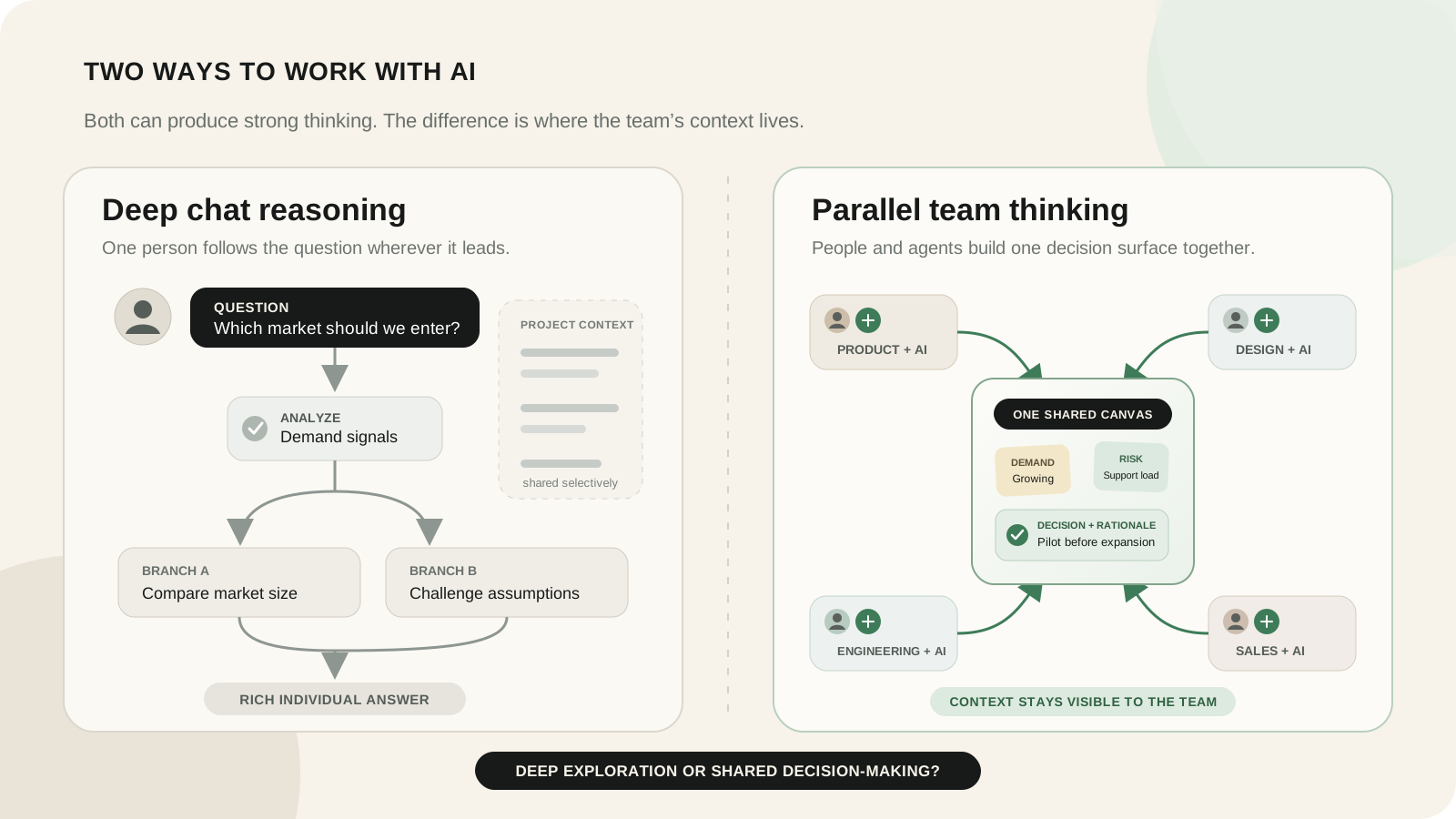
Boardblend makes that comparison the primary interface. Contributions appear on one visual canvas rather than remaining in separate chat branches.
One shared assistant versus teammate-owned agents
One shared ChatGPT conversation is simple and useful, but the first prompt and answer can anchor everyone. Separate chats preserve independence, yet their outputs may be copied into a document without source reasoning.
Boardblend lets each teammate bring an agent relationship into a common session. Product can use ChatGPT, engineering can use a coding-oriented agent, and research can use another approved tool. The team compares contributions rather than assuming model agreement is truth.
Shared context and context boundaries
ChatGPT Projects are strong context containers. They can centralize files and instructions so multiple chats address the same body of knowledge. ChatGPT Business also offers company knowledge and connectors.
Boardblend’s shared context is decision-specific and visual. Participants select what the team needs to see, while their private agent conversations need not become one undifferentiated transcript. This boundary helps preserve both individual working context and group accountability.
Conversation versus visual canvas
Chat is excellent for depth and sequence. It becomes harder to scan when a team must hold several options, evidence links, dependencies, criteria, and disagreements at once.
Boardblend’s canvas is optimized for those relationships. ChatGPT’s canvas feature supports side-by-side work on substantial writing and code, but it is not documented as a synchronous multi-user spatial whiteboard.
Parallel thinking and anchoring
For teams, separate chats can protect independent thinking better than one shared conversation. The limitation is convergence: who collects the results, and what gets lost in the handoff?
Boardblend combines independent contribution with a shared reveal and evaluation surface. For a practical sequence, see how to brainstorm with AI and the groupthink examples guide.
Synthesis, evaluation, and decision capture
ChatGPT can produce excellent summaries, decision matrices, counterarguments, and decision records when given complete context. It can also over-smooth disagreement or fill evidence gaps unless instructed carefully.
Boardblend keeps original contributions beside the synthesis. The team can see which evidence, assumption, or dissent led to the decision, then record the owner, next action, and review trigger.
Research, writing, coding, and file analysis
ChatGPT wins decisively here. Its official pricing page lists search, data analysis, files, canvas, projects, deep research, connectors, custom GPTs, and agent capabilities across plans.
Boardblend coordinates these capabilities through agents; it does not attempt to reproduce every general-purpose tool inside the canvas.
Model flexibility and agent choice
ChatGPT provides OpenAI models and the OpenAI tool ecosystem. That integrated experience is a strength.
Boardblend is model-flexible at the team layer. Different participants can bring different supported agents. This matters when functions already have specialized tools, instructions, or context they do not want to abandon for one shared assistant.
Pricing and workspace limits
OpenAI’s current Business documentation showed standard ChatGPT seats at $20 per user per month billed annually or $25 monthly, with a two-seat minimum in most supported countries. Business includes ChatGPT and Codex access, projects, apps, company knowledge, agents, workspace controls, and no training on business data by default.
Individual ChatGPT plans may be sufficient for solo brainstorming, but comparing individual subscriptions with a team collaboration product is misleading. Price the real workflow: required workspace seats, agent usage, administration, and the cost of manually reconciling separate conversations.
Worked comparison: prioritizing a roadmap
One shared ChatGPT conversation
The team provides customer evidence and asks ChatGPT to compare onboarding, an integration, and performance work. It quickly creates a matrix and recommendation. The risk is anchoring: teammates critique one polished answer rather than contributing independent views.
Separate chats inside a shared project
Product, design, and engineering each use the shared project context in separate chats. This preserves more independence and uses ChatGPT’s strengths well. Someone must then collect the branches, reconcile conflicting assumptions, and create the authoritative decision record.
Boardblend’s parallel visual workflow
The same people and their agents contribute in parallel. Their evidence, risks, and recommendations become comparable on one canvas. The team chooses performance work, records why onboarding remains uncertain, and assigns a validation owner.
Use Boardblend, ChatGPT, or both?
| Choose… | When the primary need is… |
|---|---|
| ChatGPT | Powerful individual or asynchronous AI work across research, files, writing, coding, and data |
| Boardblend | Live parallel team contribution, visual comparison, and decision provenance |
| Both | ChatGPT as one or more participant agents, with Boardblend as the shared convergence surface |
The best test is not asking both tools for ideas. Run the complete workshop: independent thinking, agent assistance, shared context, challenge, comparison, decision, and follow-through. Use the product—or combination—that makes the team’s reasoning easiest to inspect and act on.
COMMON QUESTIONS
Frequently asked questions
Is Boardblend an AI model?
No. Boardblend is a collaborative visual workspace that coordinates people and the AI agents they choose. The quality and capabilities of an agent still depend on its underlying model and tools.
Does Boardblend replace ChatGPT?
Usually not. ChatGPT is a broad AI assistant for research, analysis, writing, coding, and individual exploration. Boardblend adds a team layer for parallel contribution, shared visual context, and decision convergence.
Can teammates bring ChatGPT into Boardblend?
Boardblend is designed for bring-your-own-agent connections, so ChatGPT can be part of a participant's workflow where a supported, approved connection is available. Verify the current integration and workspace policies.
How is a visual canvas different from a shared ChatGPT project?
A shared project centralizes files, instructions, and chats. A visual canvas keeps several participants' options, evidence, relationships, disagreements, and final rationale visible together rather than across chat branches.
Which is better for individual brainstorming or team decisions?
ChatGPT is generally better for flexible individual exploration. Boardblend is better when several people and agents need to contribute in parallel and preserve how the team reached a decision.
PUT IT INTO PRACTICE
Turn everyone’s thinking into one clear next step.
See how teams use Boardblend, or open a shared canvas and start now.