PRACTICAL GUIDE
How to Brainstorm With AI as a Team
Use a practical template and prompts to brainstorm with AI as a team, preserve independent perspectives, and finish with a clear decision.

AI can make a brainstorming session faster without making it wiser. The difference is the process. If one person prompts an assistant and shares its answer first, the team may simply refine a confident anchor. If people think independently, bring their own agents, and combine the results on one shared canvas, AI can help the group explore more options and test them more rigorously.
This guide shows how to brainstorm with AI using a repeatable seven-step workshop. It moves a team from one decision-worthy question to an accountable next action without turning the session into a single AI-generated answer.
A copyable brainstorm-with-AI template
Start every session with the same compact brief:
- Decision: What must the team choose or produce?
- Outcome: What should improve if the session succeeds?
- Context: Which evidence, prior attempts, and constraints matter?
- Independent view: What does each person think before seeing AI output?
- AI role: Should the agent expand, challenge, compare, or find gaps?
- Close: Who decides, what happens next, and when will the result be reviewed?
Copy this prompt into ChatGPT or another approved agent: “Help me brainstorm this decision. Generate three approaches that use different mechanisms, name the assumption behind each, make the strongest counterargument, and list the evidence a team should verify. Do not choose for us.”
The 30-minute AI brainstorming agenda
| Time | Activity | Output |
|---|---|---|
| 0–3 minutes | Frame the decision and constraints | One specific question |
| 3–8 minutes | Independent human thinking | Distinct initial perspectives |
| 8–13 minutes | Agent expansion and challenge | Options, assumptions, and counterarguments |
| 13–18 minutes | Parallel sharing | One visible contribution set |
| 18–23 minutes | Cluster and clarify | Themes without erased disagreement |
| 23–28 minutes | Evaluate against criteria | A supported recommendation |
| 28–30 minutes | Record the decision | Rationale, owner, action, and review trigger |
Use the timing as a constraint, not a promise. A low-risk campaign idea may fit in 30 minutes. A security, hiring, or market-entry decision should use the same sequence over a longer period and include qualified review.
What AI team brainstorming is—and is not
One person prompting AI
One person can use AI to generate an outline or starter list. That is useful individual preparation, but it is not collaborative AI brainstorming. The assistant sees one framing of the problem, and the group sees one output before contributing its own information.
Multiple teammates and agents contributing
In a team workflow, each participant begins with domain knowledge and judgment. A product manager may focus on customer value, a designer on behaviour and usability, and an engineer on feasibility and operational risk. Their preferred agents can help each person uncover assumptions, alternatives, or evidence.
The group then brings those contributions into shared context. The point is not to make several models compete. It is to preserve more of what the team knows before deciding.
When this approach is inappropriate
Do not put regulated, personal, privileged, or commercially sensitive information into an AI service unless your organization has approved the service and data handling. Do not delegate legal, medical, employment, security, or financial accountability to a model. AI can structure questions and surface uncertainty; qualified people still own verification and the decision.
Prepare the session
Define the decision
Replace a topic such as “ideas for onboarding” with a question that contains an outcome and boundary: “Which onboarding change should we test next month to improve first-session activation without adding sales support?”
State who decides. A team can advise, consent, vote, or make the decision together, but ambiguity about authority creates frustration at the end.
Assemble context, evidence, and constraints
Create a compact context pack:
- the user or business outcome;
- relevant research and metrics;
- known attempts and their results;
- time, budget, technical, and policy constraints;
- stakeholders who will be affected; and
- what evidence would change the decision.
Shared context does not mean every person must use the same prompt. It means their contributions address the same reality.
Assign roles and tools
Choose a facilitator, decision owner, timekeeper, and rotating challenger. Let participants use approved agents that support their work. Record which claims came from people, which came from AI, and which still require verification.
Set privacy and fact-checking rules
Before prompting, decide what data is allowed, which sources are authoritative, and who will check factual claims. Treat uncited model output as a lead, not evidence.
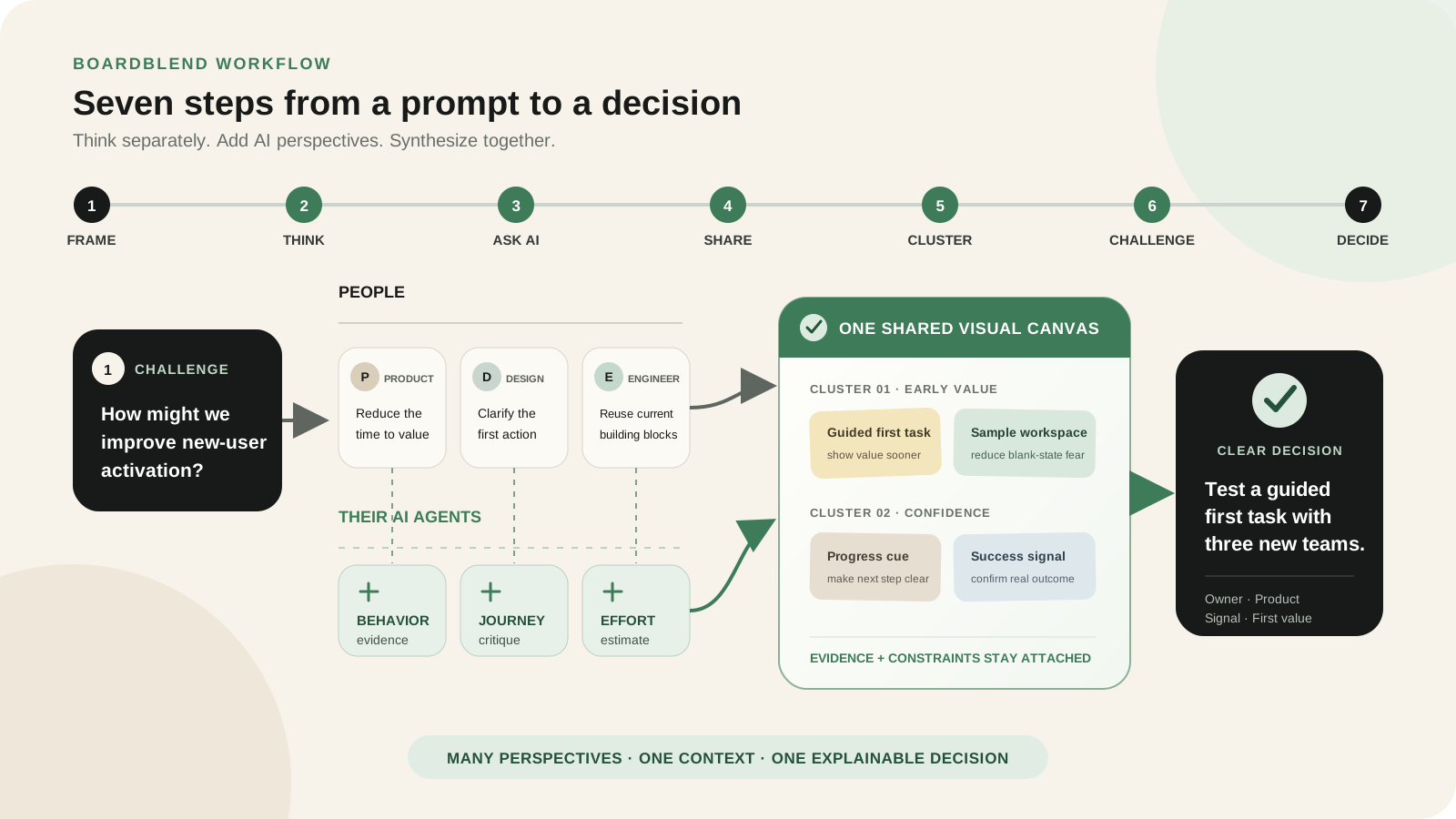
The seven-step workshop
1. Frame one decision-worthy question
Put the question, outcome, constraints, and decision owner at the top of the canvas. Ask each participant to restate what they think is being decided. Resolve framing disagreements before generating answers.
2. Think independently first
Give everyone three to five quiet minutes. Ask for a recommendation, evidence, assumptions, risks, and confidence. Independent thinking protects information that might disappear once senior opinions or polished AI outputs become visible.
For more facilitation mechanics, see groupthink examples and prevention.
3. Let each agent expand or challenge its teammate
AI should add friction as well as fluency. Ask it to identify missing stakeholders, generate a meaningfully different option, state what could make the recommendation wrong, and suggest evidence to collect.
Keep the person’s original view visible. Otherwise the agent’s rewrite can erase useful uncertainty and make every contribution sound alike.
4. Bring contributions onto one canvas
Share all initial views in parallel. Each contribution should include its owner and source. Avoid presenting one polished synthesis before the raw perspectives are visible.
Boardblend supports this pattern with one shared visual canvas and separate participant connections. Teammates can bring their own AI agents into the same working context rather than passing snippets between isolated chats.
5. Cluster ideas without erasing disagreements
Group related proposals, evidence, and risks. Name clusters by the underlying approach, not by the loudest suggestion. When two notes conflict, keep both and label the unresolved assumption.
Clustering is navigation, not a vote. A large cluster can reflect duplication rather than importance.
6. Evaluate against agreed criteria
Choose criteria before scoring the ideas. Typical criteria include expected impact, user value, confidence, effort, reversibility, strategic fit, and risk. Give each score a short rationale and flag missing evidence.
Do not add scores into a precise-looking total unless the scale and weighting genuinely support that calculation. A decision table should improve conversation, not disguise judgment.
For a worked cross-functional scoring process, use the feature prioritization guide.
7. Record the decision, rationale, owner, and next experiment
Use the AI-assisted decision-making template to record the selected option, strongest rejected alternative, decisive evidence, unresolved concerns, owner, first action, and review date or trigger. A brainstorm is incomplete until someone can act on it.
Copyable prompts for every step
Use prompts to sharpen thinking, not outsource it.
Frame: “Turn this topic into one decision we can make today. State the outcome, constraints, missing context, and decision owner.”
Expand: “Generate three approaches that use meaningfully different mechanisms. Explain the assumption behind each.”
Challenge: “Make the strongest case against my preferred option. What evidence would prove me wrong?”
Stakeholders: “Which affected users, teams, or failure modes are absent from this analysis?”
Evaluate: “Compare these options against our stated criteria. Mark every claim that needs human verification.”
Close: “Draft a decision record with the rationale, rejected alternative, unresolved risks, owner, next action, and review trigger.”
Worked example: choosing a roadmap bet
A product, design, and engineering team must choose between improving onboarding, adding an integration, or reducing report load time.
The product manager contributes activation data and customer requests. The designer contributes usability evidence and research gaps. Engineering contributes performance traces, dependencies, and delivery ranges. Each uses an agent to challenge assumptions rather than generate a replacement answer.
On the shared canvas, the team discovers that the integration has high demand but weak evidence of retention impact. Onboarding has plausible impact but a poorly defined target behaviour. Performance work affects fewer accounts but creates a severe failure for the most valuable customers.
The team chooses a two-week performance intervention, records why the integration was deferred, assigns an owner, and defines a review trigger based on account retention and latency. The output is not a longer idea list; it is a traceable decision.
Common failure modes
- Prompting before framing: the model invents a problem boundary the team never agreed to.
- Showing one AI answer first: later contributions orbit a shared anchor.
- Generating too many near-duplicates: volume creates sorting work without strategic variety.
- Synthesizing too early: uncertainty and minority views disappear into polished prose.
- Scoring without evidence: numerical confidence hides untested assumptions.
- Treating agent output as a source: plausible claims enter the decision record without verification.
- Ending with themes: nobody owns a decision or next action.
Adapt the workshop for async and remote teams
Keep the sequence but expand the clock. Publish the question and context pack, give participants a private contribution window, then reveal submissions together. Use a second window for challenges and evidence. Schedule a short live meeting only for unresolved trade-offs and the final decision.
Require explicit responses—support, concern, question, or abstain—so silence is not mistaken for consent. Record time zones and the closing deadline.
Turn the canvas into action
Before closing, ask whether a person who missed the meeting can understand what was decided, why, what remains uncertain, and what happens next. If not, the team has a brainstorm archive rather than a decision record.
Boardblend keeps human perspectives, bring-your-own AI agents, evidence, and the final rationale on one shared visual canvas. That shared context makes the workshop easier to continue without collapsing everyone’s thinking into one chat thread.
COMMON QUESTIONS
Frequently asked questions
Should people brainstorm independently before using AI?
Yes. A short independent pass protects each person’s knowledge and judgment from being anchored by the first visible AI answer. AI can then expand, challenge, or test those original views.
Can teammates use different AI agents in one brainstorm?
Yes. Different agents can contribute useful perspectives when they receive the same decision context and their outputs remain attributable. The team should compare evidence and assumptions rather than vote for a favourite model.
What context should an AI brainstorming session include?
Give every participant the decision, desired outcome, audience, evidence, constraints, known risks, and definition of success. Exclude confidential data that the selected AI service is not approved to process.
How long should an AI team brainstorm take?
A focused decision can use the 30-minute agenda in this guide. Complex or high-risk decisions need more time for evidence gathering, fact-checking, stakeholder review, and a separate approval step.
How do teams prevent AI-driven convergence?
Capture independent human views first, let agents challenge rather than replace them, delay synthesis until all contributions are visible, and preserve disagreements alongside the final decision.
Can I use AI to brainstorm ideas without letting it take over?
Yes. Write your initial view first, then ask AI for different mechanisms, missing stakeholders, counterarguments, and evidence gaps. Keep the original human contribution visible and verify factual claims before using them.
PUT IT INTO PRACTICE
Turn everyone’s thinking into one clear next step.
See how teams use Boardblend, or open a shared canvas and start now.