PRACTICAL GUIDE
Groupthink Examples—and How to Avoid It During Team Brainstorming
See practical groupthink examples from everyday team decisions, learn the warning signs, and use a repeatable process that protects independent thinking.

Groupthink happens when the desire for agreement starts to interfere with realistic evaluation. The APA Dictionary of Psychology describes it as concurrence seeking that disrupts effective group decision-making. In practice, it often looks less dramatic: a leader speaks first, the room becomes quiet, and a plausible idea becomes “the plan” before the team has examined what it might be missing.
The solution is not endless debate. It is a better sequence: think independently, share in parallel, challenge assumptions, then converge.
Seven groupthink examples in everyday team decisions
These examples are deliberately ordinary. Groupthink is not limited to historic political disasters or executive boardrooms; it appears whenever hierarchy, time pressure, cohesion, or visible opinions discourage independent judgment.
1. The leader’s idea becomes the default
A product lead opens a roadmap meeting by saying, “I think onboarding is obviously our biggest problem.” Design, engineering, support, and marketing then discuss onboarding improvements instead of first asking whether onboarding is the right problem.
Nobody had to order the team to agree. The first confident opinion narrowed the search space. Evidence about activation, retention, performance, or positioning may never enter the conversation.
Better move: have every function write its diagnosis and supporting evidence before the leader shares a preference.
2. A familiar campaign gets approved again
A marketing team repeats last quarter’s campaign because everyone recognizes the format and nobody wants to slow down the launch. The team treats familiarity as proof, even though channel costs and customer behaviour have changed.
Better move: require one “repeat,” one “adapt,” and one genuinely different option, then compare them against the same outcome and constraints.
3. Engineers stay quiet about delivery risk
A launch date is announced in a cross-functional meeting. Engineers see unresolved migration and reliability work, but the commercial excitement makes a schedule objection feel unhelpful. The final plan records the date without the technical assumptions required to meet it.
Better move: collect confidence, dependencies, and failure modes privately before discussing the public commitment.
4. A design critique becomes a popularity vote
The most senior designer reacts positively to one concept. Later comments refine that concept instead of comparing the problem-solving strengths of all concepts. The team generates lots of discussion but little independent evaluation.
Better move: ask reviewers to score each direction against the user problem before showing anyone else’s score.
5. A hiring panel converges on “culture fit”
The first interviewer describes a candidate as a strong fit. Other interviewers reinterpret mixed evidence through that label, and concerns become minor exceptions. Independent interviews did not produce independent judgment because the panel shared conclusions too early.
Better move: submit evidence against a defined rubric before the debrief begins.
6. A remote team mistakes silence for agreement
A proposal is posted in chat. Two enthusiastic replies arrive quickly; everyone else is busy or uncertain. The author reads the absence of objections as consent and moves forward.
Better move: request explicit responses—support, concern, question, or abstain—by a clear deadline.
7. One AI answer anchors the whole workshop
The facilitator asks an AI assistant for ideas and pastes the response onto the board before teammates contribute. People reorganize, extend, and polish those suggestions. The result looks productive, but the team has explored one model-generated neighbourhood.
Better move: let people and their preferred agents explore independently first. Compare overlaps and disagreements only after those perspectives are visible.
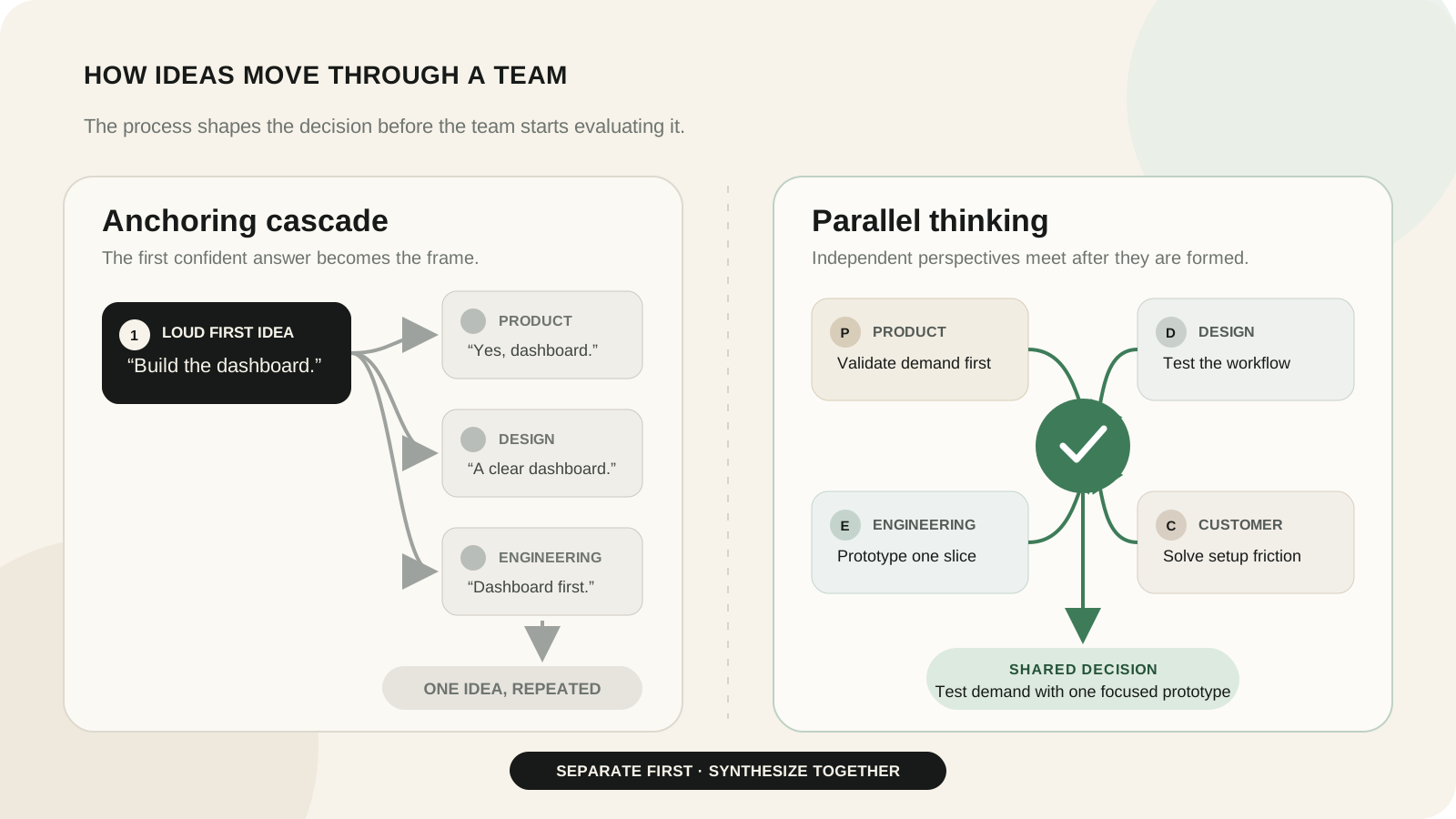
What groupthink looks like during a meeting
Agreement alone is not evidence of groupthink. A well-informed team can legitimately reach the same conclusion. Look for a cluster of process signals:
- The group settles on one option unusually early.
- Alternatives are mentioned but not developed.
- The leader’s preference is visible before independent input.
- Concerns are softened into minor implementation details.
- People explain why the preferred option will work but not how it could fail.
- The same few voices frame both the problem and the answer.
- A vote confirms a public discussion instead of collecting private judgment.
- The decision record contains no dissent, uncertainty, or rejected alternative.
- Confidence rises faster than the evidence improves.
Hierarchy matters. A recent qualitative study of medical residents found that seniority affected whose information entered group decisions and whether lower-ranking team members felt able to contribute. That does not mean every hierarchy creates groupthink, but it shows why “everyone could have spoken” is not the same as designing a process where everyone actually does. See the published study.
Why traditional brainstorming is vulnerable
Classic brainstorming asks people to generate ideas without immediate criticism. That can help fluency, but live conversation also exposes every participant to the ideas, status, and confidence of others.
Three forces then interact:
- Anchoring: early suggestions shape what later ideas resemble.
- Production blocking: only one person can hold the floor, so other thoughts wait, change, or disappear.
- Evaluation pressure: people anticipate how an idea will be received even when criticism is officially postponed.
The risk increases when the group is cohesive, the decision is stressful, or the leader strongly favours an outcome. A scoping review of groupthink in health teams also cautions that the empirical evidence is still limited and that researchers do not agree on one universal way to measure the concept. Treat groupthink as a process risk to manage—not a label to diagnose every bad decision after the fact.
A seven-step process to avoid groupthink
1. Frame a decision, not a vague topic
“Brainstorm growth” invites an unbounded idea pile. “Which activation problem should we address in the next six weeks?” gives people a shared outcome, time horizon, and decision boundary.
Write down:
- the decision to be made;
- the evidence already available;
- non-negotiable constraints;
- who owns the final call; and
- what would justify revisiting it.
2. Ask for independent input first
Give each person several quiet minutes to form a view before discussion. For consequential decisions, ask for the recommendation, evidence, assumptions, risks, and confidence—not just ideas.
Independence is valuable because groups can lose their advantage when members adapt to one another too early. A review on making better decisions in groups highlights both similarity of knowledge and social convergence as threats to independent information.
3. Collect contributions in parallel
Have everyone submit at the same time. This reduces airtime competition and makes quiet expertise visible. Names can remain visible for accountability; anonymity is useful when hierarchy or interpersonal risk would otherwise suppress candour.
4. Delay the leader’s preference
The leader can frame constraints and clarify responsibility without announcing the answer. Share the leader’s recommendation after other perspectives are captured.
5. Separate divergence from evaluation
First ask, “What are we missing?” Then ask, “How should we choose?” Switching constantly between creation and criticism rewards safe ideas and makes evaluation criteria inconsistent.
6. Create structured dissent
Assign someone to argue the strongest case against the emerging favourite. Ask what evidence would change the decision, which affected stakeholder is absent, and what failure would look obvious in hindsight.
The challenger is not a permanent pessimist. Rotate the role so dissent is part of the process rather than a personality trait.
7. Record the decision and the disagreement
A useful decision record contains:
- the chosen option;
- the criteria and evidence;
- the strongest rejected alternative;
- unresolved risks and minority views;
- an owner and next action; and
- a review trigger or date.
This prevents apparent unanimity from rewriting what the team actually knew.
Worked example: choosing a new market
Imagine a software company deciding whether to enter healthcare, education, or professional services.
In the risky version, the CEO mentions healthcare first. The group spends forty minutes discussing compliance and market size. Education and professional services receive five minutes each. Healthcare wins because it accumulated the most detail—not because the team compared the markets fairly.
In a stronger version:
- Strategy defines the decision and constraints.
- Sales evaluates demand and buying cycles independently.
- Product evaluates workflow fit.
- Engineering evaluates integration and compliance cost.
- Finance models payback and downside.
- Each function shares its evidence on one canvas.
- The team agrees on criteria before seeing the combined scores.
- A challenger identifies the strongest case against the leader.
- The final record preserves one minority view and a 90-day validation test.
The meeting can still end with healthcare. The difference is that the decision now reflects multiple information sources rather than one expanding anchor.
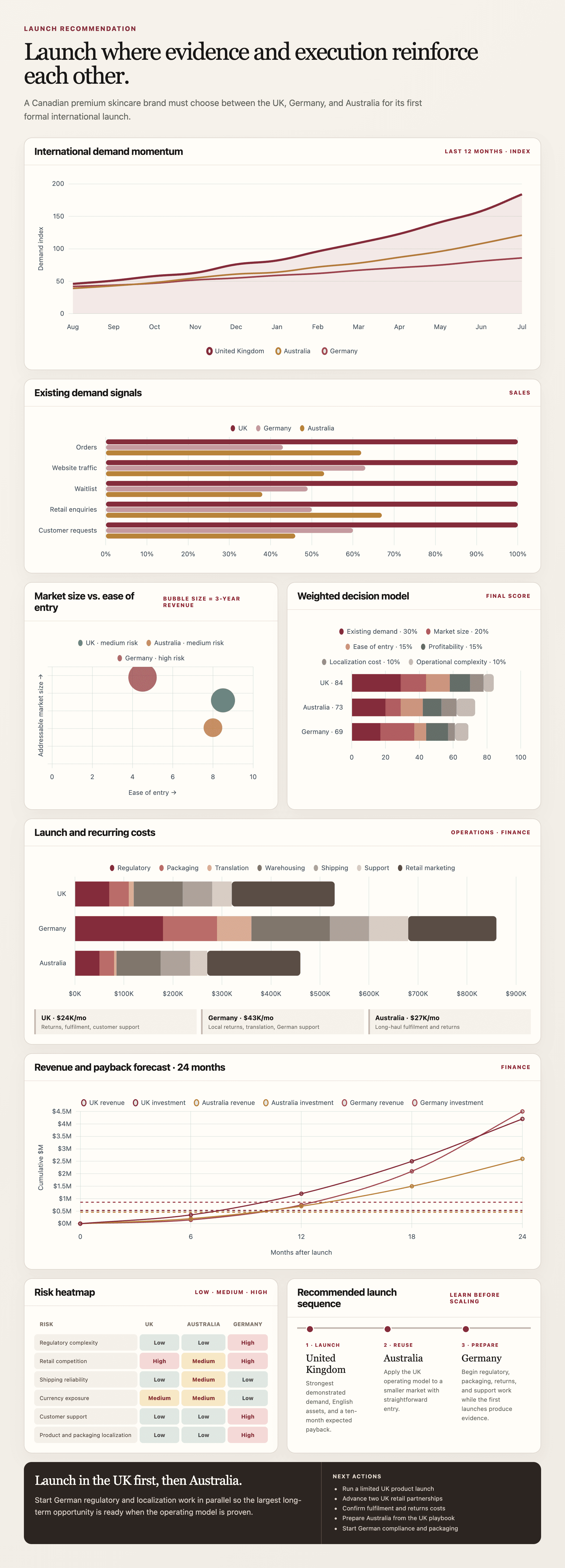
How AI can help without creating a new group anchor
AI is useful for widening the option set, identifying assumptions, finding counterarguments, and structuring evidence. It becomes risky when one answer is treated as the group’s neutral starting point.
Use AI in three passes:
- Independent expansion: each teammate asks an agent to extend or challenge their domain view.
- Cross-examination: agents identify contradictions, missing evidence, and stakeholder impacts across the collected views.
- Synthesis after comparison: the team asks for clusters or trade-offs only after original contributions remain visible.
Boardblend is designed around that sequence. Each teammate can bring an AI agent that already understands their work, while the group shares one visual canvas. AI contributes to the team’s context without replacing distinct human perspectives with one assistant’s first answer.
A quick facilitator checklist
Before the session:
- Is the decision specific?
- Are constraints and decision rights explicit?
- Will people have time to think independently?
- Can each function contribute evidence in parallel?
Before convergence:
- Did the leader delay their preference?
- Did the group develop more than one viable alternative?
- Were criteria agreed before scoring?
- Did someone test the emerging favourite?
Before closing:
- Is the rationale recorded?
- Are dissent and uncertainty visible?
- Is there an owner, next action, and review trigger?
The goal is not disagreement for its own sake. It is confidence that agreement survived independent thought.
Put the safeguards into practice with the seven-step AI brainstorming workshop, then use the human-led AI decision framework to challenge evidence and preserve the final rationale.
COMMON QUESTIONS
Frequently asked questions
What is a simple example of groupthink at work?
A product team agrees with the first feature proposed by its leader, even though several members privately see customer, design, or technical risks. The apparent consensus reflects social pressure and anchoring rather than independent agreement.
What are the main warning signs of groupthink?
Common signs include unusually fast agreement, few alternatives, self-censorship, pressure on dissenters, confidence without evidence, and a decision record that contains no risks or minority views.
Does groupthink mean a team should avoid consensus?
No. Consensus can be a useful outcome. The risk is premature consensus reached before people have contributed independent information, challenged assumptions, and compared alternatives against explicit criteria.
How can a facilitator reduce groupthink during brainstorming?
Ask people to think independently before discussion, collect contributions in parallel, delay the leader’s opinion, assign a challenger, evaluate ideas against shared criteria, and record unresolved concerns with the final decision.
Can AI make groupthink worse?
Yes. If everyone sees the same AI answer first, it can become a powerful anchor. AI is safer when teammates use it to develop or challenge independent perspectives before the group combines and evaluates the results.
PUT IT INTO PRACTICE
Turn everyone’s thinking into one clear next step.
See how teams use Boardblend, or open a shared canvas and start now.