FREE TEMPLATE
Free OKR Template With Examples and Live Progress Tracking
A free OKR template with real examples. Set objectives with measurable key results, owners and status, and track progress live as a team.
- Free, no sign-up
- Use ChatGPT, Claude or your own AI
- Up to 10 people
Try the example
Interactive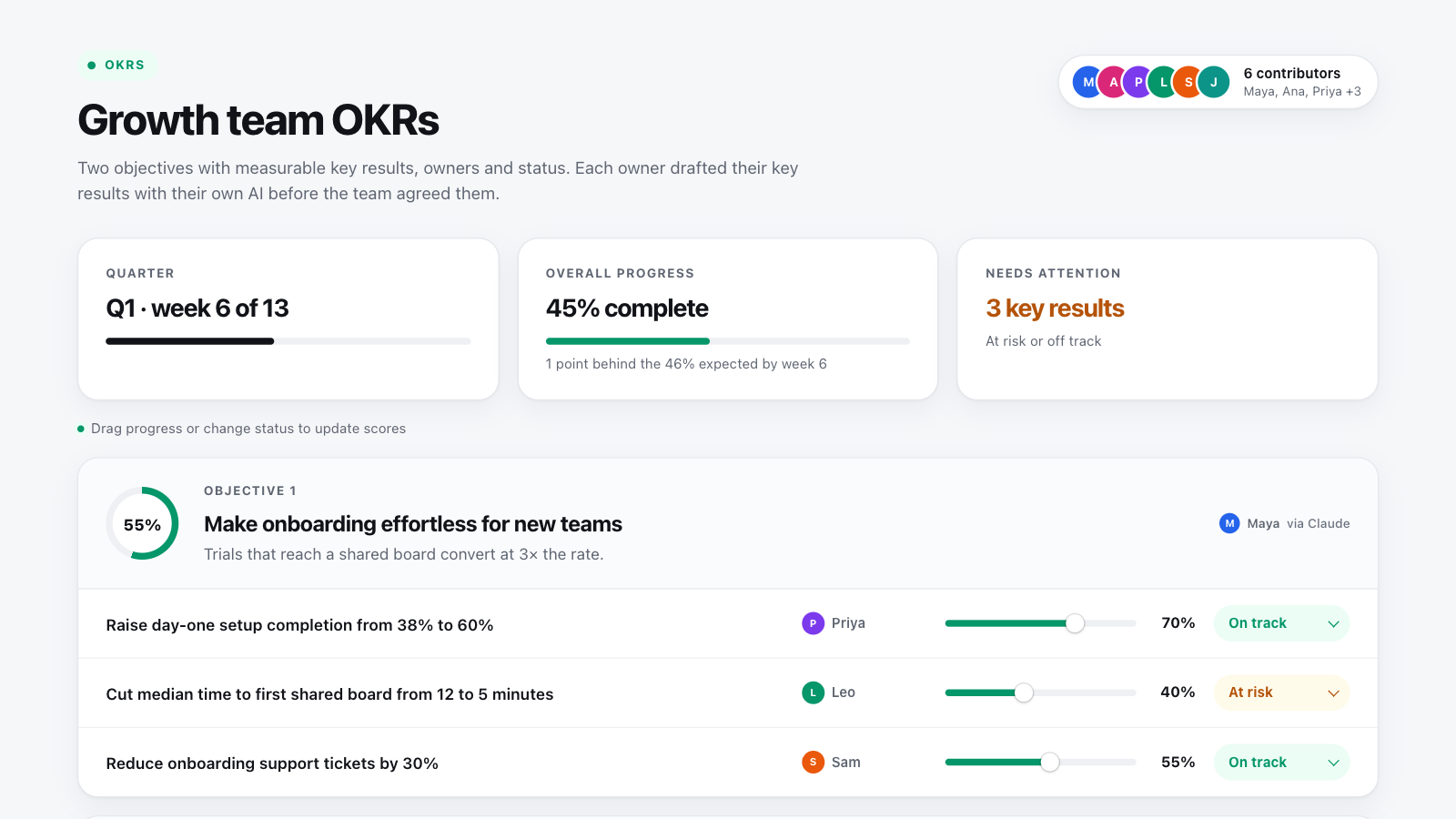
How to use this template in Boardblend
Open it as a live board
One click opens a ready-made board with every section laid out and empty. No account needed.
Connect your AI
Each person connects their own assistant to research and draft privately.
Decide together
Invite up to 10 people, agree the final version, then export it as a PDF or PNG.
OKRs—objectives and key results—give a team a short list of ambitious goals and a measurable way to know whether it reached them. The objective says where you're going; the key results prove you got there.
The example above shows a growth team's quarterly OKRs. It is interactive: drag a key result's progress or change its status, and the objective scores, overall progress and "needs attention" count update instantly.
Anatomy of the OKR template
| Part | What it is | Example |
|---|---|---|
| Objective | A qualitative, motivating goal | Make onboarding effortless for new teams |
| Why it matters | The reason this objective, this quarter | Trials that reach a shared board convert at 3× the rate |
| Key result | A measurable outcome with a baseline and target | Raise day-one setup completion from 38% to 60% |
| Owner | One person accountable for the key result | Priya |
| Progress | Movement toward the target, 0–100% | 70% |
| Status | On track, at risk or off track | At risk |
OKR examples by team
| Team | Objective | Example key result |
|---|---|---|
| Product | Make onboarding effortless for new teams | Raise day-one setup completion from 38% to 60% |
| Growth | Turn every active team into a source of new teams | Grow invited teammates per trial from 1.4 to 2.5 |
| Sales | Build a predictable mid-market pipeline | Increase qualified opportunities from 20 to 35 a month |
| Engineering | Make releases boring | Cut change failure rate from 18% to under 8% |
| People | Help new hires become productive faster | Reduce time to first shipped project from 6 to 3 weeks |
How to write good key results
- Measure outcomes, not tasks. "Launch the new wizard" is a task. "Raise setup completion to 60%" is an outcome.
- Include a baseline. "From 38% to 60%" shows ambition and makes progress clear.
- Keep them few. Two to five per objective.
- Make one person the owner. Shared ownership usually means no ownership.
- Make them ambitious but credible. If you're certain to hit every key result, they're too easy.
How to run an OKR planning session
- Agree the objectives (20 minutes). Start from strategy and last quarter's results. Limit the team to one to three.
- Draft key results privately (before or during the session). Each owner drafts measurable key results. In Boardblend each person can ask their own AI to sharpen wording, suggest baselines from their data or flag key results that are really tasks.
- Compare and challenge (20 minutes). Discuss whether each key result truly proves the objective. Look for missing perspectives—customer, quality, cost.
- Commit (10 minutes). Confirm owners and how you'll check progress.
Share and download your OKRs
Keep the board as the team's live OKR tracker: owners drag progress and change status each week, and the overall score updates for everyone. For a quarterly review or all-hands, export it as a PDF or PNG.
Tracking OKRs during the quarter
Update progress and status weekly. The status matters more than the percentage: a key result at 40% in week six may be on track, while one at 60% may be at risk if progress has stalled. Spend check-ins on at-risk and off-track key results only.
At the end of the quarter, score each key result, discuss what you learned in a lessons learned review, and carry unfinished priorities into the next set of OKRs deliberately rather than by default.
Choosing what makes the cut
Most teams have more candidate objectives than capacity. Score the candidates in a decision matrix or use the approach in our feature prioritization guide before committing. Your OKRs should also reflect the goals in your team charter.
COMMON QUESTIONS
Frequently asked questions
What does OKR stand for?
OKR stands for Objectives and Key Results. An objective is a qualitative goal that describes what you want to achieve; key results are two to five measurable outcomes that show whether you achieved it.
What is a good OKR example?
Objective: Make onboarding effortless for new teams. Key results: raise day-one setup completion from 38% to 60%; cut median time to first shared board from 12 to 5 minutes; reduce onboarding support tickets by 30%.
How many OKRs should a team have?
One to three objectives per quarter, each with two to five key results. Fewer, sharper OKRs focus a team; long lists turn them into a task tracker.
How do you score OKRs?
A common approach scores each key result from 0 to 100% (or 0.0 to 1.0) based on progress toward its target, then averages them for the objective. Many teams treat 70% on an ambitious OKR as a good result.
Can I download this OKR template?
Yes. Start the live board, add your own objectives and key results, then export it as a PDF or PNG. The board stays live, so you can keep tracking progress there through the quarter.
What is the difference between OKRs and KPIs?
KPIs are ongoing health measures you monitor continuously. OKRs are time-bound goals for change. A KPI such as conversion rate often becomes a key result when the team commits to moving it this quarter.
RUN IT WITH YOUR TEAM
Start your OKR in one click.
Everyone brings their own AI, adds their thinking, and you agree the result together on one live canvas.
More free templates
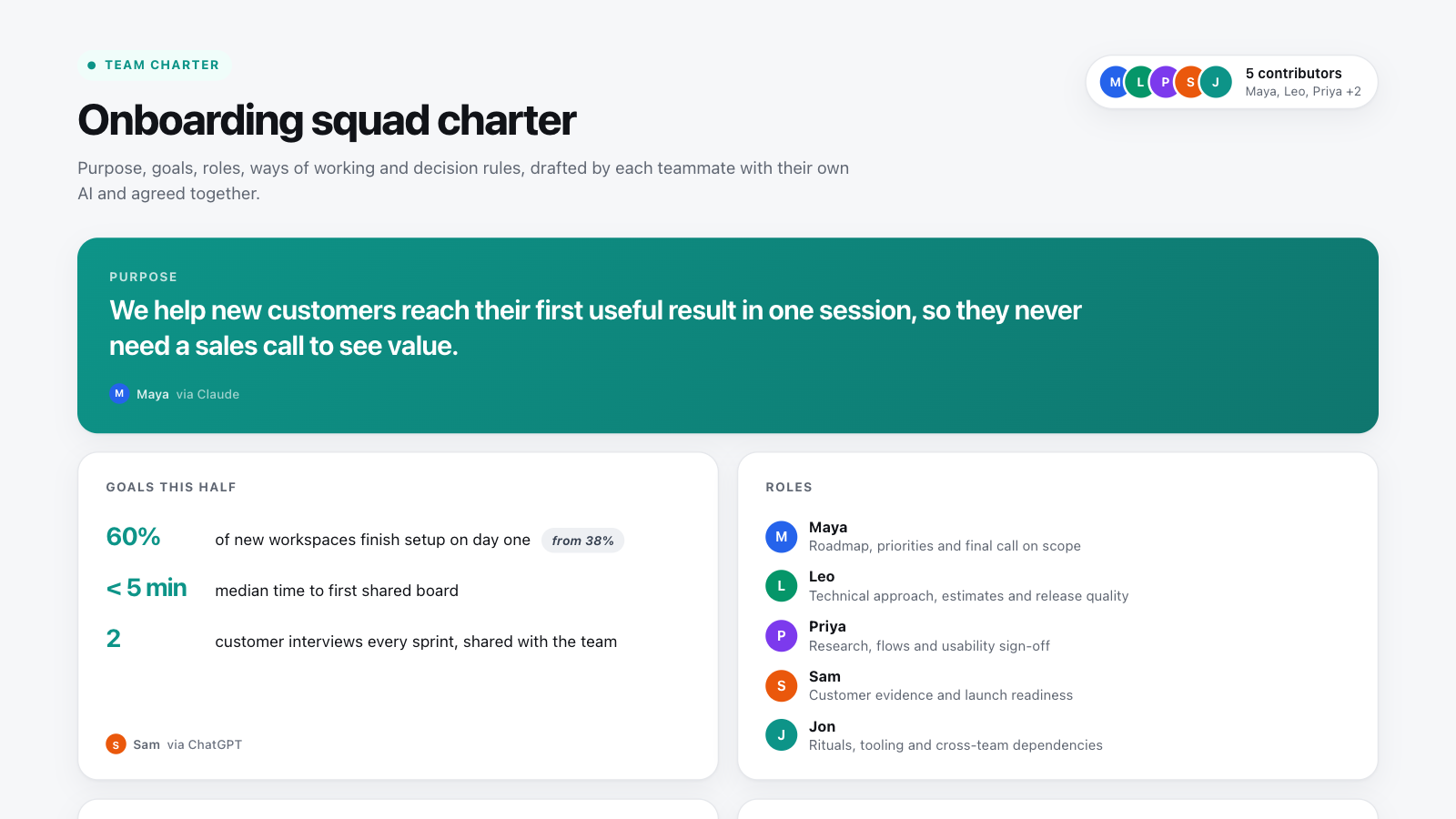
Team charter template
Agree purpose, goals, roles, ways of working and decision rules, then have everyone sign off.
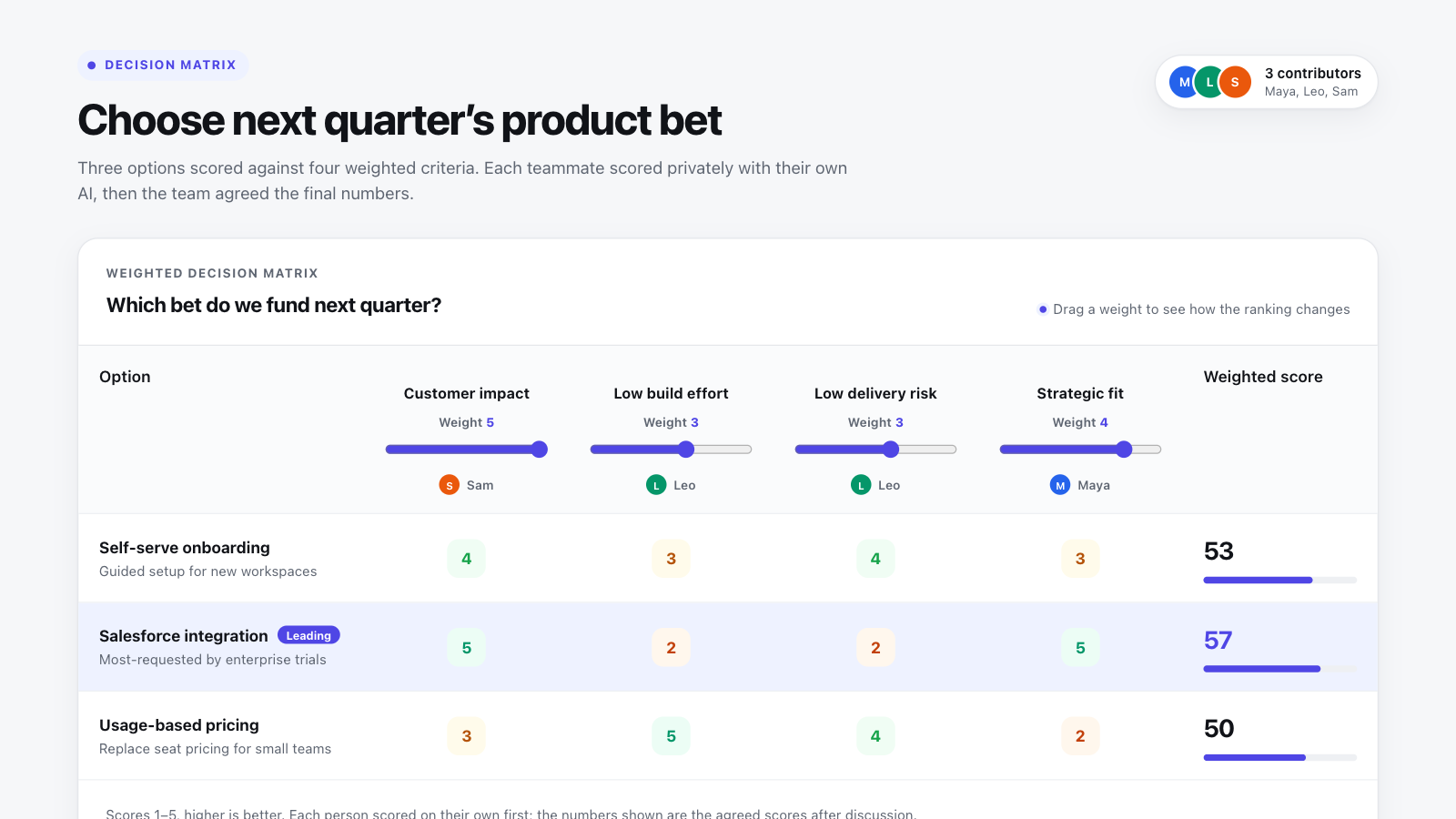
Decision matrix template
Score options against weighted criteria and see live which one wins, and how close it is.
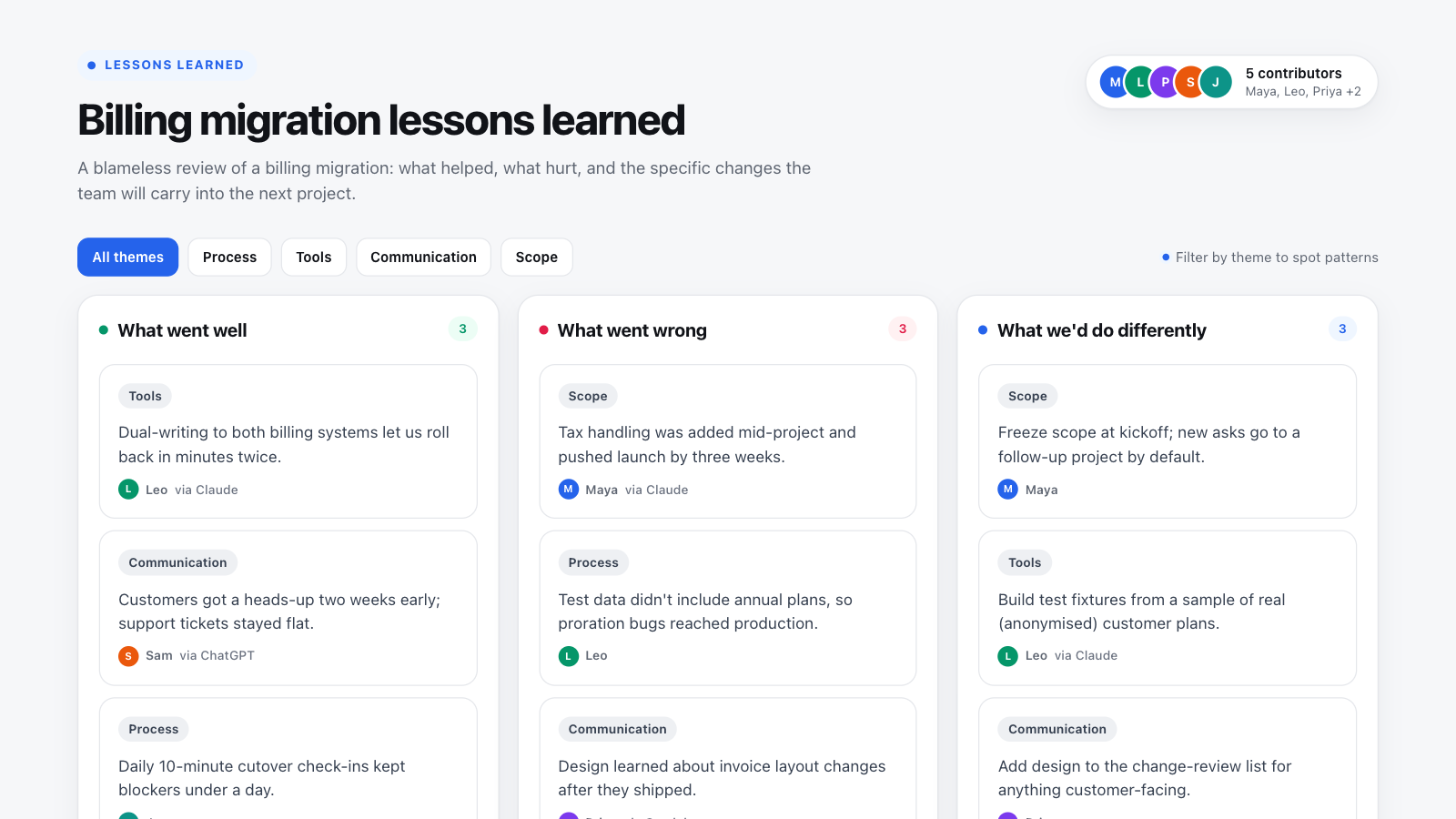
Lessons learned template
Capture what went well, what went wrong and what to change, with owners for every action.