FREE TEMPLATE
Free Pre-Mortem Template for Teams (With Example)
A free pre-mortem template with a worked example. Imagine the plan has failed, have everyone write why before discussing it, then rate the risks and change the plan.
- Free, no sign-up
- Use ChatGPT, Claude or your own AI
- Up to 10 people
Try the example
Interactive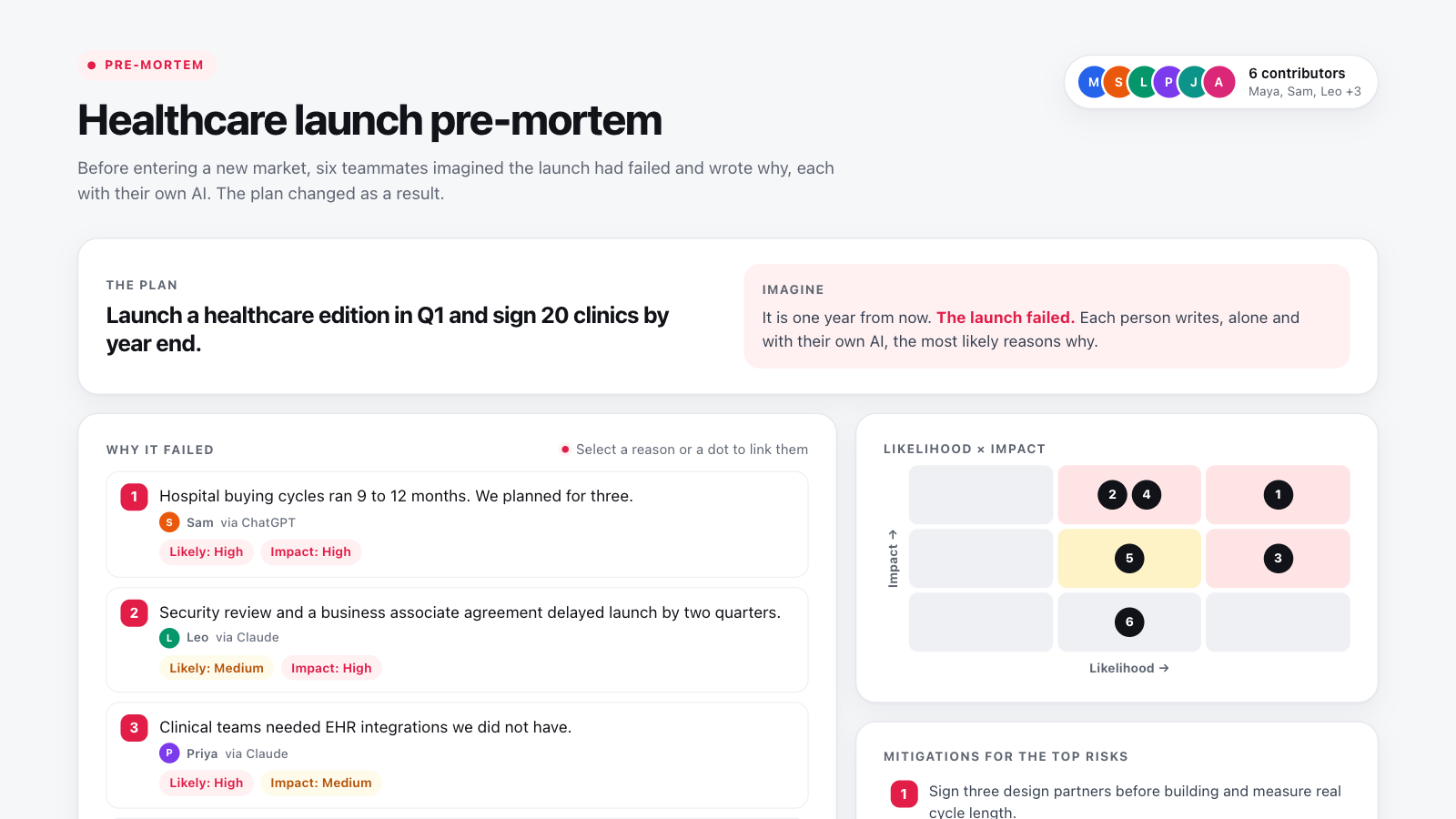
How to use this template in Boardblend
Open it as a live board
One click opens a ready-made board with every section laid out and empty. No account needed.
Connect your AI
Each person connects their own assistant to research and draft privately.
Decide together
Invite up to 10 people, agree the final version, then export it as a PDF or PNG.
A pre-mortem asks the team to imagine that a plan has already failed and to write down why, before anyone discusses it. Because failure is assumed, raising a concern becomes the task rather than a personal risk. It is one of the most effective ways to stop the first confident voice from setting the agenda.
The example above stress-tests a plan to enter the healthcare market. Select a reason or a dot on the matrix to link each risk to where it sits and to its mitigation.
The pre-mortem example, section by section
| Section | What the example shows |
|---|---|
| The plan | Launch a healthcare edition in Q1 and sign 20 clinics by year end |
| Why it failed | Six reasons from sales, engineering, design, strategy, finance and marketing, most found with each person's AI |
| Likelihood × impact | Where each reason sits, with the top risks in the red cells |
| Mitigations | Four actions that address the top risks |
| Minority view | A teammate's case for a different market, kept on record |
| What changed | A 90-day validation with design partners and a stop trigger |
How to run a pre-mortem
- State the plan. What you intend to do and what success looks like.
- Imagine failure. "It is a year from now. The plan failed." Make it vivid and certain.
- Write reasons alone. Ten minutes of silent writing. Each person can ask their own AI what failure would look like from their area. Write each reason as if it already happened.
- Share in parallel. Everyone posts at once so no reason is filtered by the first one heard.
- Rate and place. Agree each reason's likelihood and impact and place it on the matrix.
- Mitigate the top risks. One action per top reason: prevent it, detect it early or set a stop trigger.
- Decide what changes. Proceed, change or stop, with an owner. Keep minority views on record.
Give each participant this prompt:
Our plan is below. Imagine it is a year from now and the plan has failed. Using the context you have access to, list the most likely reasons it failed, written as if they already happened. Name the evidence behind each one and mark guesses as guesses.
Pre-mortem tips
- Assume failure, not risk. "Why did it fail?" draws better answers than "What could go wrong?"
- Protect the silent round. Discussion before writing brings back the anchoring the exercise exists to prevent.
- Invite the people furthest from the plan. Sales, support and finance often see failure modes the planners do not.
- Change something. A pre-mortem that changes nothing was probably not candid.
For more on why groups converge too early, see these groupthink examples. To record the final call and its review trigger, use a decision record, and after the project ends, run a lessons learned review.
COMMON QUESTIONS
Frequently asked questions
What is a pre-mortem?
A pre-mortem is a risk exercise run before a plan starts. The team imagines the plan has already failed and writes down why. Because failure is assumed, people raise concerns they would otherwise keep to themselves.
Who created the pre-mortem technique?
Psychologist Gary Klein described the pre-mortem in a 2007 Harvard Business Review article, "Performing a Project Premortem".
How does a pre-mortem reduce groupthink?
It makes dissent the task rather than a personal risk, and it asks for reasons independently before discussion, so the first confident voice does not set the agenda.
What is the difference between a pre-mortem and a post-mortem?
A post-mortem, or retrospective, examines a failure after it happens. A pre-mortem imagines the failure beforehand so the team can change the plan while it is still cheap to do so.
How long does a pre-mortem take?
Around 30 to 45 minutes: a few minutes to state the plan, ten minutes of silent writing, then time to share, rate, agree mitigations and decide what changes.
Should AI be used in a pre-mortem?
Yes, as long as each person writes their own reasons first or alongside their own AI. An AI with access to that person's context, such as sales data or the codebase, often finds failure modes the group would miss.
RUN IT WITH YOUR TEAM
Start your pre-mortem in one click.
Everyone brings their own AI, adds their thinking, and you agree the result together on one live canvas.
More free templates
Decision record template
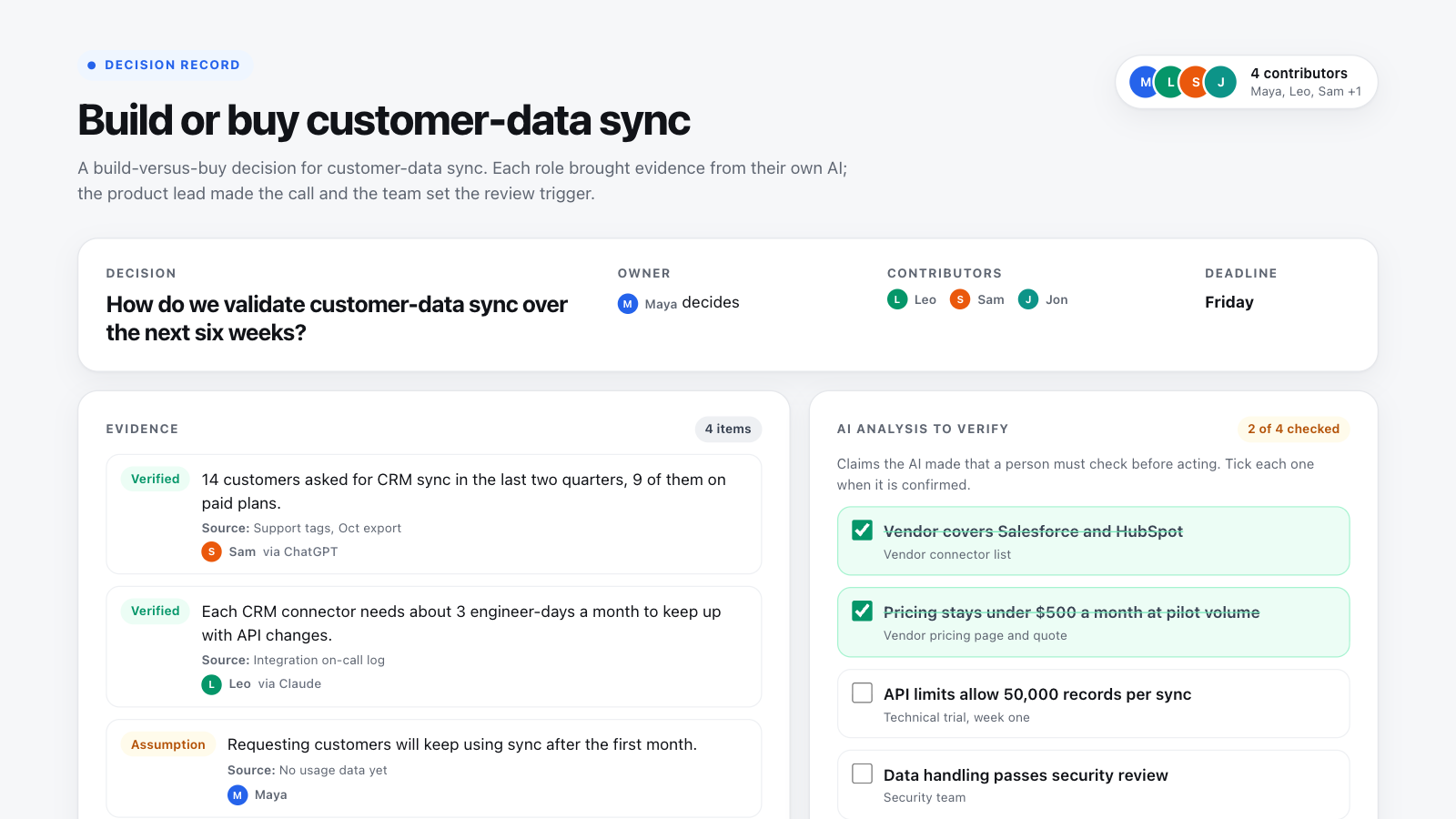
Record an AI-assisted decision: evidence, options, AI claims checked by a person, the call and its review trigger.
Decision matrix template
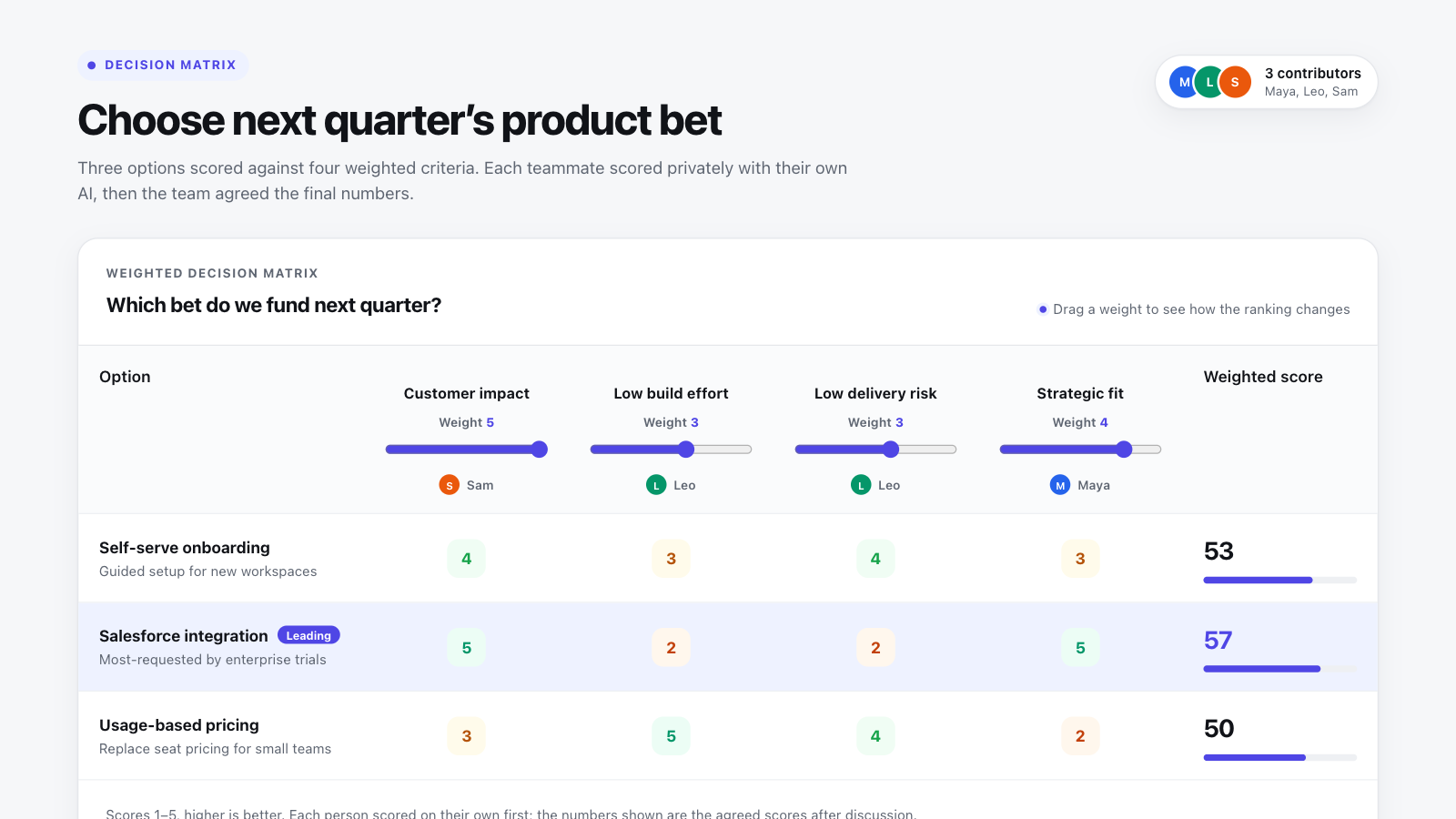
Score options against weighted criteria and see live which one wins, and how close it is.
Lessons learned template
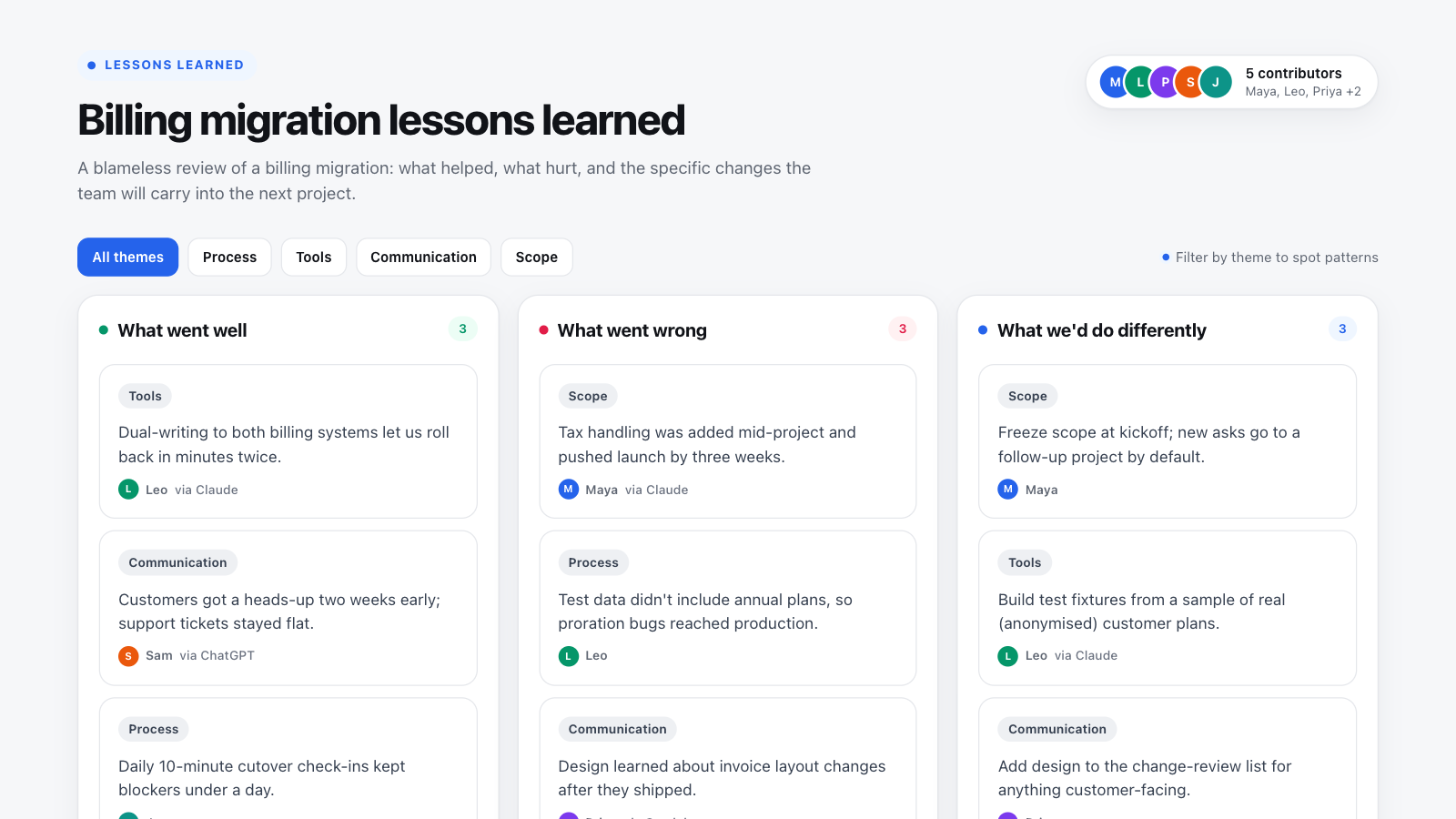
Capture what went well, what went wrong and what to change, with owners for every action.