FREE TEMPLATE
Free Mob Elaboration Template for AI-DLC (With Example)
A free mob elaboration template for AI-DLC with a worked example. Turn an intent into questions, risks, user stories, units of work and a first bolt as a team.
- Free, no sign-up
- Use ChatGPT, Claude or your own AI
- Up to 10 people
Try the example
Interactive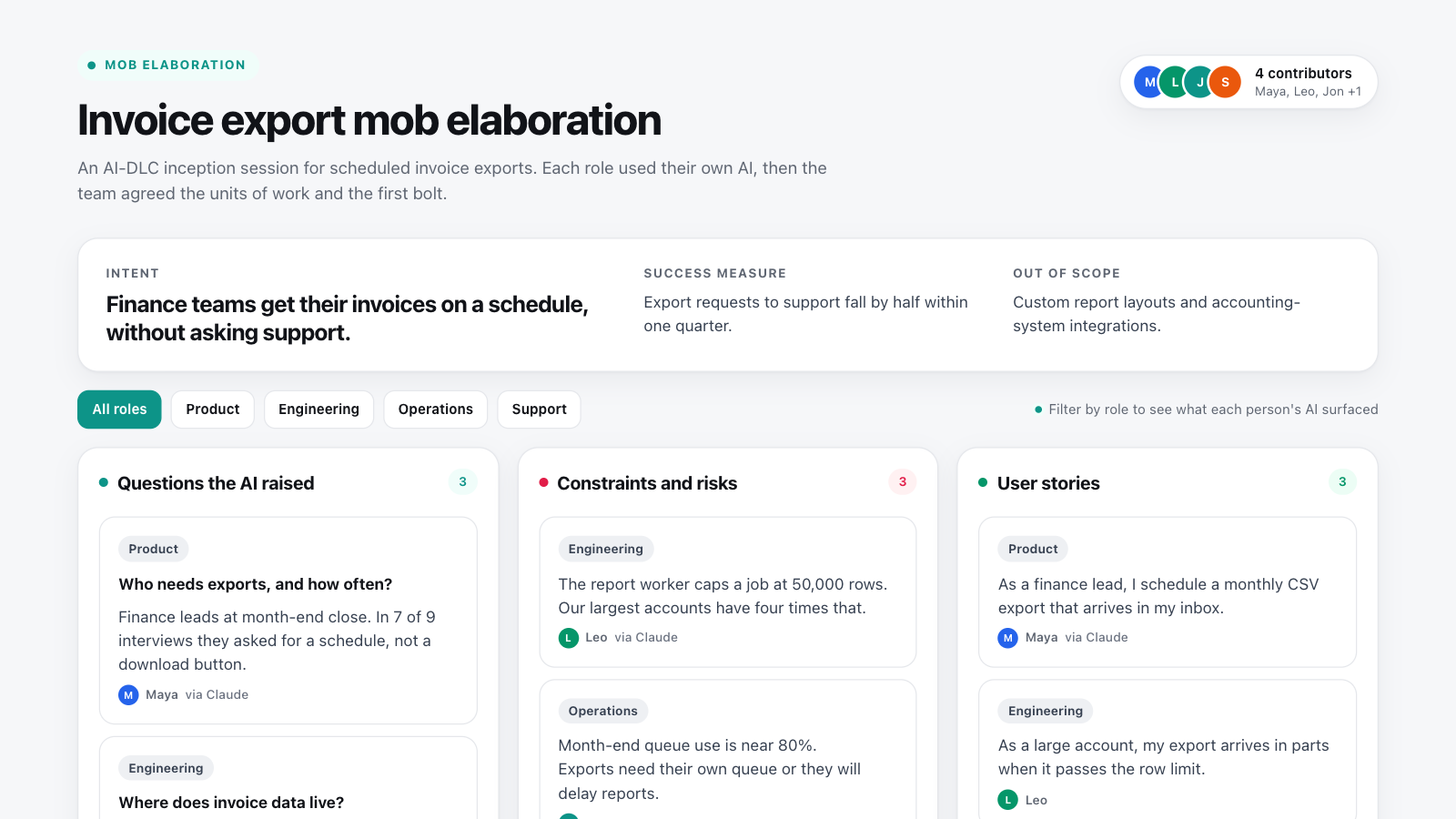
How to use this template in Boardblend
Open it as a live board
One click opens a ready-made board with every section laid out and empty. No account needed.
Connect your AI
Each person connects their own assistant to research and draft privately.
Decide together
Invite up to 10 people, agree the final version, then export it as a PDF or PNG.
Mob elaboration is the planning ritual at the start of AI-DLC, AWS's AI-Driven Development Lifecycle. The team states an intent, the AI asks questions and proposes user stories and units of work, and the whole team validates the result before anything is built.
The example above elaborates one intent: scheduled invoice exports for finance teams. Use the role filters at the top of the board to see what each person's AI surfaced. The engineer's AI found the row limit; the operations lead's AI found the month-end queue problem; neither would have appeared from the product owner's machine.
The mob elaboration example, section by section
| Section | What the example shows |
|---|---|
| Intent | Finance teams get their invoices on a schedule, without asking support |
| Questions the AI raised | Who needs exports, where invoice data lives, what else runs at month end |
| Constraints and risks | A 50,000-row job limit, a busy month-end queue, spreadsheet date formats |
| User stories | A scheduled export, exports delivered in parts, re-sending a past export |
| Units of work | Export read model, scheduled export job, schedule and delivery |
| First bolt | Two units, two days, a stated definition of done and one open concern |
Each contribution carries the role it came from. That attribution matters: a constraint read from the codebase should not be weighed like an opinion.
Mob elaboration template structure
The board you start has these sections laid out and empty:
| Section | Fill in | Who usually leads |
|---|---|---|
| Intent | Outcome, success measure, what is out of scope | Product owner |
| Questions the AI raised | The question, the answer and who answered | Whole team |
| Constraints and risks | Security, performance, compliance and operating limits, each with a source | Engineers, QA and operations |
| User stories | As a user, I do something so that an outcome happens | Product owner |
| Units of work | Scope, dependencies, owner and bolt | Engineers |
| First bolt | Units included, length, definition of done, approver and open concerns | Whole team |
When the session ends, export the board as a PDF or PNG, or keep it open as the record that construction starts from.
How to run a mob elaboration session
- Agree the intent. One sentence on the outcome, a success measure and what is out of scope. A vague intent produces vague stories.
- Explore privately for ten minutes. Each person asks their own AI what the intent means for their area. The engineer's AI reads the repository; the product owner's AI reads the research; the operations lead's AI reads the incident history.
- Add contributions to the board. Questions, constraints and candidate stories go in the matching column, each with its role and source.
- Compare and challenge. Look for where the role views disagree. Those disagreements are the decisions the session exists to make.
- Group stories into units of work. Give each unit a scope, its dependencies and one owner.
- Approve the first bolt. Choose the units, say what done means, and record who approved it and any open concern.
Give each participant this prompt for the private round:
Here is our intent. From my role's point of view and using the context you have access to, list the questions that must be answered before planning, the constraints and risks the team may not know about, and a first set of user stories or units of work. Name the source for each factual claim and mark anything you are unsure of as unknown.
Mob elaboration best practices
- Collect before you converge. If the group reads one AI's proposal first, it anchors everyone. A private round keeps each role's view intact.
- Require a source for every constraint. "The worker caps jobs at 50,000 rows" is checkable; "exports might be slow" is not.
- Keep units small enough to review. AI drafts faster than people verify. A unit the team cannot review in one sitting is too large.
- Record who approved. AI-DLC depends on people validating the plan. Name the approver on the board.
- Do not skip non-functional requirements. Security and operating limits are more expensive to fix after construction starts.
Mob elaboration, prioritization and decisions
Mob elaboration often ends with more units than the first bolt can hold. A feature prioritization session helps the team choose, and a decision matrix makes the criteria explicit when role views disagree. For the full method, including the phases, bolts and mob construction, see the AI-DLC guide.
COMMON QUESTIONS
Frequently asked questions
What is mob elaboration?
Mob elaboration is the inception ritual in AWS's AI-Driven Development Lifecycle (AI-DLC). The whole team validates the AI's questions and proposals, turning a business intent into requirements, user stories and units of work.
Who should attend a mob elaboration session?
Everyone whose knowledge changes the plan. That usually means a product owner, the engineers who will build it, and someone from QA, operations or support. A plan approved by one role alone brings the handoffs back.
How long does mob elaboration take?
It depends on the size of the intent. A contained intent can be elaborated in one working session; a larger one should be split into smaller intents first so each session ends with approved units of work.
What is the output of mob elaboration?
An approved record containing the intent, the answered questions, constraints and risks, user stories, units of work with owners and dependencies, and the plan for the first bolt.
What is the difference between mob elaboration and backlog refinement?
In backlog refinement people write and size the stories. In mob elaboration the AI drafts the questions, stories and units, and the team's job is to answer, correct and approve them together in one session.
Can you run mob elaboration remotely?
Yes. Use a shared board and a call so everyone sees the same plan. Have each role add questions and evidence privately first, then discuss the differences as a group.
RUN IT WITH YOUR TEAM
Start your mob elaboration in one click.
Everyone brings their own AI, adds their thinking, and you agree the result together on one live canvas.
More free templates
Decision matrix template
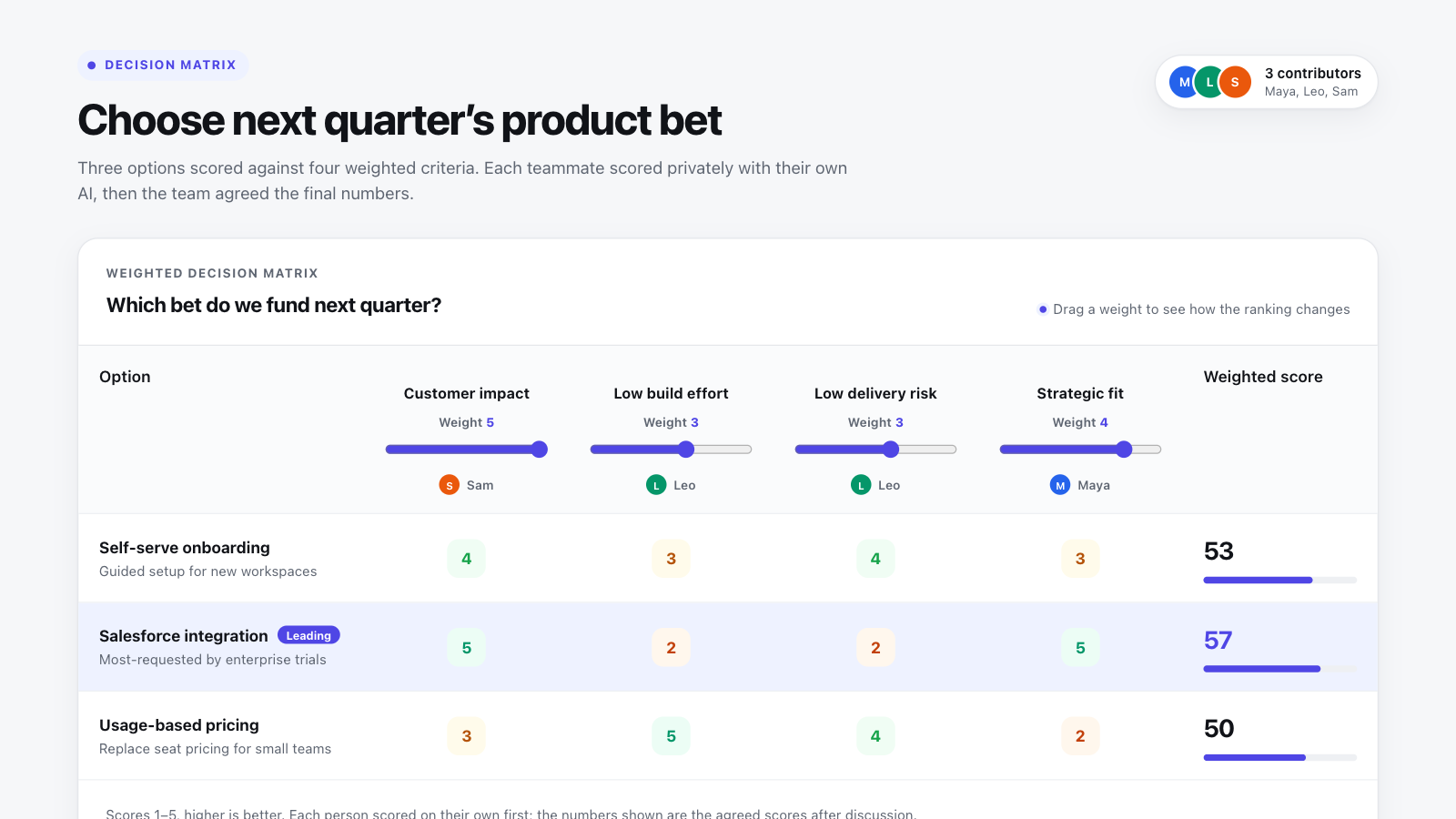
Score options against weighted criteria and see live which one wins, and how close it is.
Brainstorming template
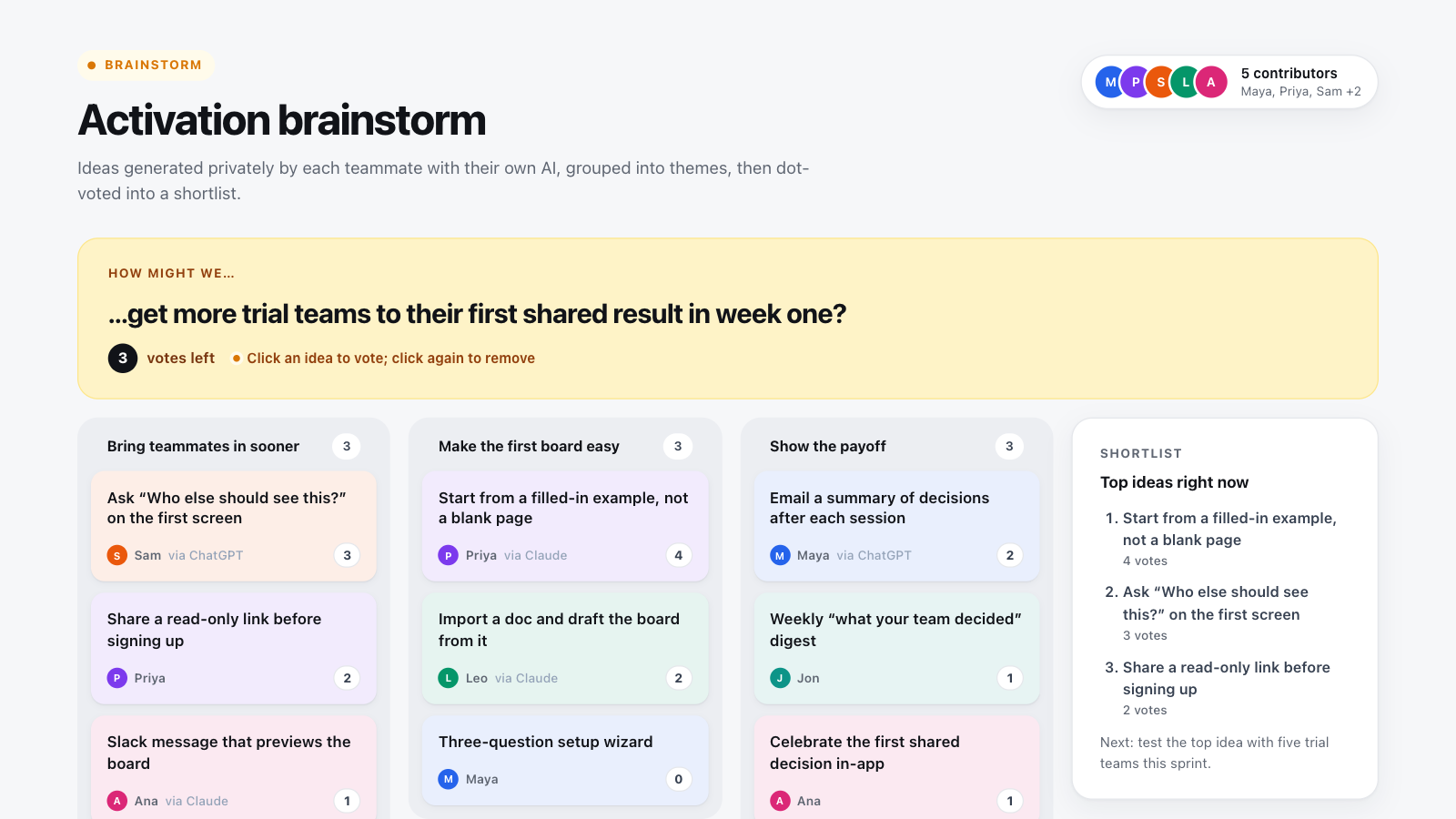
Generate ideas independently, cluster them into themes and dot-vote a shortlist.
Team charter template
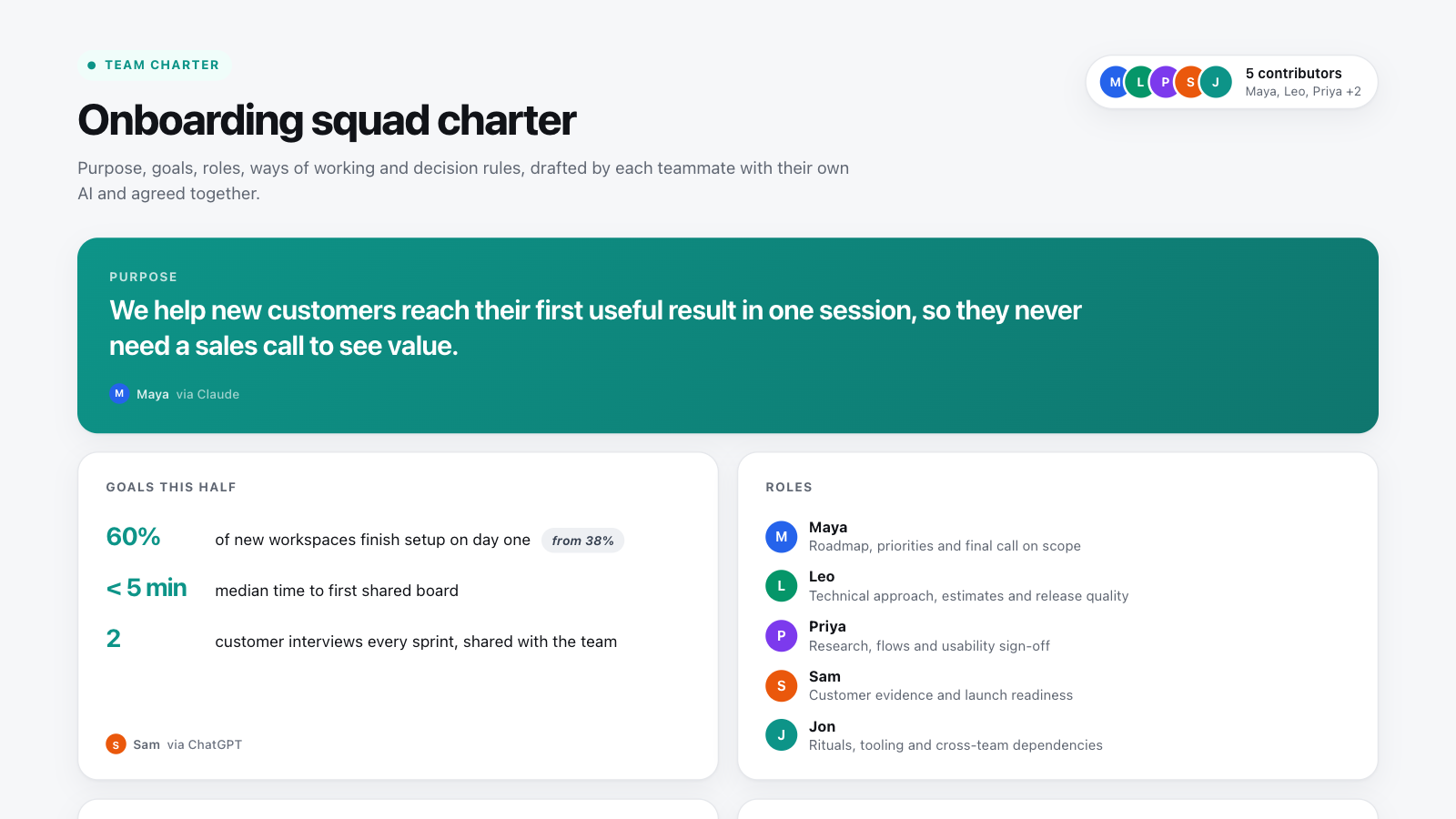
Agree purpose, goals, roles, ways of working and decision rules, then have everyone sign off.