PRACTICAL GUIDE
AI-DLC (AIDLC) by AWS: Phases, Bolts and a Free Template
AI-DLC (AIDLC) is AWS's AI-Driven Development Lifecycle. Learn its phases and bolts, then run your first mob elaboration with a free template for the whole team.
- Free, no sign-up
- Each person brings their own AI
- Up to 10 people
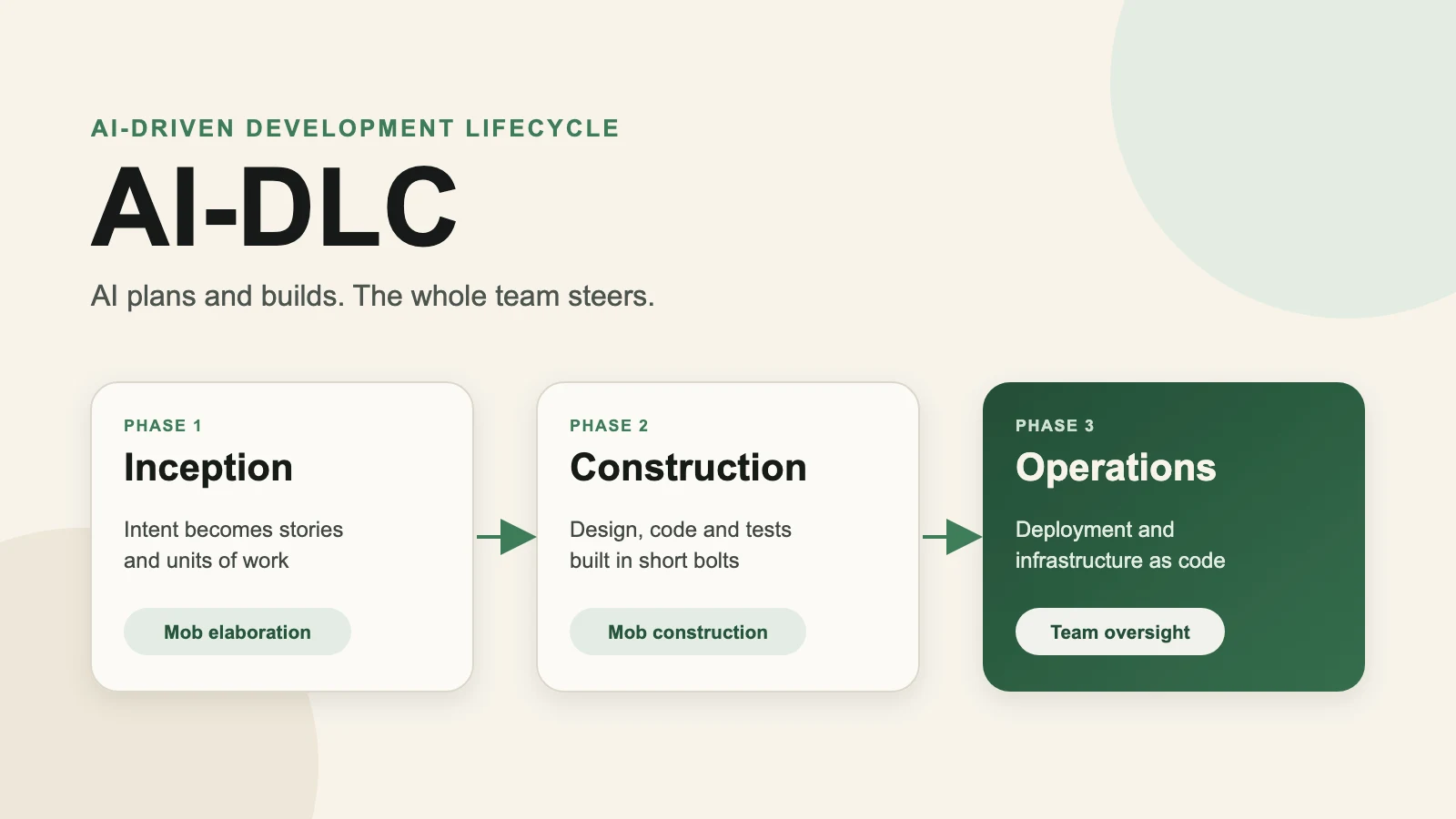
AI-DLC, also written AIDLC, is the AI-Driven Development Lifecycle: a way of building software in which AI drafts the plan, the design and the code, and a cross-functional team validates every step. AWS introduced it in July 2025. It replaces sprints with shorter cycles called bolts and has the whole team validate the AI's questions and proposals in a ritual called mob elaboration.
The fastest way to understand AI-DLC is to run one mob elaboration. This guide explains the method, then gives you a free board to run that first session, with product, engineering and QA each bringing their own AI.
What is AI-DLC (AIDLC)?
Raja SP, a Principal Solutions Architect at AWS, introduced the methodology in the post AI-Driven Development Life Cycle: Reimagining Software Engineering. Its argument is that adding an AI assistant to an existing process wastes most of what the AI can do. AI-DLC rebuilds the process around the AI and keeps people in control of the decisions.
Two ideas define it:
- The conversation is reversed. A person states an intent. The AI proposes a plan, asks clarifying questions and carries out the work, seeking approval as it goes.
- Decisions happen together, in real time. The team reviews the AI's proposals in one session, which reduces the handoffs between separate planning, design and build stages.
AWS says product owners, architects and developers can finish in hours or days tasks that previously took weeks, and that developers gain deeper business context with less cognitive load. Those are AWS's descriptions of the method, not independently measured results.
The three phases of AWS AI-DLC
| Phase | What the AI does | What the team does |
|---|---|---|
| Inception | Turns a business intent into requirements, user stories and units of work | Validates the AI's questions and proposals in mob elaboration |
| Construction | Proposes the architecture, domain model, code and tests | Clarifies technical and architectural decisions in mob construction |
| Operations | Manages infrastructure as code and deployments | Oversees deployments |
Context carries forward. The AI stores plans, requirements and design artifacts in the project repository, so each phase starts from what the previous one decided.
The open-source aidlc-workflows implementation splits the work into more phases and stages. The three above are the method as AWS introduced it.
What is mob elaboration?
Mob elaboration is the AI-DLC inception ritual in which the whole team validates the AI's questions and proposals, turning a business intent into requirements, user stories and units of work. Every later step builds on what it produces, so it is where the method succeeds or fails.
- State the intent. One or two sentences on the outcome and how the team will know it worked.
- Let the AI ask questions. The AI lists what it needs to know before it can plan. The team answers together.
- Review the proposed stories and units. The AI breaks the intent into user stories and units of work. The team corrects scope, order and acceptance criteria.
- Add risks and non-functional requirements. Security, performance, compliance and operating limits.
- Approve and plan the first bolt. People approve the units. Construction starts from the approved record.
Whose AI runs mob elaboration?
AWS describes what the team does in mob elaboration, not whose AI runs it. The aidlc-workflows rules run inside one coding agent, so in practice the session often runs from one person's machine. That AI knows only what that person's setup can reach.
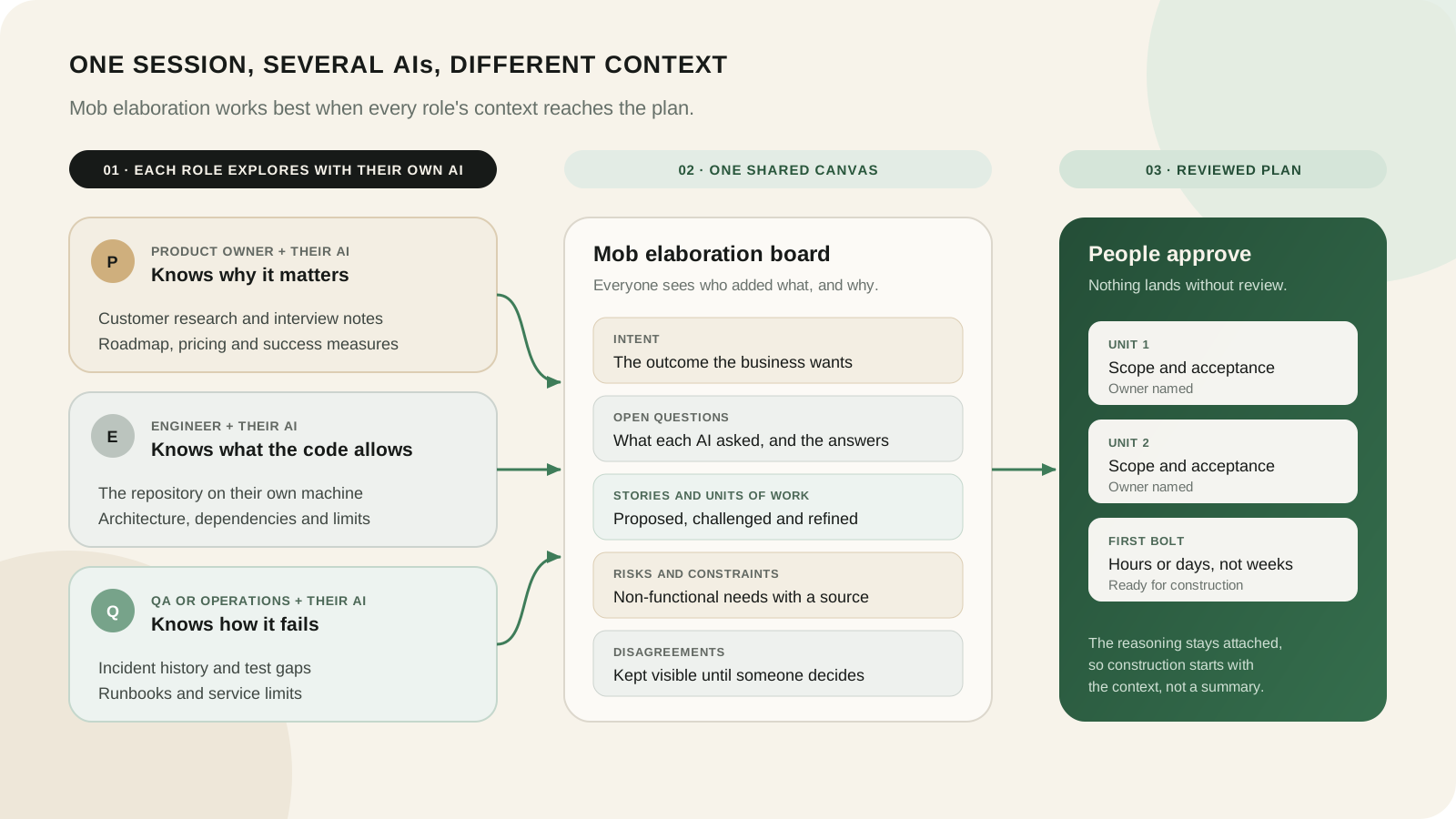
In a real team, the useful context is spread out:
- The engineer's AI can read the repository, the architecture and the dependency limits on the engineer's own machine.
- The product owner's AI has the customer research, interview notes, roadmap and success measures.
- The QA or operations lead's AI has the incident history, the test gaps and the runbooks.
If only the engineer's AI drives, the stories are technically sound and may miss why customers asked. If only the product owner's AI drives, the plan matches demand and may collide with the codebase. The team then relays context by voice, and the first confident proposal tends to win. That is the same pattern behind many groupthink examples.
How to run mob elaboration with each person's own AI
This version keeps the AI-DLC steps and adds a short private round before the group converges, the same principle as our AI brainstorming workshop.
- Open the board and share the intent. Start the mob elaboration template, invite the team and write the intent where everyone sees the same wording.
- Explore privately for ten minutes. Each person asks their own AI what the intent means for their area: questions, risks, constraints and a first cut of stories. Nothing is shared yet. The prompt below works for every role.
- Bring contributions to the board. Each person adds what the group needs to see, with a source. Contributions stay attributed, so a constraint from the codebase is not mistaken for an opinion.
- Compare and challenge. Look for places where the role views disagree. Those are the decisions the session exists to make.
- Agree the units and the first bolt. A named owner approves the final record.
Give each participant this prompt for the private round:
Here is our intent. From my role's point of view and using the context you have access to, list the questions that must be answered before planning, the constraints and risks the team may not know about, and a first set of user stories or units of work. Name the source for each factual claim and mark anything you are unsure of as unknown.
The same evidence-first approach is described in our guide to AI-assisted decision making. When role views disagree on which option to take, a decision matrix makes the criteria explicit. If the session ends with more units than one bolt can hold, a feature prioritization session helps the team choose.
In Boardblend, each participant connects their own AI to the session, such as Claude Code, Claude Desktop, Codex or ChatGPT. They explore privately, then propose changes to the shared canvas. The session leader reviews each proposed change before it is accepted, so the plan never changes without a person agreeing. Up to ten people can join, and starting a board needs no sign-up.
Worked example: scheduled invoice exports
This is an illustrative example, the same one used in the template. The intent is: finance teams get their invoices on a schedule, without asking support.
| Role | What their AI surfaced | Effect on the plan |
|---|---|---|
| Product | Interview notes show finance leads want a monthly schedule, not a download button | The first story becomes a scheduled export |
| Engineering | Invoice data sits in two services, and the report worker caps a job at 50,000 rows | A read-model unit is added, and exports are split into parts |
| Operations | The report queue already peaks at month end, and an earlier export job timed out | Exports get their own queue |
| Support | Customers open exports in a spreadsheet and ask for past files again | Unambiguous dates and a re-send story are added |
A single AI run from the engineer's machine would probably have found the row limit and missed the schedule. Run from the product owner's machine, it would have found the schedule and missed the queue. The team approved three units and put the read model and the export job into the first bolt.
AI-DLC terms: intent, unit, bolt and mob
| Term | Meaning | Closest agile term (our mapping) |
|---|---|---|
| Intent | The business outcome the team wants | Goal or initiative |
| Unit of work | A set of tasks that delivers part of the intent | Epic |
| Bolt | A work cycle measured in hours or days | Sprint |
| Mob elaboration | The team and AI turn an intent into stories and units | Backlog refinement and sprint planning |
| Mob construction | The team and AI design, build and test together | Development and review |
AWS itself maps only two of these: units of work replace epics, and bolts replace sprints.
AI-DLC vs agile
AI-DLC does not discard agile. It keeps short feedback loops, frequent validation and working software, and changes who drafts the work and how long a cycle lasts.
| Agile | AI-DLC | |
|---|---|---|
| Who drafts plans and code | People, with AI assisting | AI, with people validating |
| Cycle length | Sprints of one to four weeks | Bolts of hours or days |
| Planning | Refinement, planning and review meetings | Mob elaboration with the whole team |
| Handoffs | Between product, design, engineering and QA | Fewer; roles decide together |
| Main human skill | Producing the work | Steering and verifying the work |
AI-DLC vs AI SDLC
"AI SDLC" is the general term for using AI anywhere in a software development lifecycle, such as code completion, test generation or review. AI-DLC is one specific, named method with its own phases, rituals and vocabulary.
Where spec-driven development fits
Spec-driven development has an AI work from a written specification instead of a string of prompts. In AI-DLC, the requirements, stories and units agreed in inception play that role: construction starts from an approved record, not from a conversation.
What is mob construction?
Mob construction is the construction-phase ritual. The AI proposes a logical architecture, domain model, code and tests for a unit of work, and the team clarifies technical and architectural decisions in real time. It builds on the record from mob elaboration, so a question left open in inception returns here as rework. Teams usually run it per bolt: agree the design, let the AI build, then verify the result against the unit's acceptance criteria before the next bolt starts.
AIDLC workflow: how to start with aidlc-workflows
- Start with one intent. Pick a contained piece of work with a clear outcome, not a whole roadmap.
- Try the open-source rules. AWS Labs publishes aidlc-workflows, steering rules that guide a coding agent through the method and stop at approval gates. They work in Claude Code, Cursor, Codex CLI, GitHub Copilot, Kiro and opencode.
- Put the whole team in the first session. The method depends on product, engineering and QA validating together. A plan that one role approves alone brings the handoffs back.
- Keep the record. Store the approved intent, stories, units and open concerns where construction can use them.
Risks and limits of AI-DLC
- Rubber-stamped approvals. When the AI produces a plan in minutes, reviewing it properly feels slow, and approval becomes a formality. Ask each role to name one thing they checked.
- Review becomes the bottleneck. AI can draft faster than people can verify. Keep units small enough to review in one sitting.
- One role's context dominates. The plan reflects whatever the driving AI could reach. Collect every role's input before discussing the AI's proposal.
- Missed non-functional requirements. Security and operating limits are more expensive to fix after construction starts.
- Bolts treated as short sprints. A bolt is sized by the unit of work, not by the calendar.
- Sensitive data in an unapproved AI. Each participant should use an AI service their organization has approved for the material involved.
AI-DLC moves the team's effort from writing to judging. The judging is only as good as the context in the session, which is why it is worth making sure every role, and every role's AI, can contribute before the plan is approved.
COMMON QUESTIONS
Frequently asked questions
What is AI-DLC (AIDLC)?
AI-DLC, also written AIDLC, stands for AI-Driven Development Lifecycle. It is a software methodology introduced by AWS in 2025 in which AI drafts the plans, requirements, design and code, and a cross-functional team validates each step. It has three phases, inception, construction and operations.
AI-DLC vs agile: does AI-DLC replace agile?
It changes the vocabulary and the pace more than the values. Sprints become bolts measured in hours or days, and epics become units of work. Short feedback loops, frequent validation and working software all remain.
What is mob elaboration in AI-DLC?
Mob elaboration is the inception ritual in AI-DLC. The whole team validates the AI's questions and proposals, turning a business intent into requirements, user stories and units of work.
What is mob construction in AI-DLC?
Mob construction is the construction-phase ritual in AI-DLC. The AI proposes architecture, code and tests, and the team clarifies technical and architectural decisions in real time.
What is a bolt in AI-DLC?
A bolt is the AI-DLC replacement for a sprint. It is a short, intense work cycle measured in hours or days rather than weeks, in which one or more units of work are built and verified.
Is AI-DLC the same as AI SDLC?
No. AI SDLC is a general term for using AI anywhere in a software development lifecycle. AI-DLC is one specific, named methodology from AWS with its own phases, rituals and vocabulary.
Do you need AWS tools to use AI-DLC?
No. AI-DLC is a methodology, not a product. The open-source aidlc-workflows rules from AWS Labs run in several coding agents, including Claude Code, Cursor, Codex CLI, GitHub Copilot and Kiro.
Can remote teams run mob elaboration?
Yes. The ritual needs the whole team to see and challenge the same plan at the same time, which a shared canvas and a call provide. Remote teams should have each role add questions and evidence before the group discussion starts.
RUN IT WITH YOUR TEAM
Run your first mob elaboration in one click.
Everyone brings their own AI, adds what it finds, and you agree the result together on one live canvas.