FREE TEMPLATE
Free Competitive Analysis Template (With Example)
A free competitive analysis template with a worked example. Compare rivals feature by feature, map positioning, find gaps and agree where your team can win.
- Free, no sign-up
- Use ChatGPT, Claude or your own AI
- Up to 10 people
Try the example
Interactive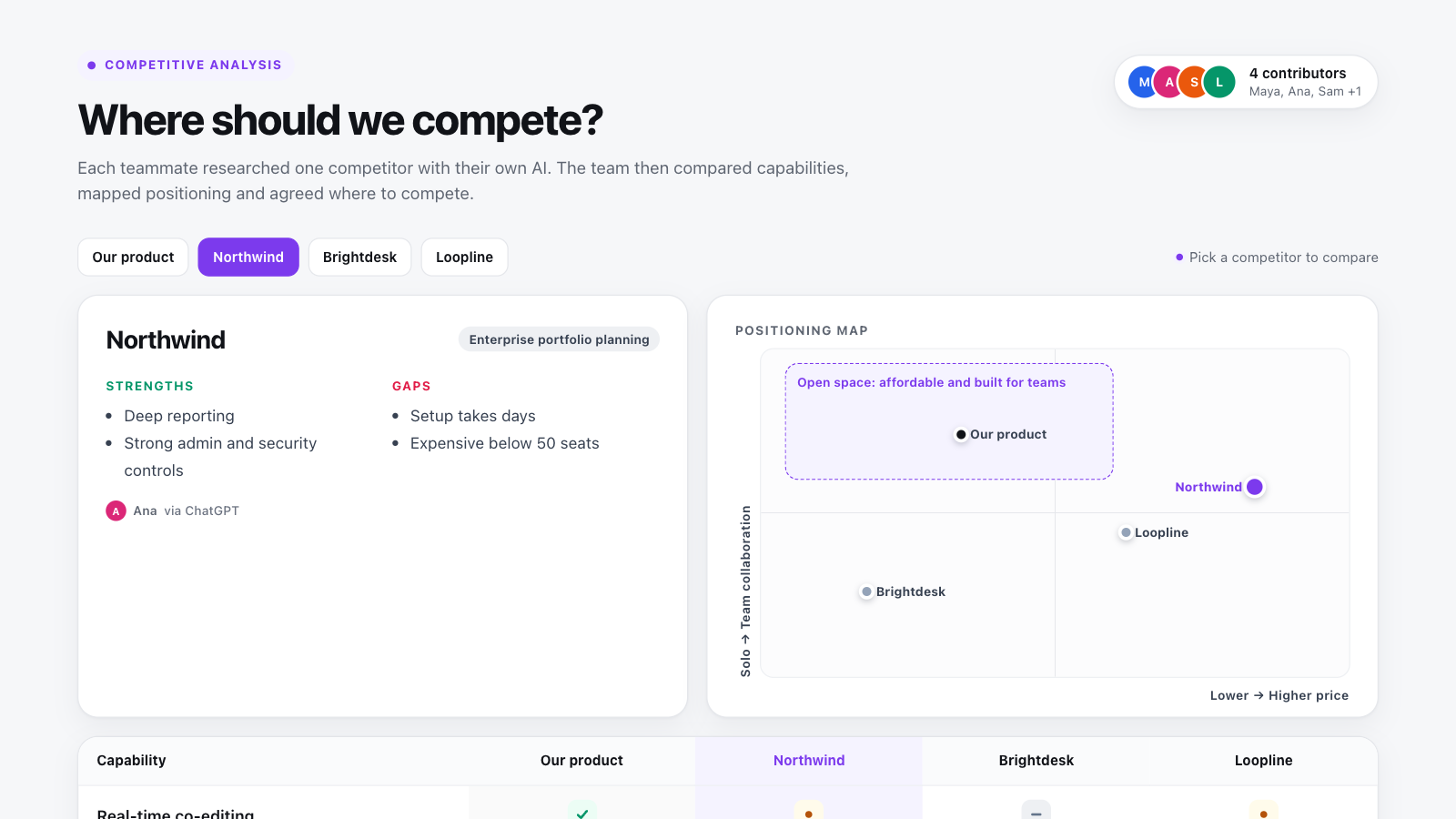
How to use this template in Boardblend
Open it as a live board
One click opens a ready-made board with every section laid out and empty. No account needed.
Connect your AI
Each person connects their own assistant to research and draft privately.
Decide together
Invite up to 10 people, agree the final version, then export it as a PDF or PNG.
A competitive analysis helps a team decide where it can win, not just list what rivals do. The most useful ones end with a clear position: what you'll be known for, which gaps you'll close, and which battles you'll deliberately avoid.
The example above compares a planning product with three fictional rivals. It is interactive: select a competitor to see its profile, highlight it on the positioning map and spotlight its column in the feature table.
What's in the competitive analysis template
Competitor profiles
For each competitor: who it is for, two or three real strengths and two or three gaps. Be fair. Underestimating a competitor's strengths is the most common way an analysis misleads.
Positioning map
Two axes that customers genuinely trade off—here, price and depth of collaboration. The dashed area marks open space no rival occupies: affordable and deeply collaborative. Choose axes from customer conversations, not from your own feature list.
Feature comparison
A capability table using three levels: strong, partial and missing, each with its own colour and mark. Compare the capabilities that drive buying decisions, not every feature.
Takeaway
One or two sentences on where you will compete and what you won't chase. In the example: own "fast to start, built for teams", close the feedback-inbox gap, and don't chase portfolio reporting.
Competitive analysis example
| Capability | Our product | Northwind | Brightdesk | Loopline |
|---|---|---|---|---|
| Positioning | Planning for small product teams | Enterprise portfolio planning | Simple roadmaps for solo PMs | All-in-one product suite |
| Real-time co-editing | Strong | Partial | Missing | Partial |
| Customer feedback inbox | Missing | Partial | Missing | Strong |
| Setup under 10 minutes | Strong | Missing | Strong | Missing |
| Portfolio reporting | Partial | Strong | Missing | Partial |
| Free plan | Partial | Missing | Strong | Partial |
Product competitive analysis template
For product teams, compare the capabilities buyers evaluate: core features, pricing tiers, integrations, onboarding time and roadmap signals from changelogs. Put your product in the first column and score each capability strong, partial or missing.
Marketing competitive analysis template
For marketing teams, swap the rows for messaging, target customer, channels, pricing-page positioning, content and SEO focus, and review sentiment. Change the map axes to price versus brand perception.
Download your competitive analysis
Fill in the board with your team, then use Export PDF or Export PNG to download a copy to share, print or attach to a document.
How to run a competitive analysis with your team
- Agree the competitors and criteria (10 minutes). Include at least one indirect alternative.
- Research in parallel (before the session). Assign one competitor per person. In Boardblend, each teammate can ask their own AI to summarize pricing pages, documentation, reviews and changelogs, then add a profile to the board with sources.
- Fill the comparison together (20 minutes). Discuss any cell where people disagree; that usually means a capability is poorly defined.
- Place everyone on the map (10 minutes). Debate the positions—this is where strategy conversations happen.
- Write the takeaway (15 minutes). Decide what you'll do differently. If several moves compete for resources, score them in a decision matrix.
Tips for an honest analysis
- Use customer language. Describe capabilities the way buyers do.
- Cite sources. A link next to each claim makes the analysis easy to trust and update.
- Include the "do nothing" option. Spreadsheets and email are often the real competitor.
- Revisit it. Markets move; a dated analysis is worse than none.
For broader context on comparing tools, see our Miro alternatives roundup, which uses the same approach of fair strengths and gaps. If the analysis shows a lost deal pattern you don't understand, run a 5 whys on it.
COMMON QUESTIONS
Frequently asked questions
What should a competitive analysis include?
A practical competitive analysis includes a short profile of each competitor (positioning, strengths and gaps), a feature or capability comparison, a positioning map showing how you differ, and a clear conclusion about where you will and won't compete.
How many competitors should you analyze?
Three to five is usually enough—your closest direct competitors plus one alternative customers use instead, such as a spreadsheet or an all-in-one suite. More than that makes the comparison shallow.
What is a competitive positioning map?
A positioning map plots competitors on two axes that matter to customers, such as price and depth of collaboration. Empty areas on the map can reveal positions no one owns yet.
Should a competitive analysis include a SWOT?
A SWOT for your own product is a useful final step. The profiles and comparison table supply strengths, weaknesses and threats, and empty space on the positioning map points to opportunities.
How often should you update a competitive analysis?
Review it quarterly, and whenever a competitor makes a major launch, pricing change or acquisition. Keeping it on a shared board makes small updates easy.
Can AI do a competitive analysis?
AI can speed up research by summarizing public websites, pricing pages, reviews and release notes. Verify important claims against primary sources, and keep the conclusions—where to compete—with your team.
RUN IT WITH YOUR TEAM
Start your competitive analysis in one click.
Everyone brings their own AI, adds their thinking, and you agree the result together on one live canvas.
More free templates
Decision matrix template
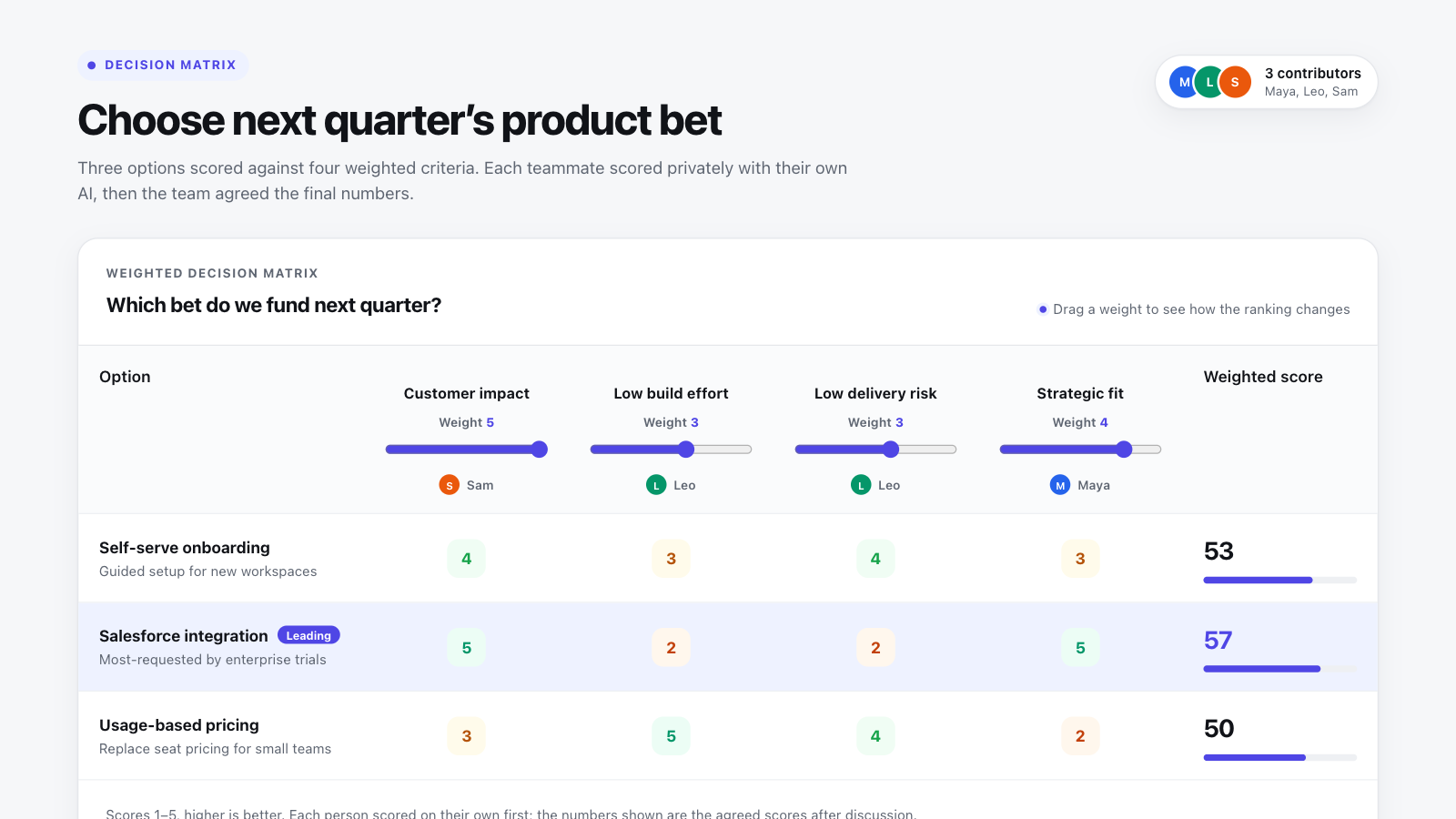
Score options against weighted criteria and see live which one wins, and how close it is.
Brainstorming template
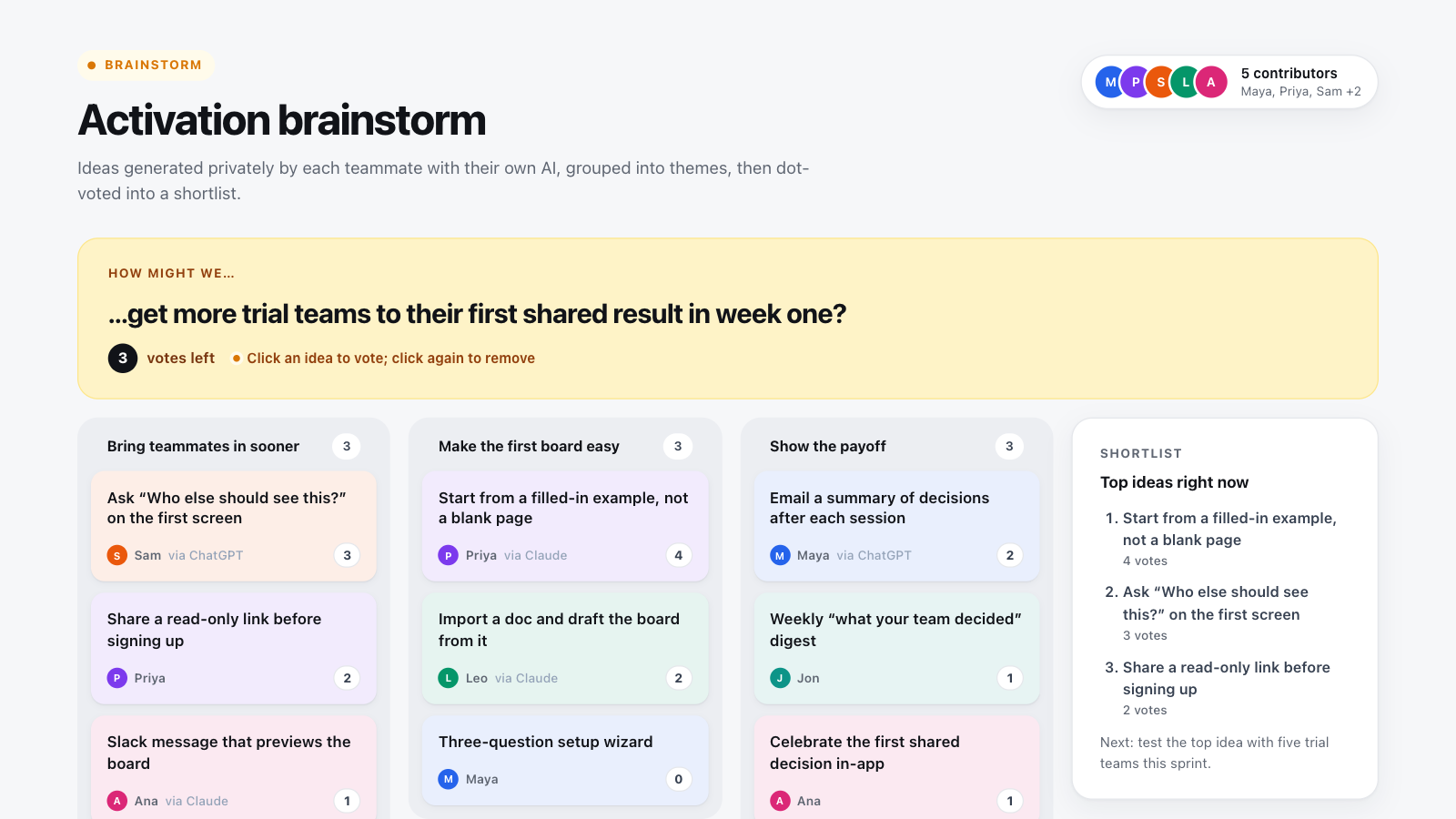
Generate ideas independently, cluster them into themes and dot-vote a shortlist.
OKR template
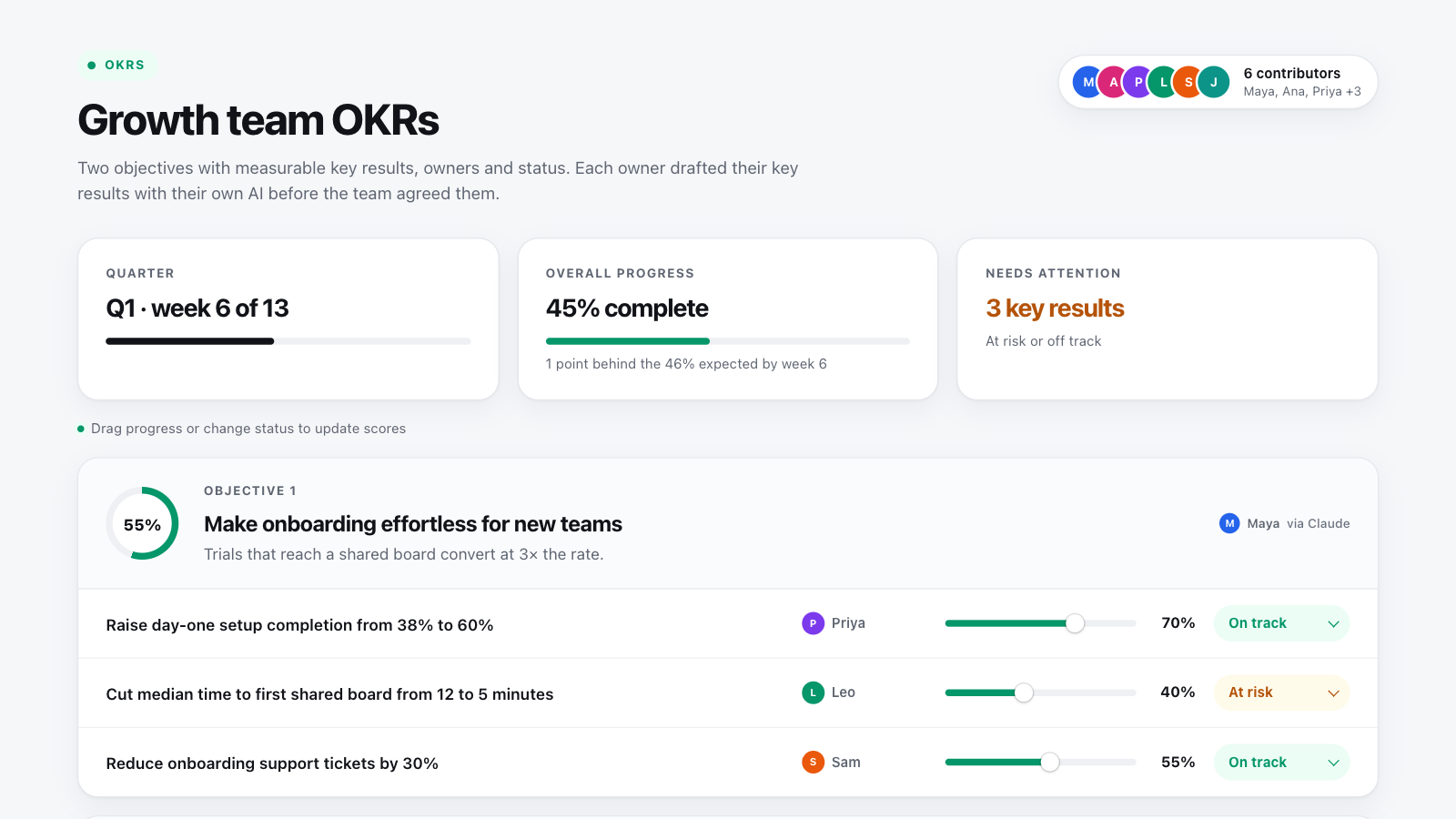
Set objectives with measurable key results, owners and status, and track progress as a team.