FREE TEMPLATE
Free 5 Whys Template for Root Cause Analysis
A free 5 whys template with a worked example. Trace a problem to its root cause one why at a time, back every answer with evidence and agree countermeasures.
- Free, no sign-up
- Use ChatGPT, Claude or your own AI
- Up to 10 people
Try the example
Interactive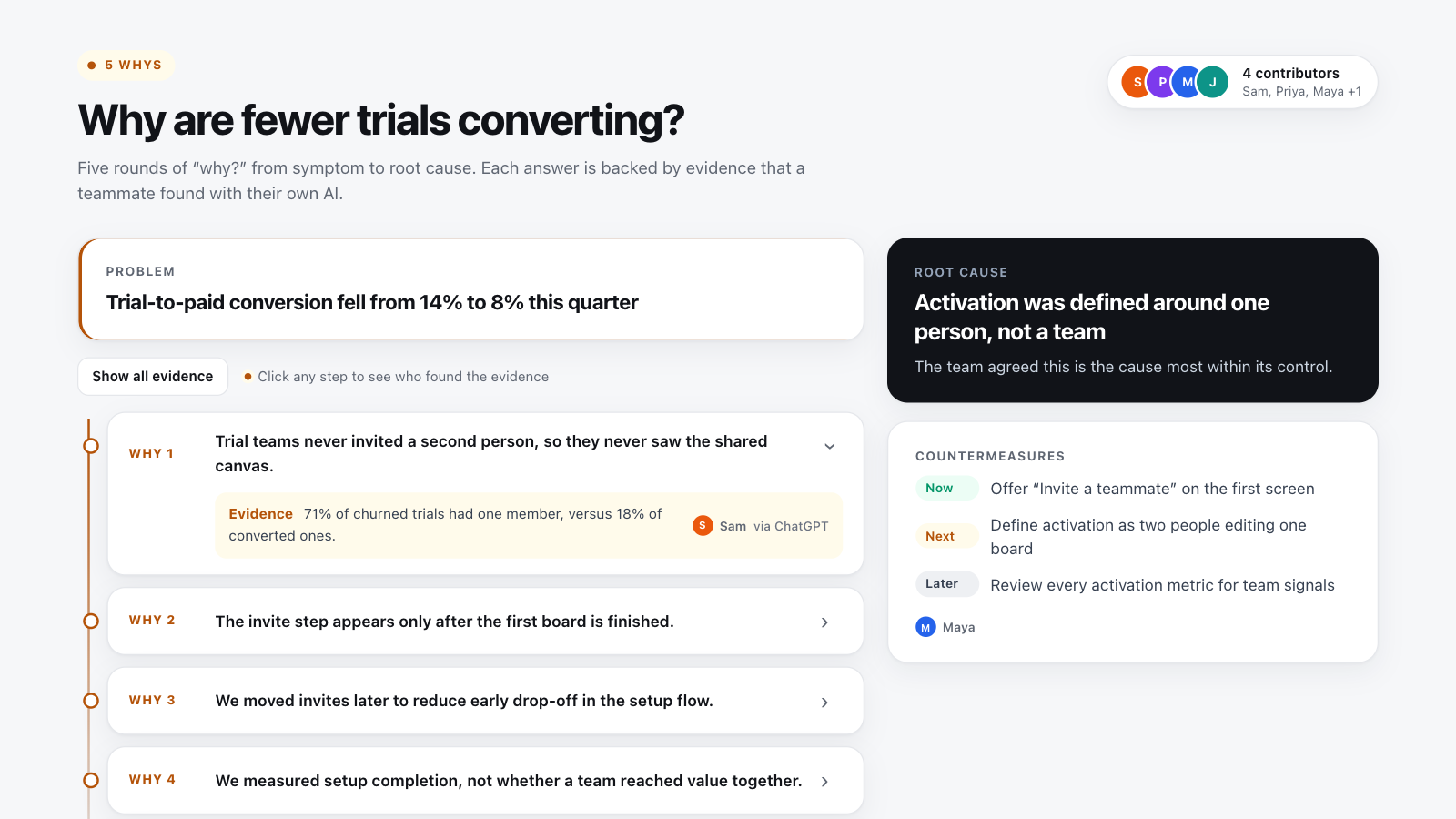
How to use this template in Boardblend
Open it as a live board
One click opens a ready-made board with every section laid out and empty. No account needed.
Connect your AI
Each person connects their own assistant to research and draft privately.
Decide together
Invite up to 10 people, agree the final version, then export it as a PDF or PNG.
The 5 whys is the simplest root cause analysis technique there is: state a problem, ask why it happened, then ask why again about the answer—roughly five times—until you reach a cause you can fix. Done well, it moves a team from patching symptoms to changing the system that created them.
The example above traces a drop in trial conversion. Click any step to see the evidence behind it and who found it, or use Show all evidence to expand the full chain.
The 5 whys example, step by step
| Step | Question | Answer |
|---|---|---|
| Problem | — | Trial-to-paid conversion fell from 14% to 8% |
| Why 1 | Why did conversion fall? | Trial teams never invited a second person |
| Why 2 | Why didn't they invite anyone? | The invite step appears only after the first board is finished |
| Why 3 | Why is it so late? | It was moved to reduce early drop-off in setup |
| Why 4 | Why was that the goal? | The team measured setup completion, not team value |
| Why 5 | Why that metric? | Activation was never defined as a team outcome |
The root cause—activation defined around one person—is something the team can change, and changing it would prevent the whole chain from recurring.
5 whys template structure
The board you start has these steps laid out and empty, ready for your answers:
| Step | Question | Answer | Evidence |
|---|---|---|---|
| Problem | What happened, how much, when? | ||
| Why 1 | Why did the problem happen? | ||
| Why 2 | Why did that happen? | ||
| Why 3 | Why did that happen? | ||
| Why 4 | Why did that happen? | ||
| Why 5 | Why did that happen? | ||
| Root cause | What, if fixed, stops it recurring? | ||
| Countermeasure | What will we change, who owns it, by when? |
When the chain is agreed, export the board as a PDF or PNG for your incident report.
5 whys examples outside software
Manufacturing: A machine stopped. Why? A fuse blew from overload. Why? The bearing was poorly lubricated. Why? The lubrication pump wasn't pumping enough. Why? Its shaft was worn. Why? No filter, so metal scrap got in. Countermeasure: fit a filter.
Logistics: A customer delivery was missed. Why? The truck left late. Why? Loading started late. Why? The pick list printed after the shift began. Why? The order system batches lists overnight and the batch failed. Why? Nobody is alerted when the batch fails. Countermeasure: alert the shift lead on batch failure.
How to run a 5 whys session
- Write a specific problem. Include a number and a time frame. "Conversion fell from 14% to 8% this quarter" focuses the team far better than "growth is slow".
- Ask why, and require evidence. For each answer, ask "how do we know?" In Boardblend teammates can use their own AI to check data, recordings or tickets before an answer is accepted.
- Repeat until you reach an actionable cause. Stop when fixing the cause would prevent the problem, and the cause is within the team's control.
- Agree countermeasures. Pair the root cause with immediate, next and longer-term actions, each with an owner.
5 whys best practices
- Ask about the process, not the person. "Why did the process allow this?" leads somewhere; "why did Sam do that?" doesn't.
- Watch for branches. If a why has two valid answers, follow both. A fishbone diagram helps when causes multiply.
- Don't stop at "human error". Ask why the system made the error easy.
- Test the chain backwards. Read it from the root cause up using "therefore". If each step follows, the logic holds.
5 whys, fishbone and lessons learned
These techniques work as a sequence. Use a fishbone diagram to explore many possible causes, the 5 whys to follow the most likely ones to their root, and a lessons learned review to record the changes you'll make. Investigating privately before discussing, as described in our guide to AI-assisted decision making, keeps the first confident answer from becoming the accepted one.
COMMON QUESTIONS
Frequently asked questions
What is the 5 whys technique?
The 5 whys is a root cause analysis technique where you ask "why?" about a problem, then ask "why?" again about each answer, usually about five times, until you reach a cause that, if fixed, would stop the problem recurring.
Do you always need exactly five whys?
No. Five is a rule of thumb. Stop when you reach a cause the team can act on and that explains the problem; sometimes that takes three whys, sometimes seven.
What is an example of the 5 whys?
In this template, trial conversion fell. Why? Trial teams never invited a second person. Why? The invite step appeared only after the first board was finished. Why? It was moved to reduce setup drop-off. Why? The team measured setup completion, not team activation. Why? Activation was defined around one user. That last answer is the root cause.
What are the limitations of the 5 whys?
It can follow a single path and miss other causes, and answers can drift into opinion. Back each answer with evidence, and pair the 5 whys with a fishbone diagram when a problem may have several causes.
Who created the 5 whys?
Sakichi Toyoda, founder of Toyota Industries, is credited with developing the technique. Taiichi Ohno later made it a core part of the Toyota Production System, and it spread widely through lean manufacturing.
RUN IT WITH YOUR TEAM
Start your 5 whys in one click.
Everyone brings their own AI, adds their thinking, and you agree the result together on one live canvas.
More free templates
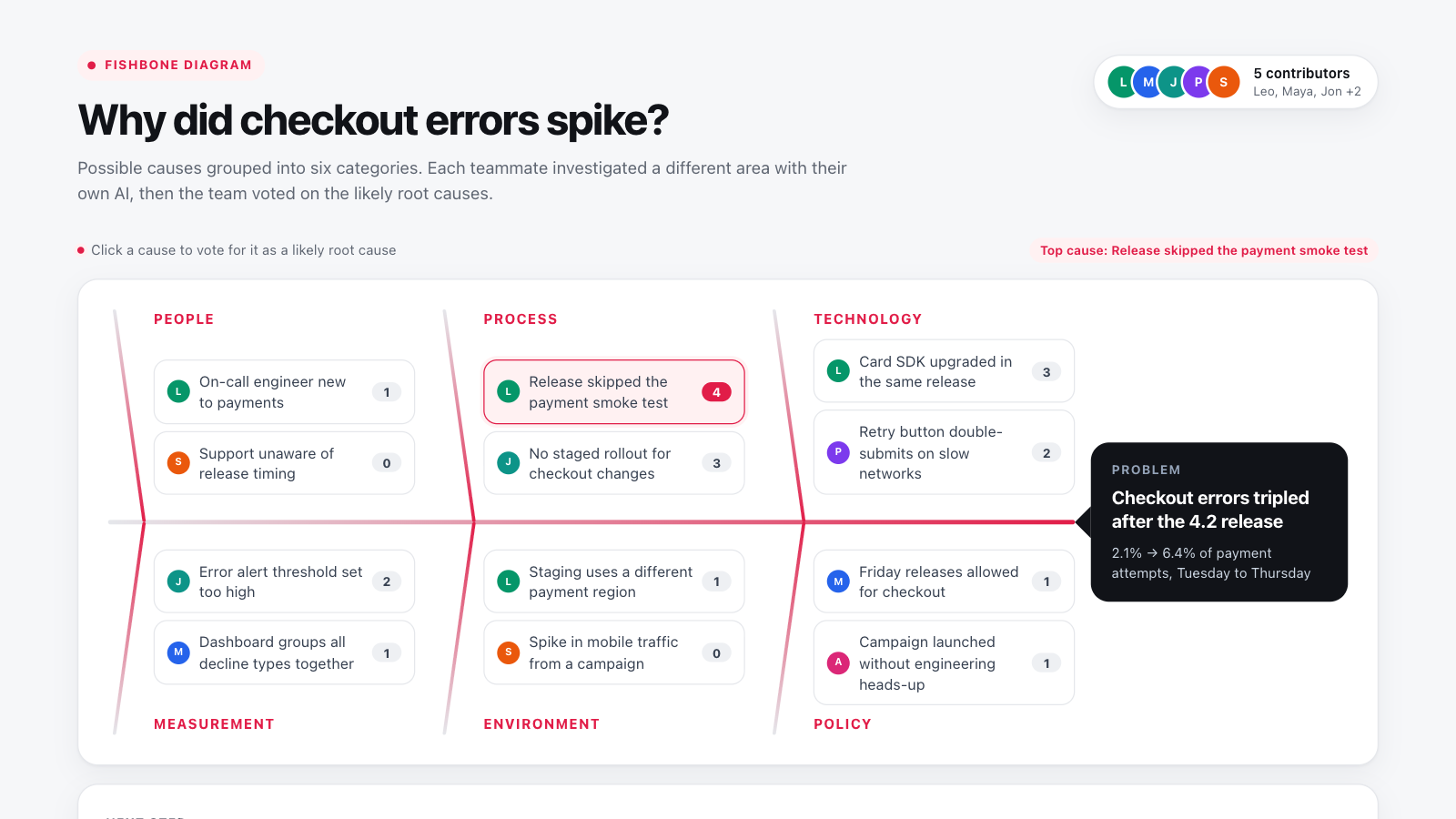
Fishbone diagram template
Map possible causes of a problem across six categories, then vote on the likely root cause.
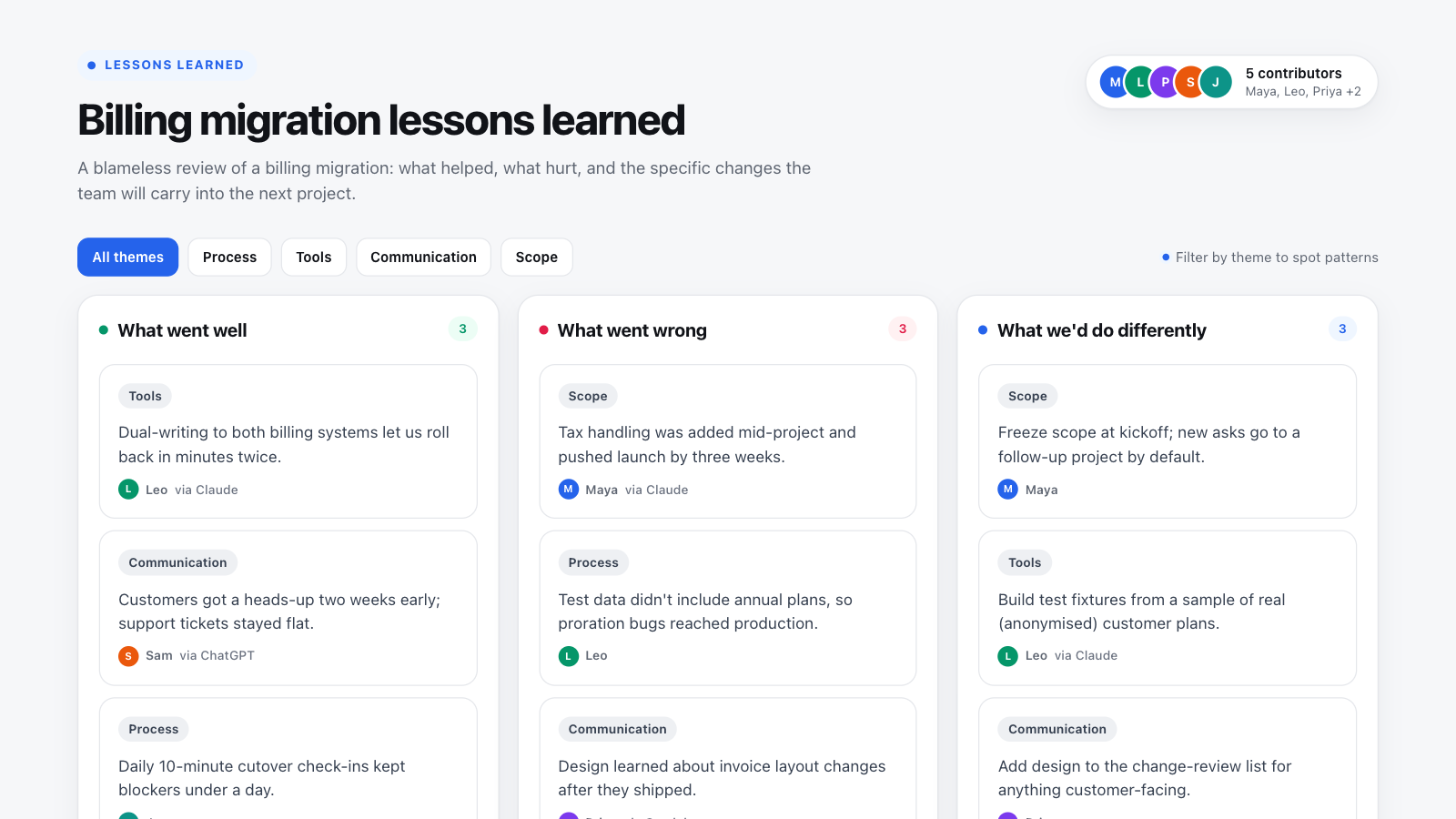
Lessons learned template
Capture what went well, what went wrong and what to change, with owners for every action.
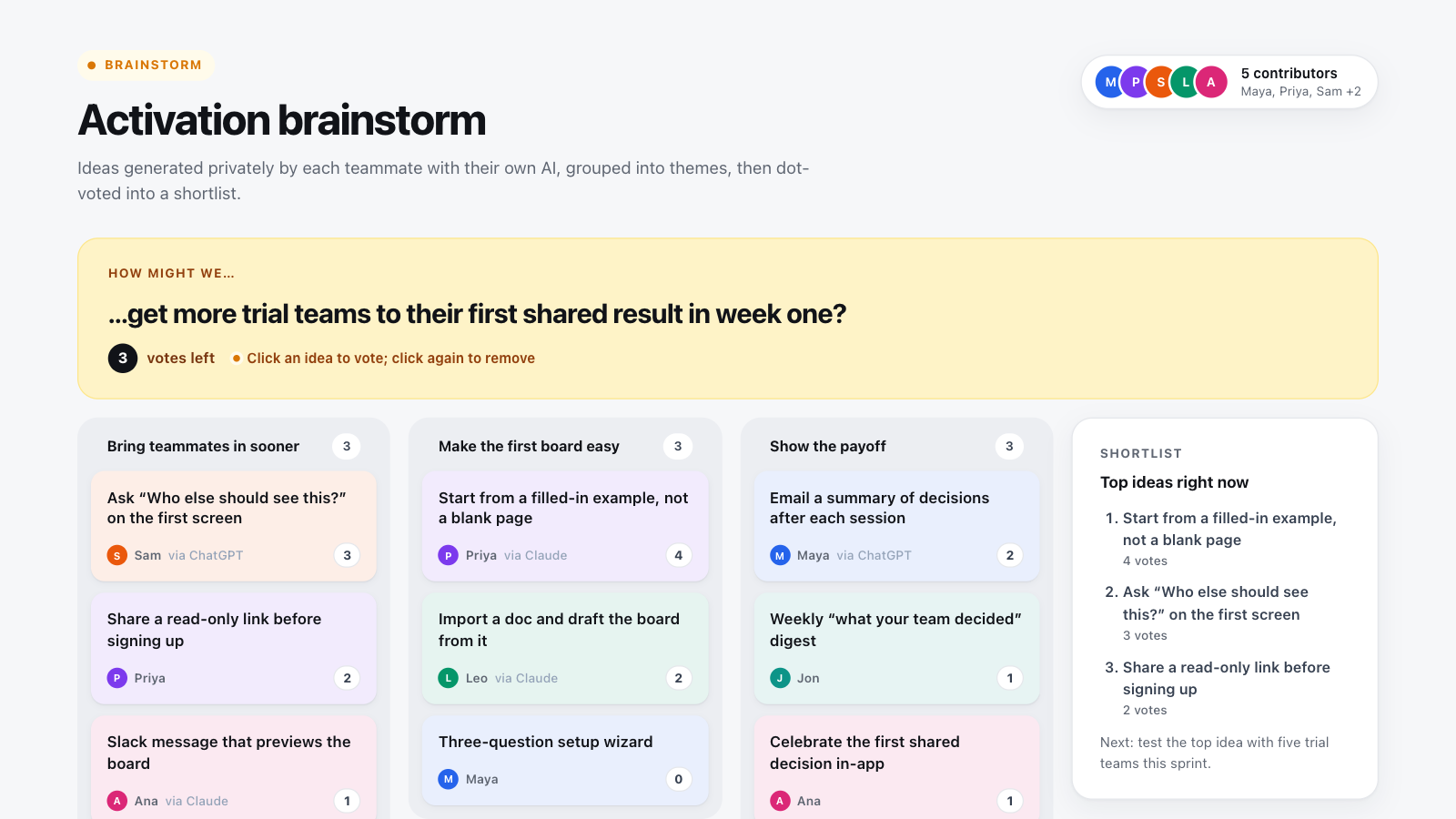
Brainstorming template
Generate ideas independently, cluster them into themes and dot-vote a shortlist.