FREE TEMPLATE
Free AI Brainstorming Workshop Template (30 Minutes)
A free 30-minute AI brainstorming workshop template with a worked example. Think alone, let your own AI challenge you, then cluster, evaluate and decide as a team.
- Free, no sign-up
- Use ChatGPT, Claude or your own AI
- Up to 10 people
Try the example
Interactive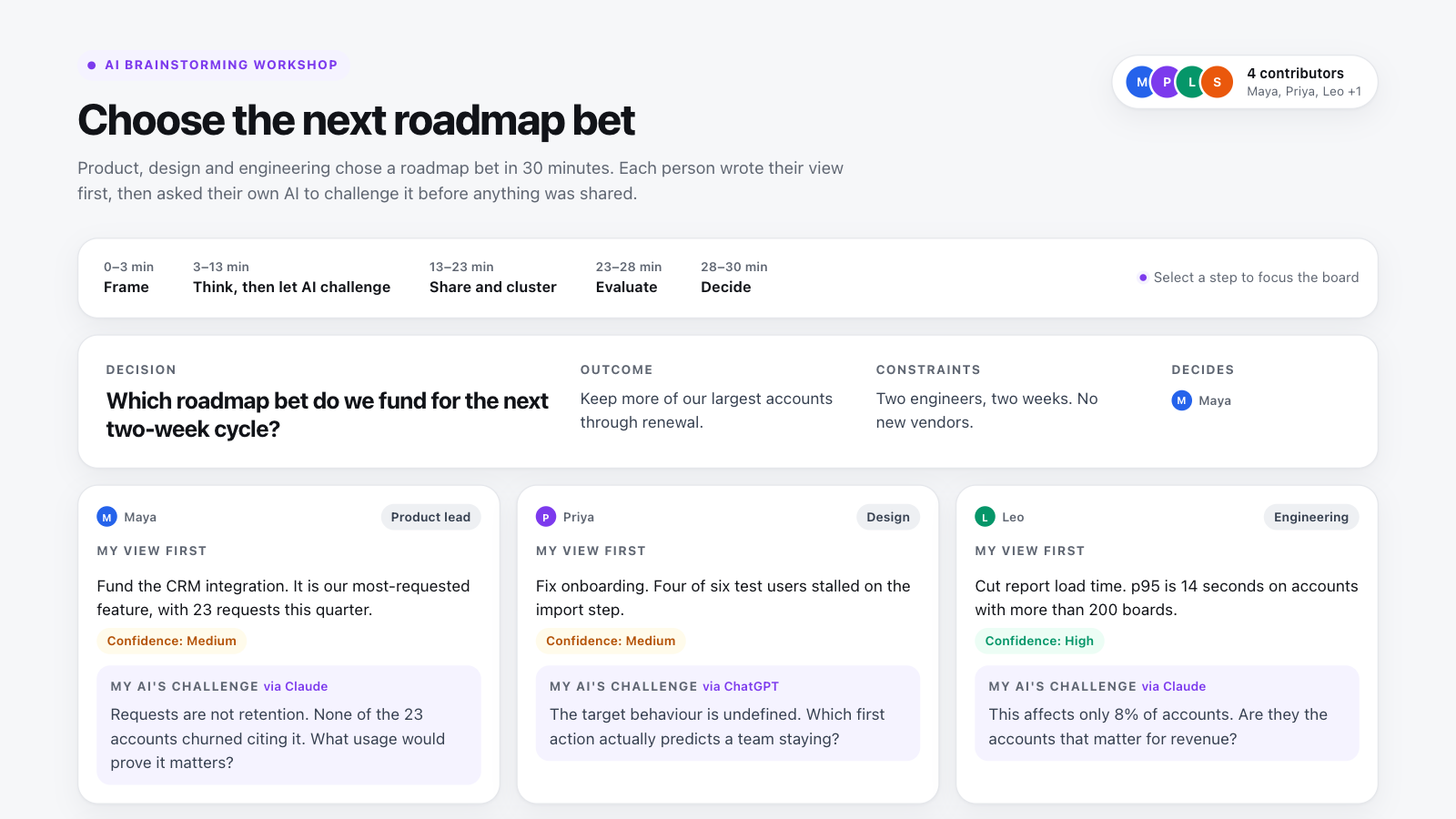
How to use this template in Boardblend
Open it as a live board
One click opens a ready-made board with every section laid out and empty. No account needed.
Connect your AI
Each person connects their own assistant to research and draft privately.
Decide together
Invite up to 10 people, agree the final version, then export it as a PDF or PNG.
This template runs a 30-minute AI brainstorming workshop that ends in a decision, not a longer idea list. Each person writes their own view first, asks their own AI to challenge it, and only then does the team share, cluster and evaluate.
The example above is a product, design and engineering team choosing a roadmap bet. Select a step in the agenda bar to focus the board on that part of the workshop.
The workshop example, section by section
| Section | What the example shows |
|---|---|
| Agenda | Five timed steps, from framing to deciding |
| Brief | One decision, the outcome, the constraints and who decides |
| Views and AI challenges | Each person's recommendation and confidence, then what their AI found wrong with it |
| Clusters | Notes grouped by approach, with two open questions kept visible |
| Evaluation | Ratings with reasons for impact, confidence, effort and reversibility, with no precise-looking total |
| Decision | A two-week performance fix, the deferred option and a review trigger |
The 30-minute agenda
| Time | Step | Output |
|---|---|---|
| 0–3 min | Frame the decision and constraints | One specific question |
| 3–8 min | Think independently | Each person's view, evidence and confidence |
| 8–13 min | Let your own AI challenge you | Counterarguments and missing evidence |
| 13–23 min | Share in parallel and cluster | Themes, with disagreements kept |
| 23–28 min | Evaluate against agreed criteria | A supported recommendation |
| 28–30 min | Decide | Owner, next action and review trigger |
Give each participant this prompt for the challenge step:
Here is the decision and my current view. Do not replace my view. Tell me what could make it wrong, what evidence is missing, which stakeholder I have not considered, and one meaningfully different option. Name your sources and mark anything uncertain.
Workshop tips
- Keep the original view beside the challenge. If the AI rewrites the view, useful uncertainty disappears.
- Name clusters by approach. "Report performance" beats "Leo's idea".
- Agree criteria before rating. Changing criteria after seeing the options rewards the favourite.
- End with a review trigger. A decision without one is rarely revisited.
For the full method, prompts and failure modes, read how to brainstorm with AI. To score the options numerically, use a decision matrix, and to document the result, use a decision record.
COMMON QUESTIONS
Frequently asked questions
How do you run a brainstorming workshop with AI?
Frame one decision, give everyone a few minutes to write their own view, then have each person ask their own AI to challenge it. Share all views and challenges at once, cluster them without erasing disagreements, evaluate against agreed criteria and record the decision.
Why write your own view before using AI?
If people see an AI's polished answer first, it anchors everyone and their own knowledge disappears. Writing first keeps distinct perspectives, then the AI adds friction by challenging each one.
How long should an AI brainstorming workshop take?
About 30 minutes for a contained decision. Higher-stakes decisions, such as hiring, security or market entry, should follow the same sequence over a longer period with qualified review.
Should everyone use the same AI?
Not necessarily. Each person's AI is most useful when it has the context only that person has, such as the codebase, research notes or customer data. Different models also tend to raise different challenges.
How is this different from a regular brainstorming template?
A brainstorming template collects and clusters ideas. This workshop template is built around a decision: each view is paired with an AI challenge, options are rated against criteria, and the session ends with an owner and review trigger.
RUN IT WITH YOUR TEAM
Start your AI brainstorming workshop in one click.
Everyone brings their own AI, adds their thinking, and you agree the result together on one live canvas.
More free templates
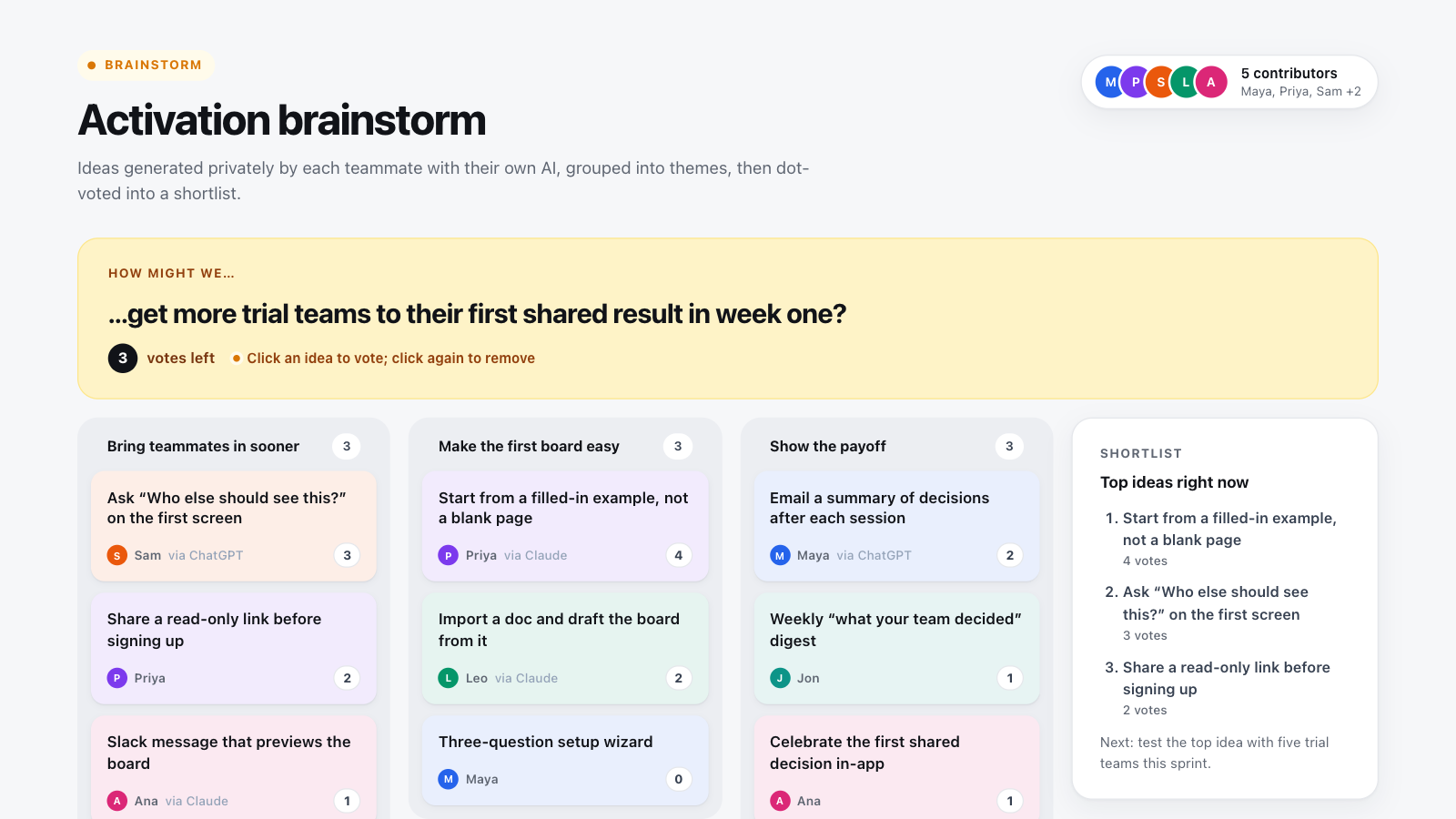
Brainstorming template
Generate ideas independently, cluster them into themes and dot-vote a shortlist.
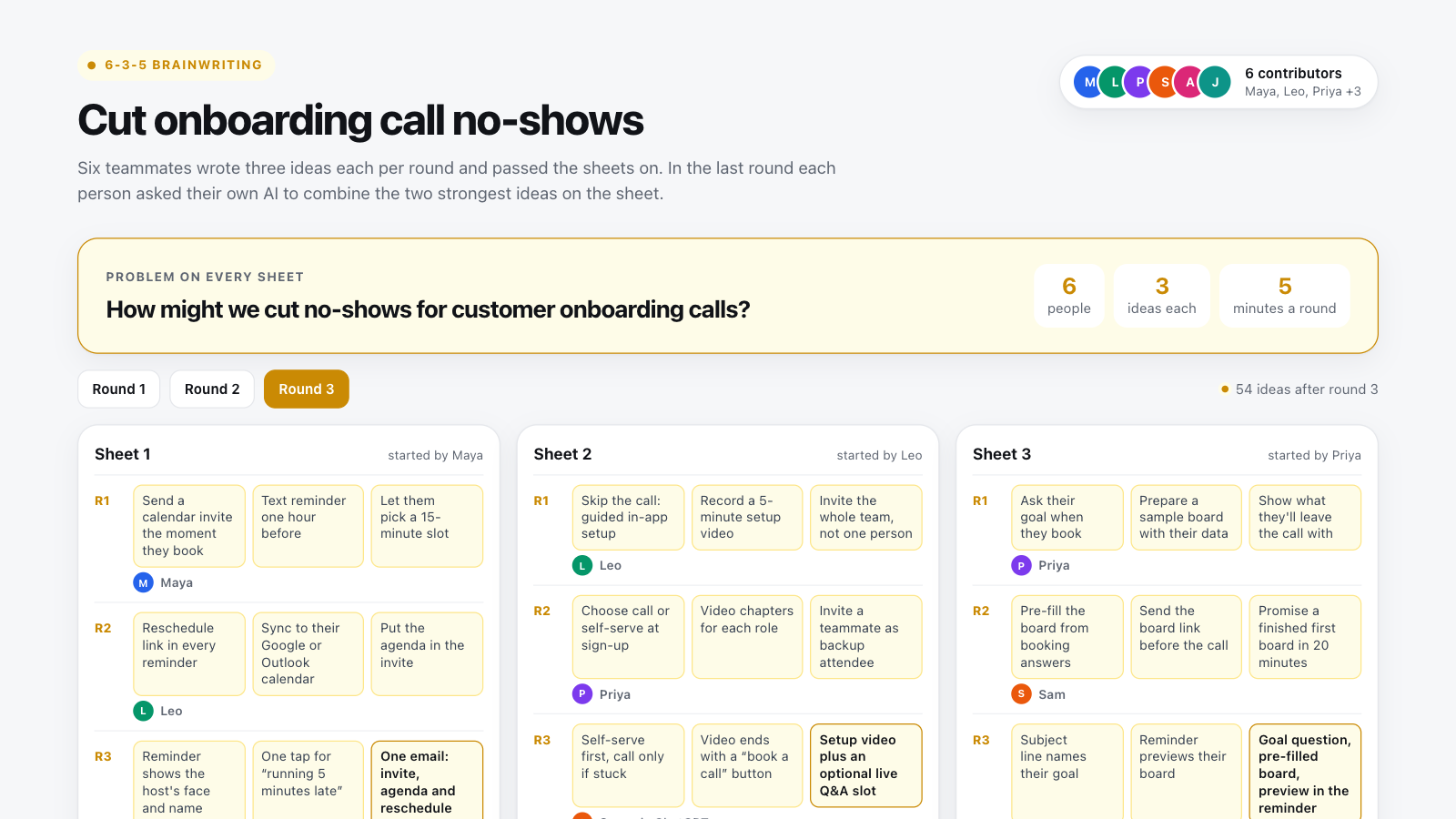
6-3-5 brainwriting template
Run 6-3-5 brainwriting: six people write three ideas in five minutes, pass the sheet on and build on each other.
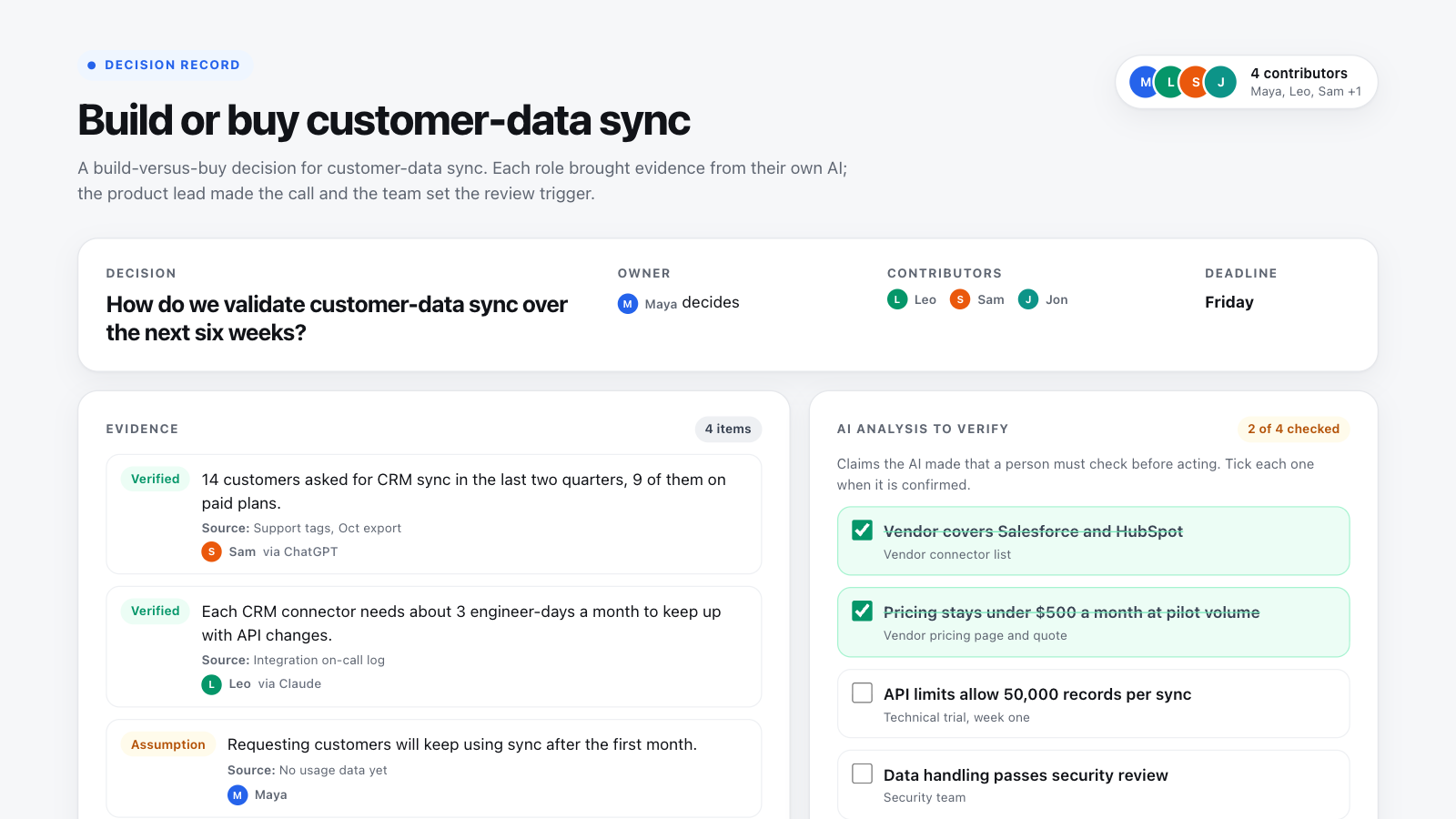
Decision record template
Record an AI-assisted decision: evidence, options, AI claims checked by a person, the call and its review trigger.