FREE TEMPLATE
Free 6-3-5 Brainwriting Template (With Example)
A free 6-3-5 brainwriting template with a worked example. Six people write three ideas in five minutes, pass the sheet on and build on each other's ideas.
- Free, no sign-up
- Use ChatGPT, Claude or your own AI
- Up to 10 people
Try the example
Interactive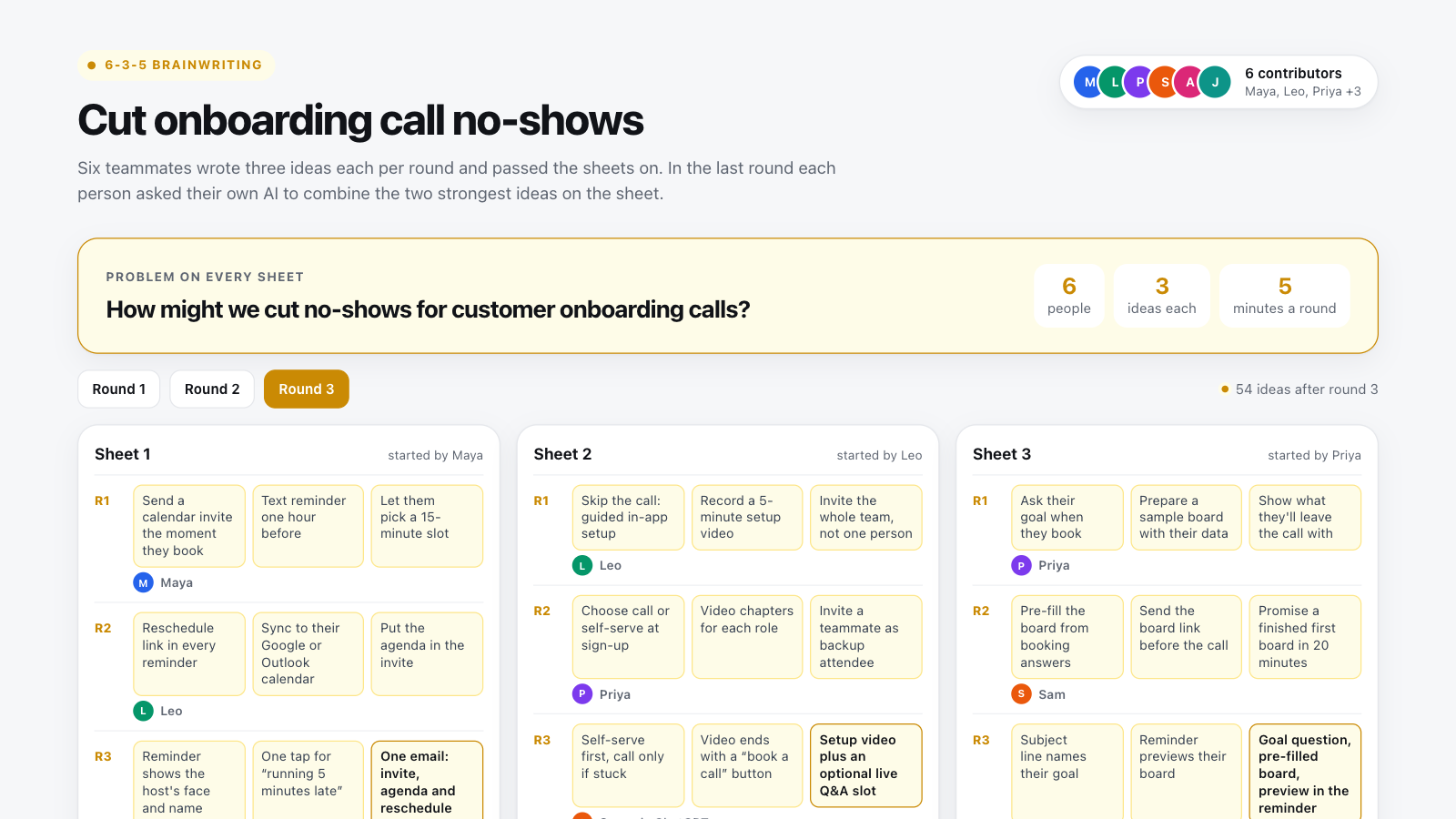
How to use this template in Boardblend
Open it as a live board
One click opens a ready-made board with every section laid out and empty. No account needed.
Connect your AI
Each person connects their own assistant to research and draft privately.
Decide together
Invite up to 10 people, agree the final version, then export it as a PDF or PNG.
6-3-5 brainwriting is a silent brainstorming method: six people each write three ideas in five minutes, then pass the sheet to the next person, who builds on what is there. Because everyone writes at once, nobody waits for airtime and the most senior voice cannot set the direction in the first minute.
The example above tackles one problem: no-shows for customer onboarding calls. Use the Round buttons to replay how the six sheets built up. The highlighted ideas in the last round are ones each person's AI combined from the two strongest ideas already on the sheet.
The 6-3-5 example, section by section
| Section | What the example shows |
|---|---|
| Problem | One "how might we" question, the same on every sheet |
| Sheets | Six sheets, each started by a different person and extended by the next |
| Rounds | Three ideas per person per round; the team stopped after three rounds when ideas repeated |
| AI-combined ideas | In the last round, each person's AI merged the two strongest ideas on their sheet |
| Shortlist | The four ideas with the most dot votes |
| Next step | Two ideas to test for four weeks, an owner and a success measure |
How to run 6-3-5 brainwriting
- Write one clear problem. Phrase it as a question and put it at the top of every sheet.
- Round one: write silently. Each person writes three ideas on their sheet in five minutes. No discussion.
- Pass the sheet on. Each person reads the sheet they receive and adds three new ideas, building on, combining or contrasting what is there.
- Repeat. Run six rounds, or stop when ideas start repeating.
- Final round with AI (optional). Each person asks their own AI to combine the two most promising ideas on their sheet into a stronger one.
- Cluster and vote. Group similar ideas, give everyone three dots and shortlist the winners.
- Pick what to test. Choose one or two ideas, name an owner and set a success measure.
Use this prompt for the final round:
Here are the ideas on my brainwriting sheet. Pick the two most promising and combine them into one stronger idea that keeps what makes each work. Answer in one sentence and do not add new assumptions.
6-3-5 brainwriting tips
- Write short. An idea is a phrase, not a paragraph. Short ideas are easier to build on in five minutes.
- Build, don't repeat. Encourage "yes, and" ideas that extend the sheet rather than restating it.
- Keep the AI to the end. If AI writes round one, every sheet starts sounding the same.
- Vote on clusters, not duplicates. A large cluster may reflect repetition rather than importance.
For eleven more techniques and when to use each, see our guide to team brainstorming activities. For a looser format, use the brainstorming template, and to choose between the shortlisted ideas, use a decision matrix.
COMMON QUESTIONS
Frequently asked questions
What is the 6-3-5 brainwriting method?
6-3-5 brainwriting is a silent idea-generation technique. Six people each write three ideas in five minutes, then pass their sheet to the next person, who adds three more ideas that build on what is there. Six rounds produce up to 108 ideas in about 30 minutes.
Who invented 6-3-5 brainwriting?
The method is credited to Bernd Rohrbach, a German marketing professor, who described it in 1968 under the name Methode 635.
What if we don't have exactly six people?
The numbers are a guide. With four or five people, keep three ideas and five minutes per round and run as many rounds as there are people. With more than six, split into parallel groups of six.
Do you have to run all six rounds?
No. Many teams stop when new ideas start repeating earlier ones. The example on this page stopped after three rounds for that reason.
How do you run brainwriting remotely?
Give each person a sheet on a shared board and rotate which sheet they add to each round. Everyone writes at the same time, so remote teams lose nothing compared with a room.
How does AI fit into 6-3-5 brainwriting?
Keep the early rounds human so each person's thinking stays distinct. In the final round, each participant can ask their own AI to combine the two most promising ideas on their sheet into a stronger one, marked as AI-combined.
RUN IT WITH YOUR TEAM
Start your 6-3-5 brainwriting in one click.
Everyone brings their own AI, adds their thinking, and you agree the result together on one live canvas.
More free templates
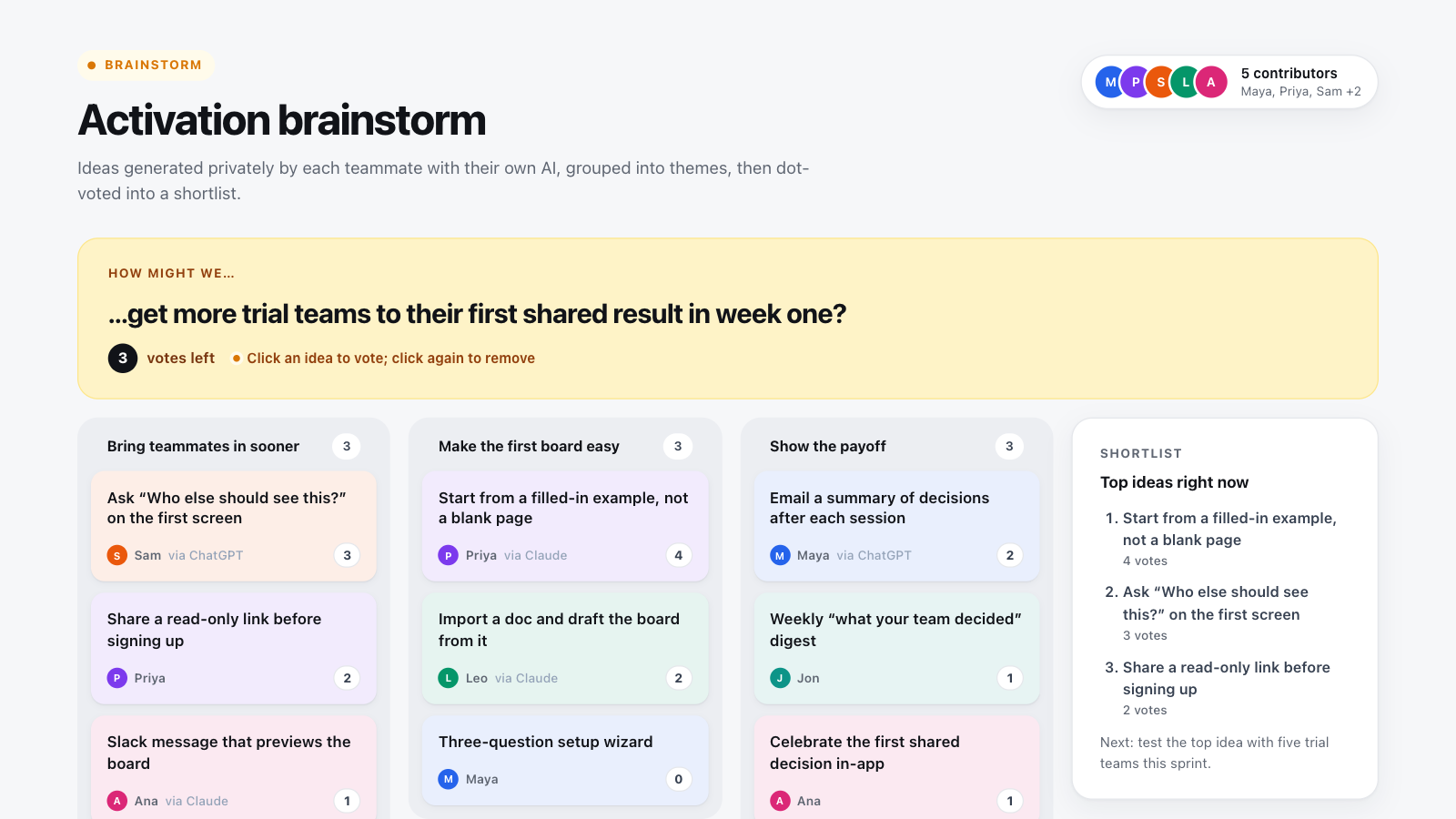
Brainstorming template
Generate ideas independently, cluster them into themes and dot-vote a shortlist.
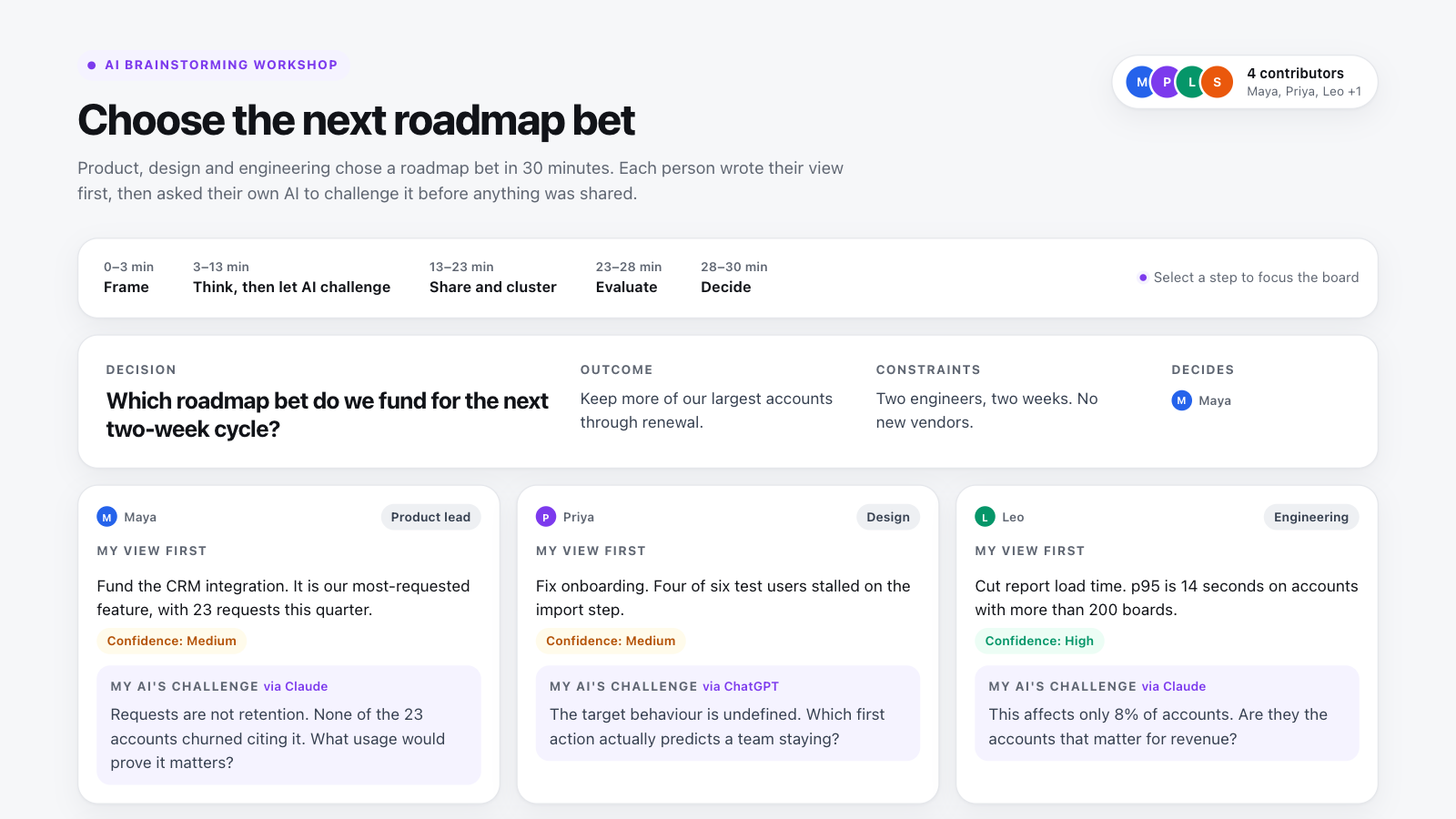
AI brainstorming workshop template
Run a 30-minute AI brainstorm: think alone, let your own AI challenge you, then cluster, evaluate and decide together.
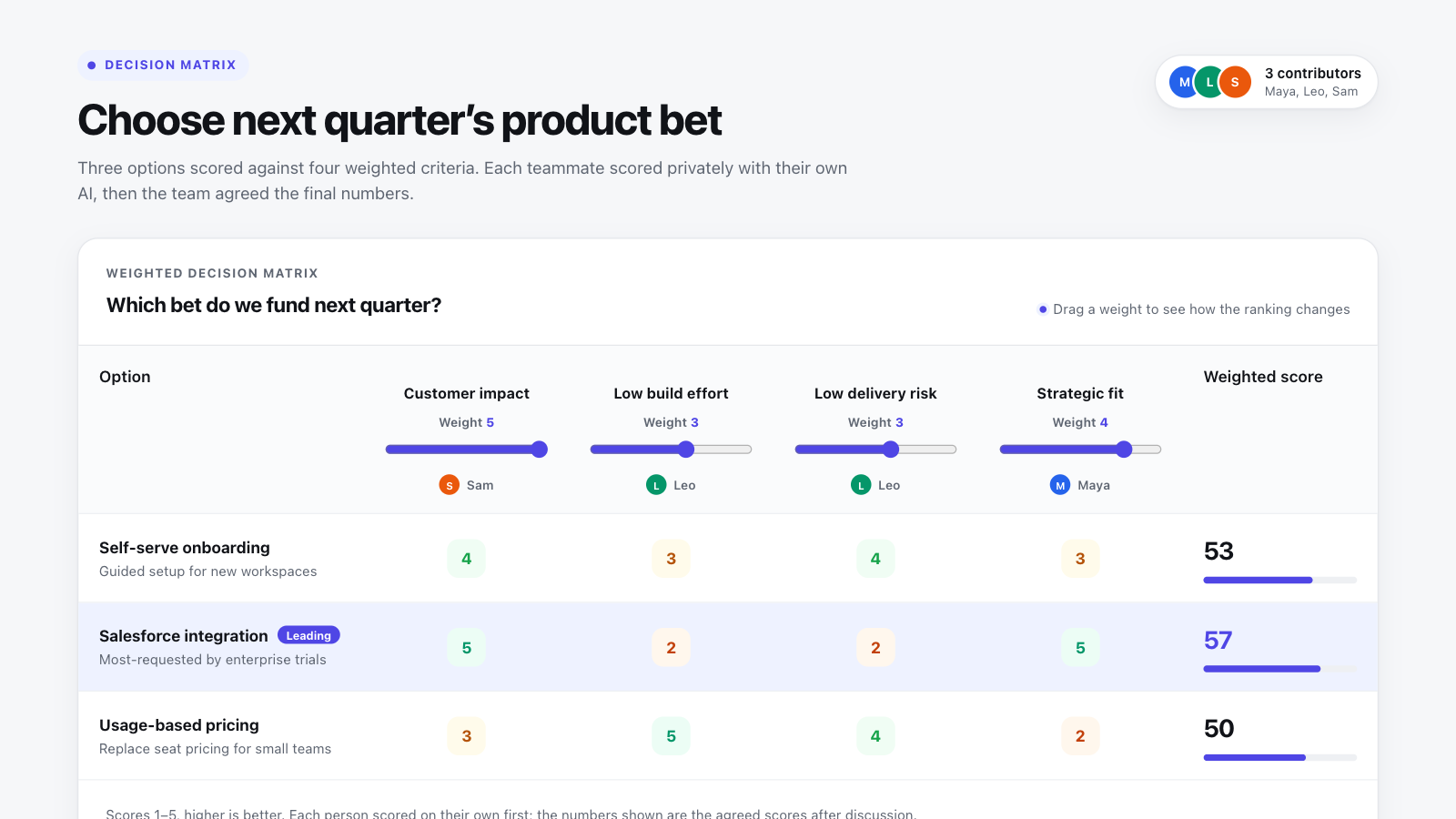
Decision matrix template
Score options against weighted criteria and see live which one wins, and how close it is.