PRODUCT COMPARISON
Boardblend vs Lucidspark for Team Brainstorming
Compare Boardblend and Lucidspark for AI brainstorming, visual collaboration, facilitation, diagramming, shared evidence, and documented team decisions.

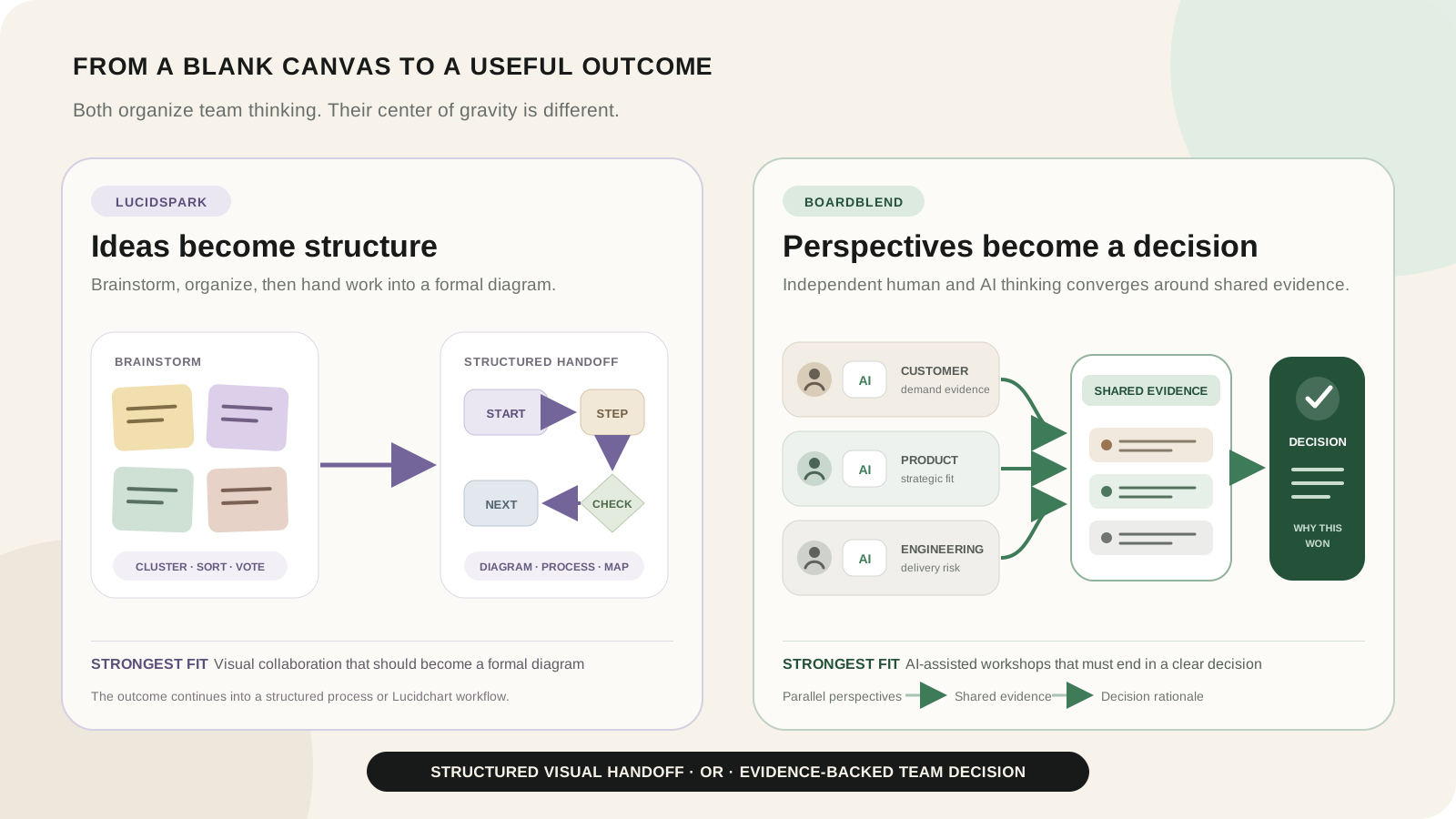
Boardblend and Lucidspark both help teams move beyond a blank page. Lucidspark is the stronger choice for visual brainstorming that should become structured diagrams, plans, and Lucidchart documentation. Boardblend is the more focused choice for independent human-and-agent analysis, shared evidence, and a final decision with rationale.
Boardblend vs Lucidspark at a glance
| Choose Boardblend when… | Choose Lucidspark when… |
|---|---|
| Several people and personal agents must reach one decision | Ideas should move into diagrams, processes, or structured plans |
| Evidence, disagreement, and provenance are central | Whiteboarding and facilitation breadth are central |
| The final rationale is the primary artifact | A visual model or Lucidchart document is the primary artifact |
| A focused workflow reduces setup | Templates, breakout boards, voting, and controls are valuable |
| Agent choice matters | Lucid ecosystem continuity matters |
Decision workspace or visual whiteboard?
Lucidspark is an infinite whiteboard for ideation, facilitation, project planning, user research, strategic work, and movement into formal visual documentation. It combines freeform collaboration with structured objects and the wider Lucid platform.
Boardblend is a decision workspace. It narrows the canvas around participants, agents, evidence, options, trade-offs, and the final rationale.
Feature comparison
| Criterion | Boardblend | Lucidspark |
|---|---|---|
| Primary orientation | AI-assisted team decisions | Visual brainstorming and structured collaboration |
| Shared infinite canvas | Decision-focused surface | Broad infinite canvas |
| Participant-specific agents | Core product model | Not documented as Lucid AI's core model |
| Built-in AI | Through connected agents | Idea generation, expansion, sorting, summaries, mind maps |
| Facilitation | Purpose-specific | Timer, voting, breakout boards, broadcast, facilitator controls |
| Diagramming | Not the primary use case | Strong, with Lucidchart connection |
| Structured planning | Decision record | Dynamic tables, Lucid Cards, paths, frames, integrations |
| Decision provenance | Explicit close | Facilitator-designed |
| Ecosystem | Focused | Broad Lucid and work-tool integrations |
Capturing ideas and perspectives
Lucidspark makes collaborative capture easy with sticky notes, drawing, shapes, comments, chat, reactions, colour-coded collaborators, templates, and an infinite canvas. It is well suited to open-ended visual exploration.
Boardblend asks each participant to develop a view and agent-supported analysis before contributions converge. It gives up some freeform breadth to make source, evidence, and disagreement clearer.
AI-assisted brainstorming
Teammate-owned agents in Boardblend
Boardblend allows participants to use different supported agents and share relevant results into one session. The team is not limited to a single built-in model relationship.
AI ideation and synthesis in Lucidspark
Lucid’s official AI page describes AI that understands canvas context, generates and expands ideas, organizes themes, summarizes work, and helps create visual structures. Its Lucidspark product page highlights AI for brainstorming, dynamic mind maps, and visual activities.
That integrated AI is efficient for one shared visual environment. Official sources reviewed did not describe a different participant-owned agent working in parallel for each teammate.
Parallel collaboration and facilitation
Lucidspark is stronger for general facilitation. Official materials describe timers, voting, breakout boards, broadcast, facilitator controls, frames, paths, and ways to gather participants’ attention.
Boardblend’s parallelism is tied to participant reasoning and agents rather than a broad facilitation toolkit. For independence and convergence, see the AI brainstorming workshop.
Visual organization and diagramming
Lucidspark wins clearly. Teams can start with loose ideas, organize them with containers and dynamic structures, then move into Lucidchart for formal diagrams. This is valuable for architecture, operations, processes, and system planning.
Boardblend is not the better diagramming tool. Its visual organization exists to make a decision legible.
Lucidchart and documentation workflows
The Lucid ecosystem is a decisive strength when brainstorm output must become a process map, system diagram, journey, or governed visual document. Lucid Cards and integrations also connect ideas to work systems such as Jira and Azure DevOps.
Boardblend is better when the durable artifact should explain why the team chose a path. Teams can then use that rationale to guide a Lucidchart document.
Comparing, scoring, and choosing ideas
Lucidspark supports voting, sorting, visual activities, tables, and structured planning. A facilitator can design a strong comparison and decision exercise.
Boardblend makes comparison more opinionated. Criteria, evidence, original scores, disagreement, selected option, rejected alternative, owner, and review trigger remain connected.
Decision history and provenance
Lucidspark preserves the visual board and collaboration history, while the exact decision record depends on how the team structures the workspace.
Boardblend foregrounds provenance between participant, agent, evidence, and conclusion. This is especially useful when a future reviewer needs to understand why the decision was reasonable at the time.
Templates, integrations, and administration
Lucidspark is stronger for templates, integrations, and established visual-collaboration administration. The official product materials emphasize templates, guest collaboration, project planning, facilitation, and connections across the Lucid platform.
Boardblend’s smaller scope is an advantage only when teams prefer a direct decision workflow over a broader platform.
Pricing and limits
Lucidspark has a free plan. Lucid’s official materials have listed paid Individual and Team plans with region- and application-dependent pricing. Lucid also states AI is currently available to users but may become a paid capability later.
Because the live plan presentation can vary, compare current pricing for editors, guests, Lucidspark and Lucidchart access, AI use, integrations, and administration directly against Boardblend’s current plans.
Worked comparison: build versus buy
A team must decide whether to build an integration platform, buy a vendor service, or validate demand manually.
In Lucidspark: the team brainstorms options, uses AI to expand and group concerns, maps the vendor and system flows, votes or scores, and moves the chosen architecture into Lucidchart. This is the stronger path when understanding the system is the hardest part.
In Boardblend: product, engineering, finance, and support contribute evidence and agent challenges in parallel. The team chooses a time-boxed vendor pilot, records cost and reliability exit criteria, and preserves the minority case for building later. This is stronger when accountability and revisit conditions are the hardest part.
Which one should you choose?
Choose Lucidspark for whiteboarding, facilitation, mind maps, structured visual planning, formal diagram handoff, and the Lucid ecosystem.
Choose Boardblend for differentiated participant and agent reasoning, visible evidence and disagreement, and an explicit decision record.
Use both when Boardblend owns the rationale and Lucidspark or Lucidchart owns the resulting visual model. Link them so future teams can move from “what we decided” to “how the system works” without reconstructing the reasoning.
If the rationale is the primary artifact, the AI-assisted decision-making framework shows how to structure evidence, challenge assumptions, and define a review trigger.
COMMON QUESTIONS
Frequently asked questions
Is Boardblend a Lucidspark alternative?
Boardblend is a focused Lucidspark alternative for human-and-agent team decisions, but it does not replace Lucidspark's broader whiteboarding, facilitation, diagramming connections, and Lucid ecosystem.
Which product is better for diagramming?
Lucidspark is better for diagramming-oriented workflows, especially when ideas should move into Lucidchart, formal process maps, system diagrams, or structured visual documentation.
Does Lucidspark have AI brainstorming features?
Yes. Lucid AI can generate and expand ideas, sort content into themes, summarize sessions, build mind maps, and work with canvas context. Availability and future pricing may change.
Which product is better for cross-functional decisions?
Boardblend is more focused on separate functional and agent perspectives, shared evidence, visible disagreement, and a final rationale. Lucidspark can support decisions through facilitation, voting, tables, and task handoff.
Can teams use Boardblend and Lucidspark together?
Yes. Boardblend can hold the decision rationale while Lucidspark and Lucidchart document the resulting process or system. Name one authoritative record and link the artifacts.
PUT IT INTO PRACTICE
Turn everyone’s thinking into one clear next step.
See how teams use Boardblend, or open a shared canvas and start now.